
 Arthur McMiler
- The upgrade effort includes the installation of a 4K video wall that can display information at different classification levels
- Peraton’s Bill Baer said the result of the modernization is “a game changer” for the customer
- The upgrade adds to Peraton’s recent cyber, AI and spectrum work for defense customers
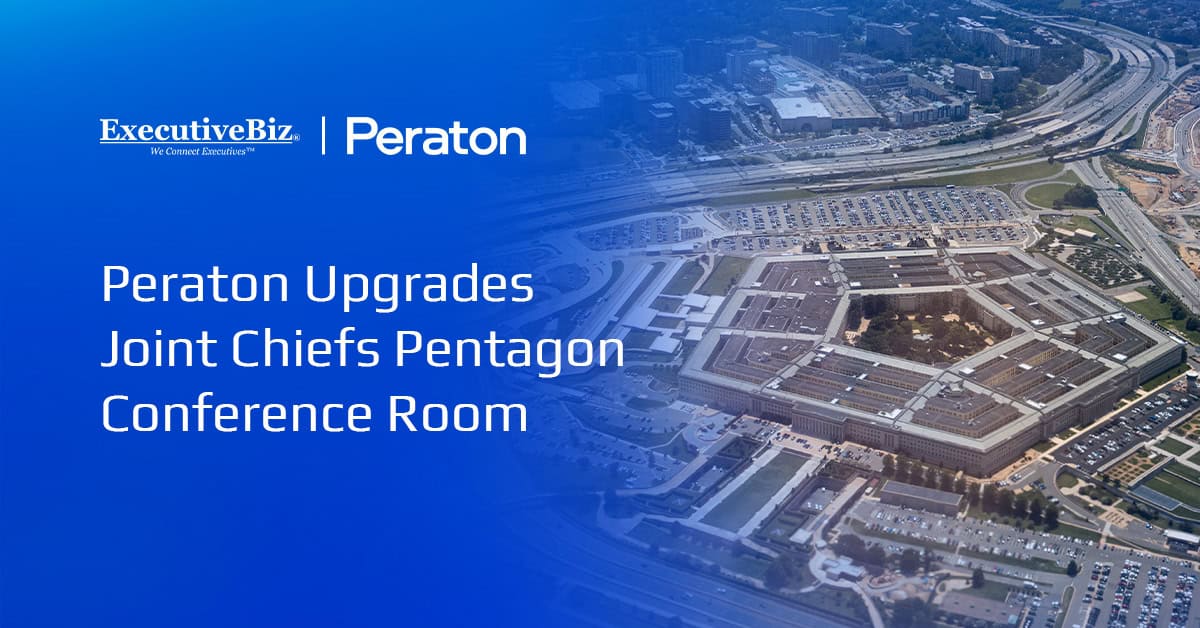
Peraton has completed a modernization of the Marshall Conference Room, the Joint Chiefs of Staff meeting space at the Pentagon. The company said Thursday that the effort includes the installation of a 4K video wall that works to allow participants to view and interact with information at different classification levels without having to move to different conference spaces.
Commenting on the modernization work, Bill Baer, Peraton’s director of technology program management, said the Joint Staff wanted a venue where the chairman of the Joint Chiefs could receive senior government officials to conduct national security business.
“It exponentially increased the capabilities of what they can present and interact with within the room in any given meeting,” Baer said. He called the outcome “a game changer” for the customer.
For his part, Linnel Hickman, Peraton’s senior director of technology program management, said the work generated savings for the government while supplying a capability that “very niche customers need in a classified world.”
How Does the Pentagon Project Fit Into Peraton’s Defense Work?
The Joint Chiefs effort adds to a series of recent Peraton defense engagements. In December 2025, the company won a recompete contract to continue supporting the U.S. Forces Korea Joint Cyberspace Center, covering threat analysis, mission assurance and operational planning. It also secured a $196 million Army contract for operational and cybersecurity support to the Network Enterprise Technology Command’s Global Cyber Center.
Tom Afferton, president of Peraton’s cyber and intelligence sector, told ExecutiveBiz in September that a new Army Regional Cyber Center-Europe award extends a partnership of nearly 20 years supporting defensive cyber operations across Europe and Africa.
In January, the company’s research arm, Peraton Labs, was named a prime contractor under the Department of War’s Advanced Spectrum Coexistence Demonstration program, which seeks to let military and commercial systems operate securely in shared spectrum bands. In April, Peraton earned Cybersecurity Maturity Model Certification Level 2 after a third-party assessment validated its safeguards for controlled unclassified information.
What AI Tools Has Peraton Developed for Government Decision-Makers?
In May, Peraton released a commercial version of IRIS, short for Peraton Interactive Realtime Information System. IRIS is an AI-driven decision-support tool for analysts, mission planners and commanders. In July, the company launched an enterprise agentic AI platform built on zero trust architecture. Peraton said the platform is Federal Risk and Authorization Management Program Moderate-compliant and has a path to FedRAMP High.
In his September interview, Afferton said Peraton is building risk-based guardrails to determine which cyber tasks AI can automate and which require human validation.
The company has also expanded its security partnerships. In December 2025, it teamed with Zscaler to pair Peraton’s hybrid multicloud services with Zscaler’s zero trust architecture.
Beyond defense, Peraton received an $825.9 million contract under the Centers for Medicare & Medicaid Services’ ClaimsCore initiative in May to help replace legacy Medicare fee-for-service claims systems. In February, it secured an $11.7 million delivery order to maintain and modernize the agency’s Durable Medical Equipment claims processing system.