
 Charles Lyons-Burt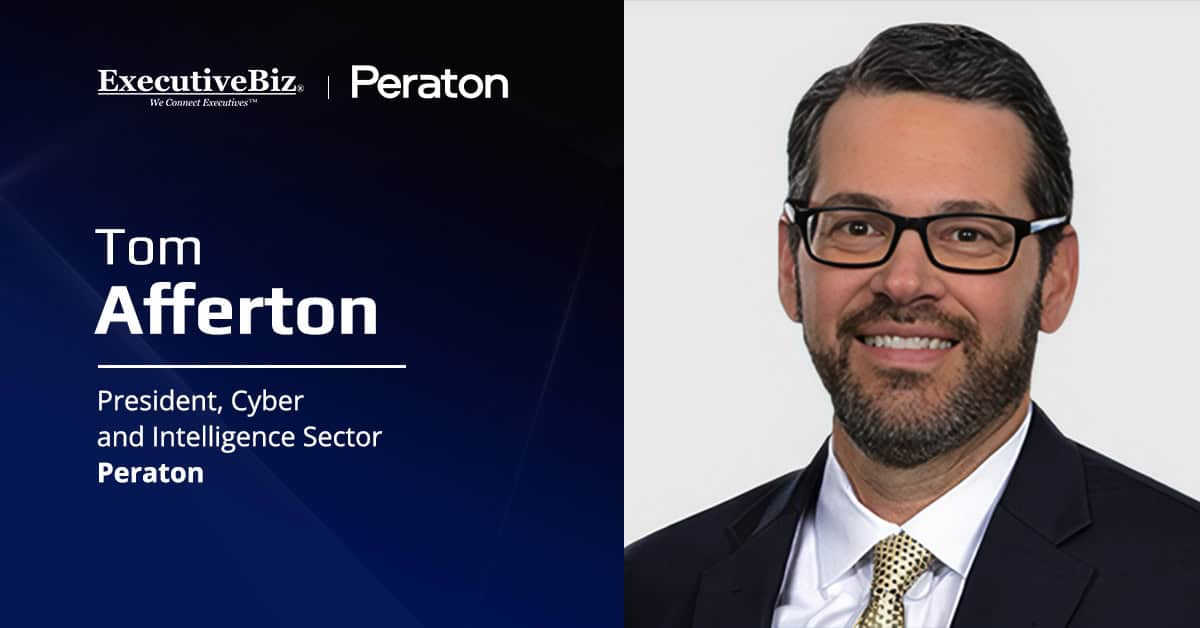
- Two-decade Army cyber partnership extends with continued Regional Cyber Center-Europe support
- Peraton is building risk-based guardrails for AI-enabled cyber automation
- Afferton’s title now spans both the cyber and intelligence missions
Tom Afferton, president of Peraton‘s cyber and intelligence sector, returns to ExecutiveBiz fresh off a new contract win supporting the U.S. Army’s Regional Cyber Center-Europe — the latest chapter in a partnership with the Army that now stretches back nearly 20 years. In this installment of our ongoing conversation with Afferton, he walks through how Peraton is drawing lines around what AI should and shouldn’t be trusted to automate in cyber operations, the practical hurdles slowing agentic AI adoption across government and why he considers adversarial influence campaigns as dangerous as any traditional cyberattack. He also addresses a shift closer to home: the recent addition of “intelligence” to his title.
Readers looking for more context can revisit ExecutiveBiz’s prior conversations with Afferton below:
- Executive Spotlight: Tom Afferton, President of Cyber Mission Sector at Peraton — Aug. 2022
- How Peraton Is Maintaining Cyber Leadership, According to Tom Afferton — Nov. 2024
- Peraton’s Tom Afferton on Impacts & Security Needs Following Treasury Hack — Jan. 2025
- Peraton Cyber President Tom Afferton on AI-Driven Defense & the Future of Cyber Ops — Oct. 2025
ExecutiveBiz: You recently announced a win associated with supporting the U.S. Army’s Regional Cyber Center-Europe. Congratulations on that.
Tom Afferton: Thanks. That award extends a nearly two-decade-long partnership and allows our team in Germany to continue supporting defensive cyber operations across Europe and Africa. That work complements our support to U.S. Army Cyber Command, or ARCYBER, at Fort Gordon, as well as our support to the Network Enterprise Technology Command’s Global Cyber Center at Fort Huachuca, which we took on last fall. Through these programs, we’re enabling full-spectrum cyber operations, defending Army networks across the globe and helping deliver information advantage to Army commanders at multiple echelons.
EBiz: What’s your take on the recent cybersecurity-related executive orders released in June? How will they affect the government contracting industry?
Afferton: To answer this question, I’ll address what is driving some of the recent executive orders: the demonstration of sophisticated capabilities by AI platforms to identify cyber vulnerabilities at unprecedented speed and scale. This shifts the focus of technology enabling cyber operators further downstream, from processing alerts to accelerating remediation. AI automation can certainly help; however, complex operations left unchecked can have unintended consequences, and AI itself introduces a new attack surface for adversaries.
At Peraton, we’ve been thinking about how to account for policy, mission context and risk tolerance in establishing guardrails for using AI for automation. It depends on the circumstances, but it’s likely safe to automate something like blocking IP addresses of known bad actors, since that’s well-defined, reversible and low-consequence. Having AI auto-generate code to remediate a chip-level zero-day exploit may be an action you want a human to validate before launching, and that further depends on the system you’re defending and the stakes involved. All of that points to incorporating risk management into AI-enabled cyber automation platforms. Our end goal remains to enhance people’s abilities to make better decisions, including deciding what actions can be automated by AI — not to replace people, but to make them more effective.
EBiz: Aside from managing risk, what challenges have your teams seen in AI adoption?
Afferton: There are tremendous opportunities with AI-enabled automation. The pace of adoption varies across agencies, but all of our customers are moving out in some capacity. The Army is a good example: through Task Force Lexington, it’s aggressively advancing real operational use cases of agentic AI in cyber operations. However, there are numerous practical challenges that can’t be underestimated. Data quality and data management gaps can limit the effectiveness of AI tools, and access to leading-edge tools across security classifications can be another constraint. The common denominator I hear most cited by customers as a hurdle to AI adoption is people. There are widely varying levels of proficiency among operators, which can affect everything from the quality of results to the cost-effectiveness of token consumption.
We took this journey within my sector at Peraton and brought some lessons learned to our customers. Peraton has built agentic AI platforms that are now commercially available and in production with government users, supporting everything from information operations to massive-scale program management. My whole staff also uses the platform daily for many different internal applications. We found that embedding tutorial capabilities within the AI platform creates an environment for progressive learning; it takes users from basic chatbot prompters to AI orchestrators. We also find great value in having a dedicated team of AI customer advocates who can spend time with users to show them how to best use the platform efficiently to solve their specific mission problems. The key is to show how people can engage with the platform themselves and achieve immediate value, drawing them into further self-driven learning. Through this approach, we’ve achieved operational efficiencies in internal applications like contract management and media relations, in addition to core customer missions like cyber operations, digital forensics and intelligence analysis.
EBiz: How have you seen shifting geopolitical dynamics affecting the cyber threat? What have we learned, and how should U.S. capabilities evolve to meet mission needs?
Afferton: The geopolitical dynamics are changing every day. A common theme is increased collaboration across industry and government. For example, one of the frontier model companies just posted a call to action urging leading companies and government to increase efforts to build secure technology and get it into the hands of operators. Peraton is supportive of these efforts and directly involved across military, intelligence, civilian and critical infrastructure environments.
The threat side of the equation is likewise evolving quickly in the context of rapid technology advancements and global conflicts. Everyone is talking about the threat of agentic AI being used to launch complex attacks. That’s critically important, and I’ve already talked about leveraging AI for automating cyber defense. We absolutely must focus on the nuts and bolts of securing critical systems and making sure they’re resilient, so the people who use those systems know they’ll work when they need them. Conversely, a cyberattack, or even the perception of one, can influence people’s behaviors in a negative way if they lose faith in those critical systems. The use of influence operations by our adversaries to shape public behavior is a dimension of the cyber threat that I don’t think we give enough attention to.
Recent advisories emphasized that our adversaries are attempting to penetrate critical infrastructure systems with the goal of creating U.S. homeland distractions during military operations elsewhere in the world. If the goal is distraction and public chaos, we not only have to defend against actual cyberattacks, but we also need to defend against adversaries using influence operations to create the misperception of cyberattacks.
Peraton is a market leader in supporting global information operations. We’ve developed unique tradecraft and technology, like our IRIS agentic AI platform, to quickly assess and act in the information environment. Those capabilities can likewise be deployed to defend against cyber-related influence campaigns to complement traditional cyber defense. I think this will become increasingly important in the current threat environment.
EBiz: I see that “intelligence” has been added to your title, in addition to “cyber,” since our discussion last year. What can you tell me about your changing role?
Afferton: We’ve built an expanded line of business at Peraton to serve cyber, law enforcement and intelligence customers, mirroring the interagency collaboration taking place across government. While I can’t go into too much detail, I’ll say that I now support customers on both sides of the Potomac River. A common priority we see across these customers is making intelligence more actionable. We’re approaching that by driving tighter integration between intelligence and operations through cross-functional teams that include intelligence analysts, operators and technologists. That enables intelligence to be produced that’s more closely aligned with operational needs. Technologists serve dual roles, providing subject matter expertise on some of the content being gathered as well as quickly turning around capabilities necessary to collect and process intelligence, securely and at scale.
Who Is Tom Afferton?
Before joining Peraton, Afferton spent 17 years at Northrop Grumman across a series of progressively senior leadership roles. Most recently, he served as vice president of Defense and Intelligence, leading a line of business that provided secure information technology and mission solutions to defense, intelligence and civil security customers. Earlier in his Northrop Grumman tenure, he led lines of business supporting civilian, public safety, defense and intelligence customers, served as vice president of civil solutions and chief operating officer of the company’s $1 billion civil division, and served as general manager of Northrop Grumman’s public safety practice, overseeing programs across the U.S. and U.K.
Afferton began his career at AT&T, where he held a variety of engineering and management positions of increasing scope and responsibility related to planning and operating optical networks, giving him early exposure to network security. He earned a bachelor’s degree in electrical engineering from the University of Virginia and a master’s degree in electrical engineering from Stanford University.
What Is Peraton?
Peraton is a next-generation national security company that creates technology-based solutions for essential U.S. government customers. The company’s core capabilities include mission capability integration, enterprise IT and cybersecurity — with deep expertise in digital forensics, system resilience, communications engineering and data management. Peraton works with every branch of the U.S. Armed Forces and key agencies — including U.S. Cyber Command, the intelligence community, the Department of Homeland Security and the Department of State — to counter threats across digital and physical domains. Peraton’s proprietary platforms include IRIS™ for information operations, Threatboard™ for cyber threat intelligence and Peraton(x)™ for agentic AI applications.