
 Jane Edwards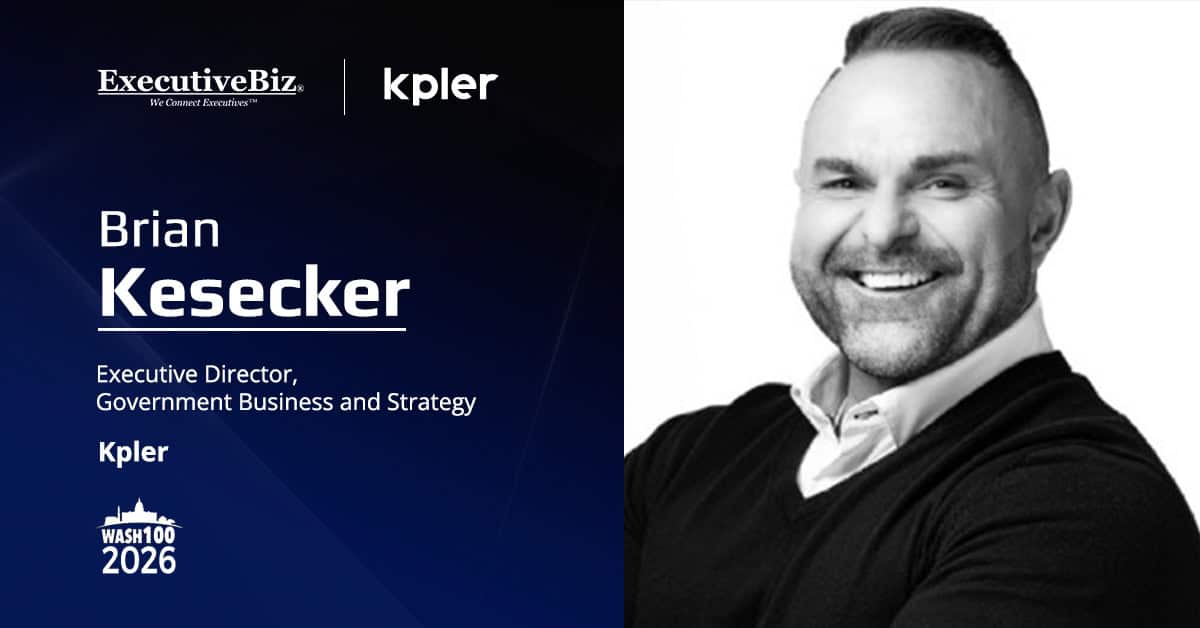
- Kesecker has outlined concentrated allied energy import dependencies across key suppliers and terminals
- Kesecker said cargo-level mapping has linked energy flows to ports, pipelines and chokepoints
- Kpler data shows that traditional maritime domain awareness does not fully capture supply chain exposure risks
Brian Kesecker, executive director of U.S. government business and strategy at data and analytics company Kpler, said allied burden sharing depends on supply chains that continue functioning even when global trade is disrupted, noting that the loss of a supplier, maritime chokepoint, or shipping route can rapidly constrain fuel availability, military sustainment, industrial production and power generation.
In exclusive comments shared with ExecutiveBiz, Kesecker, a 2026 Wash100 awardee, said allied and partner energy import dependencies show a high degree of concentration in a limited number of supplier countries and export terminals, indicating potential exposure points in fuel security and military sustainment.
What Do Allied Energy Import Dependencies Reveal?
Kesecker said Kpler Defense data shows that several nations rely heavily on single-source or narrowly concentrated supply routes, including Jordan, which receives 100 percent of its crude from Muajjiz, Ras Tanura and other Saudi terminals, and Finland, which sources 73 percent of its crude from Mongstad, Norway.
According to the Kpler executive, the data also highlights similar concentration patterns in liquefied natural gas and coal flows, including Poland’s reliance on U.S. Gulf LNG terminals, such as Sabine Pass and Calcasieu Pass, for 73 percent of its LNG imports and the Philippines’ dependence on Indonesian terminals for 98 percent of its thermal coal supply. These dependency structures demonstrate how allied energy security can be tightly linked to a small set of global suppliers and maritime routes.
How Does Cargo-Level Mapping Improve Supply Chain Visibility?
Kesecker said traditional maritime domain awareness identifies where vessels operate, but not the specific cargoes they carry or the terminals and pipelines that underpin allied energy supply chains.
He noted that Kpler Defense links cargo movements to suppliers, installations, ports and chokepoints, providing a more detailed view of supply chain dependencies and operational resilience requirements.
“Operational resilience begins with understanding the supply chains that sustain allied military power,” Kesecker said.
Who Is Brian Kesecker?
Brian Kesecker serves as executive director of U.S. government business and strategy at Kpler, where he oversees the company’s engagement with defense, intelligence and civilian government customers. A longtime national security executive, he has extensive experience helping federal agencies adopt data-driven technologies and build mission-focused partnerships.
Kesecker previously held leadership positions at Sayari Labs, Chainalysis and SAIC.
In a recent Executive Spotlight interview, Kesecker discussed the growing role of unclassified commercial data in modern intelligence operations and how it can support faster decision-making and information-sharing across joint and coalition missions.
Kesecker also recently shared exclusive comments with ExecutiveBiz, saying that traffic through the Strait of Hormuz has begun to recover, maritime visibility has improved and regional shipping networks continue adapting to elevated security risks following the June 17 interim memorandum of understanding between the U.S. and Iran.