
 Isaac Martin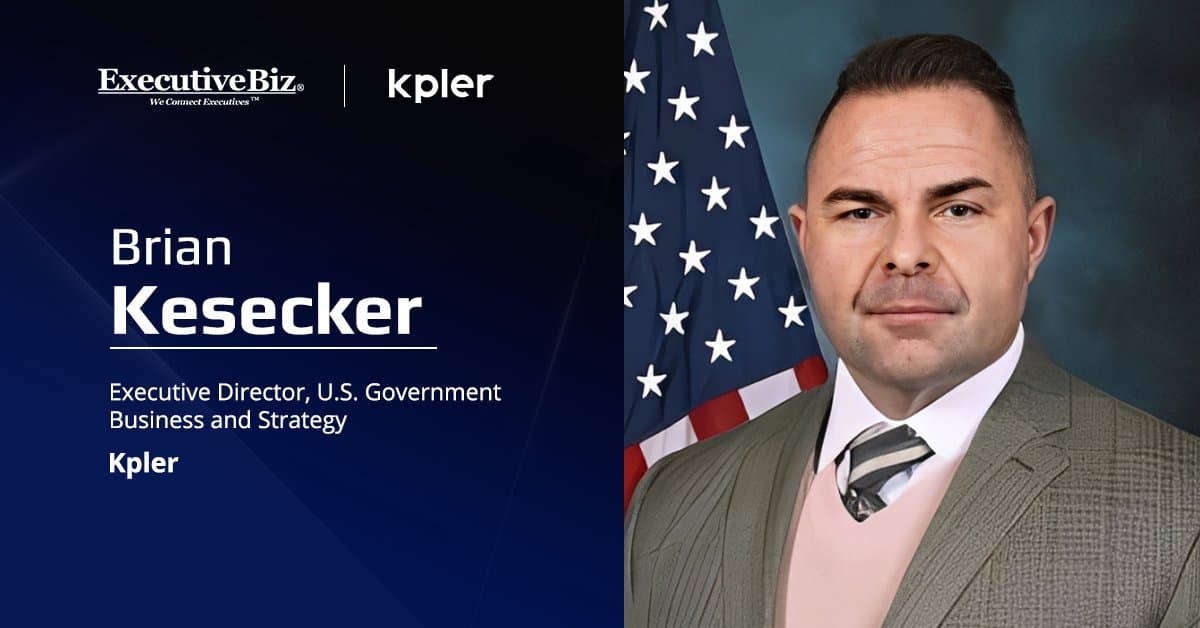
Brian Kesecker is stepping into an expanded leadership role at Kpler as the company pushes deeper into U.S. defense, intelligence and homeland security missions that increasingly rely on unclassified data and commercial intelligence.
Kesecker was promoted this month to executive director of U.S. government business and strategy after spending just over two years helping build Kpler’s public sector footprint. In his new role, he is responsible for shaping the company’s engagement with the Department of War, intelligence community and federal civilian agencies, with a focus on scaling maritime intelligence and analytics in support of operational decision-making.
Before joining Kpler, Kesecker held senior leadership roles at SAIC, Sayari Labs and Chainalysis, where he supported government customers working across intelligence analysis, supply chain risk, cyber operations and counter-threat finance. Earlier in his career, he worked as a systems engineer at the Defense Information Systems Agency, supporting global communications and mission assurance programs for the U.S. military.
In this Spotlight interview, Kesecker discusses how unclassified data is reshaping intelligence workflows, accelerating the kill chain and enabling broader information-sharing across joint and coalition missions.
ExecutiveBiz: Where are you seeing the most exciting opportunities to deliver better capabilities to our warfighters today, and how are you and Kpler harnessing these opportunities?
Brian Kesecker: Right now, the biggest opportunity is collapsing the time between collection, insight and action at the tactical edge. Warfighters don’t need another dashboard—they need ground truth, presented fast, at unclassified levels, with confidence scoring and context baked in.
At Kpler, we’re harnessing three unique strengths:
- Depth and diversity of global maritime data — Automatic identification system, or AIS, commercial shipping documents, commodity flows, sanctions data and at-port intelligence allow us to expose what’s happening behind vessel movements, not just where a ship is.
- Natural language access to structured data through our new Model Context Protocol, or MCP, capability — so analysts, targeteers and logisticians can ask plain-language questions like “show me dark fleet activity around Fujairah in the last 72 hours” and get answers in seconds, without engineering support.
- Integration-first architecture — We’re not a closed platform; we’re building to plug directly into mission systems like Maven, Defense Logistics Agency supply chain risk management tools and service-specific common operational pictures, or COPs.
The result is faster, clearer decision support for kinetic and non-kinetic responses: sanctions enforcement, interdiction, logistics rerouting and predictive MDA.
EBiz: What are your thoughts on how we can improve cross-domain weapon systems or accelerate the kill chain and its integrated lethality?
Kesecker: We need to stop treating data as a back-office function and start treating it as a combat enabler. Cross-domain lethality isn’t a hardware problem anymore—it’s a transparency and latency problem.
Three principles guide our thinking:
- Unclassified-first sourcing — Much of the kill chain can now begin with commercially acquired intelligence data that does not require clearance barriers, unlocking more operators, more analysts and more operational flexibility.
- Model-based prioritization — Instead of forcing analysts to hunt signals manually, we leverage AI to highlight anomalies, unknown actors, changes in routing or behaviors that correlate with illicit activity. This is what accelerates “find, fix, finish.”
- Designing for interoperability — The kill chain must support ingestion into systems that already exist at the edge. If your data can’t feed the Advanced Battle Management System, Project Convergence, Office of Naval Intelligence toolsets, or maritime fusion centers, it’s not operationally relevant.
If we get those three right, the kill chain becomes faster, more automated and more lethal—not because we built a new sensor, but because we removed friction between the sensor, the data layer and the operator.
EBiz: We’ve seen a historic migration within the intelligence community toward more unclassified work, which is sparking changes in the way the IC develops software. Can you elaborate more on the impact that unclassified work has had on your organization’s software development?
Kesecker: This shift is one of the best things that has happened to innovation inside the IC.
For Kpler, it’s driven three major changes in how we build:
- Natural-language development — MCP allows software teams to build tools without proprietary coding knowledge, making unclassified prototyping dramatically faster. We can deploy in weeks, not acquisition cycles.
- Zero-friction onboarding — If a capability can be evaluated and tested without a clearance, we can get it in front of operators faster, collect feedback faster, iterate faster, and then deploy the “classified version” only where needed.
- API-driven modularity — The IC no longer wants monolithic tools—they want containers, microservices and lightweight data packages that can be moved from unclassified to classified enclaves with zero rework.
Unclassified development has essentially shifted innovation left—proving concepts, building analyst workflows and generating operational value before anyone signs an ATO or provisions a SCIF.
EBiz: Open-source intelligence and the need for information-sharing between mission partners are on the rise. How is your organization adapting to these needs?
Kesecker: This is core to Kpler’s DNA.
Two key adaptations stand out:
1. Commercial data as a coalition tool
Commercial data doesn’t carry ‘not releasable to foreign nationals,’ a.k.a. NOFORN, or ‘releasable to,’ a.k.a. REL, caveats, which means:
- Partners at the Coast Guard, Customs and Border Protection, special operations forces and allied navies can access the same picture
- Coalition task forces gain symmetry of information
- We build trust through shared transparency rather than “trust me” classified briefings
As a result, Kpler fits directly into:
- Joint Interagency Task Force, or JIATF, constructs
- Multinational sanctions task forces
- Port-level interdiction operations
- Maritime fusion centers
2. Interoperability and controlled dissemination
We’re building specifically for federated access:
- Multiple agencies can use the same dataset while maintaining siloed mission contexts
- ATO-agnostic web access means no system rebuild
- Derivative analysis can be shared even when raw data cannot
Who Is Brian Kesecker?
Brian Kesecker is executive director of U.S. government business and strategy at Kpler. He is a longtime national security executive with experience supporting defense, intelligence and federal civilian agencies through data-driven technology adoption and mission-focused partnerships.
What Is Kpler?
Kpler is a data and analytics company that provides intelligence on global trade, commodity flows and maritime activity. Its platforms deliver visibility into vessel movements, supply chains and market dynamics, supporting both commercial users and government organizations operating in complex global environments.