
 Jane Edwards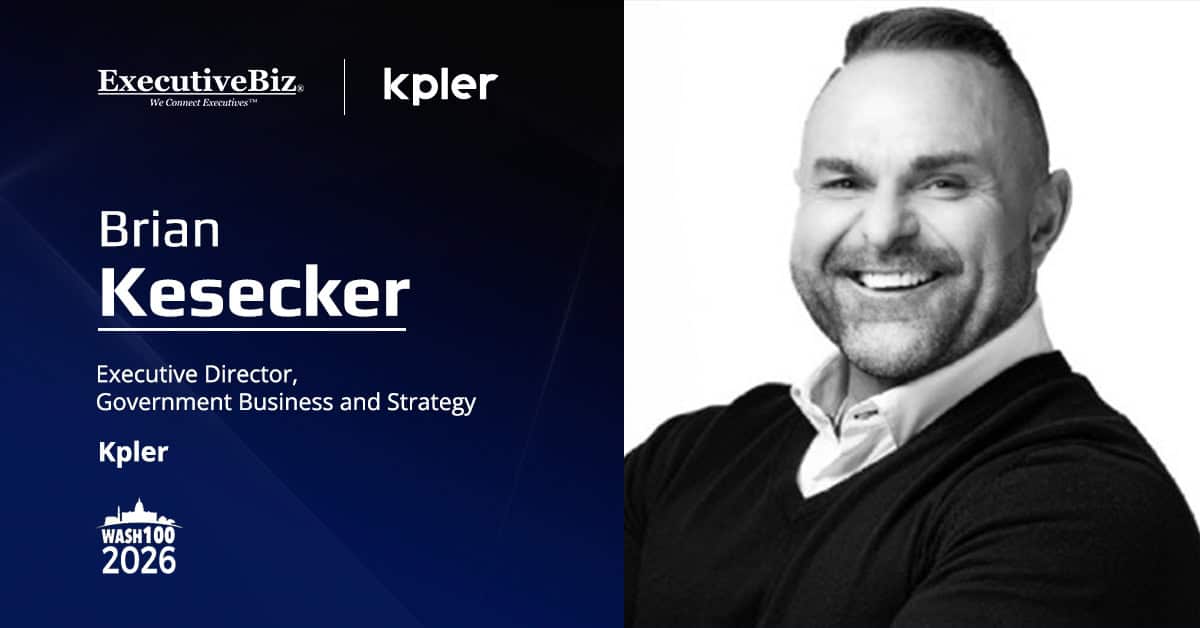
- Strait of Hormuz traffic has recovered but remains below typical levels
- Kpler tracked more than 20 million barrels of ship-to-ship crude transfers
- Kesecker says regional maritime networks continue adapting to security risks
Brian Kesecker, executive director of U.S. government business and strategy at data and analytics company Kpler, said traffic through the Strait of Hormuz has begun to recover, maritime visibility has improved and regional shipping networks continue adapting to elevated security risks following the June 17 interim memorandum of understanding between the U.S. and Iran.
In exclusive comments shared with ExecutiveBiz, Kesecker, a 2026 Wash100 awardee, said the developments provide defense, intelligence and maritime security professionals with insight into how critical energy supply chains recover following disruption and how maritime operators adapt to contested operating environments.
What Are Kesecker’s Observations on Crude Oil Transits & Maritime Visibility?
According to Kesecker, confirmed Middle Eastern crude oil transits exceeded 115 million barrels in June to date, or about 4.9 million barrels per day, compared with an average of roughly 13 million barrels per day in 2025.
He added that Kpler tracked more than 20 million barrels of ship-to-ship crude transfers involving unidentified vessels in the Gulf of Oman, likely originating from the Middle East Gulf.
Kesecker also said maritime visibility has improved since the MOU. Approximately 13 million barrels of the roughly 21 million barrels of Iranian crude oil that transited the Strait of Hormuz in June moved after the agreement was signed. He noted that several Iranian cargoes also maintained Automatic Identification System coverage for longer stretches of their voyages than previously observed.
He added that cargoes loaded before or during the early stages of the conflict have begun departing the Gulf, indicating that previously delayed shipments are moving through the region’s maritime network.
What Other Shipping Trends Has Kesecker Observed?
Kesecker pointed to increased loadings from Kharg Island, the 60-day waiver and returning ballast vessel activity as indicators that Iranian maritime exports are recovering. However, he said export activity remains concentrated among a limited number of buyers.
He added that maritime operators continue relying on alternative routing through Oman, mine-clearance efforts, unidentified vessel activity, Global Navigation Satellite System interference and other risk-management measures.
“The recovery in Strait of Hormuz traffic reflects the resilience and adaptability of regional maritime networks rather than a complete return to pre-conflict conditions,” Kesecker said.
According to the Kpler executive, regional operators have continued using bypass infrastructure, offshore transfer networks, alternative routing and dark vessel activity to facilitate crude shipments amid ongoing security challenges. He said those operating patterns remain evident even as improved vessel visibility and the movement of previously delayed cargoes indicate a gradual transition toward more predictable operating conditions.
What Does the US-Iran Memorandum of Understanding Include?
According to NPR, President Donald Trump and Iranian President Masoud Pezeshkian signed the MOU to establish a framework for ending the conflict between the two countries. Pakistani Prime Minister Shehbaz Sharif also signed the preliminary agreement after Pakistan helped mediate the negotiations.
The 14-point MOU calls for an immediate ceasefire, negotiations toward a final agreement within 60 days, the gradual restoration of commercial shipping through the Strait of Hormuz, U.S. waivers for Iranian oil exports, progress toward lifting sanctions, commitments related to Iran’s nuclear program and the establishment of a mechanism to monitor implementation before a final agreement is submitted to the United Nations Security Council.
Who Is Brian Kesecker?
Brian Kesecker serves as executive director of U.S. government business and strategy at Kpler, where he oversees the company’s engagement with defense, intelligence and civilian government customers. A longtime national security executive, he has extensive experience helping federal agencies adopt data-driven technologies and build mission-focused partnerships.
Kesecker previously held leadership positions at Sayari Labs, Chainalysis and SAIC.
In a recent Executive Spotlight interview, Kesecker discussed the growing role of unclassified commercial data in modern intelligence operations and how it can support faster decision-making and information-sharing across joint and coalition missions.