
 Jane Edwards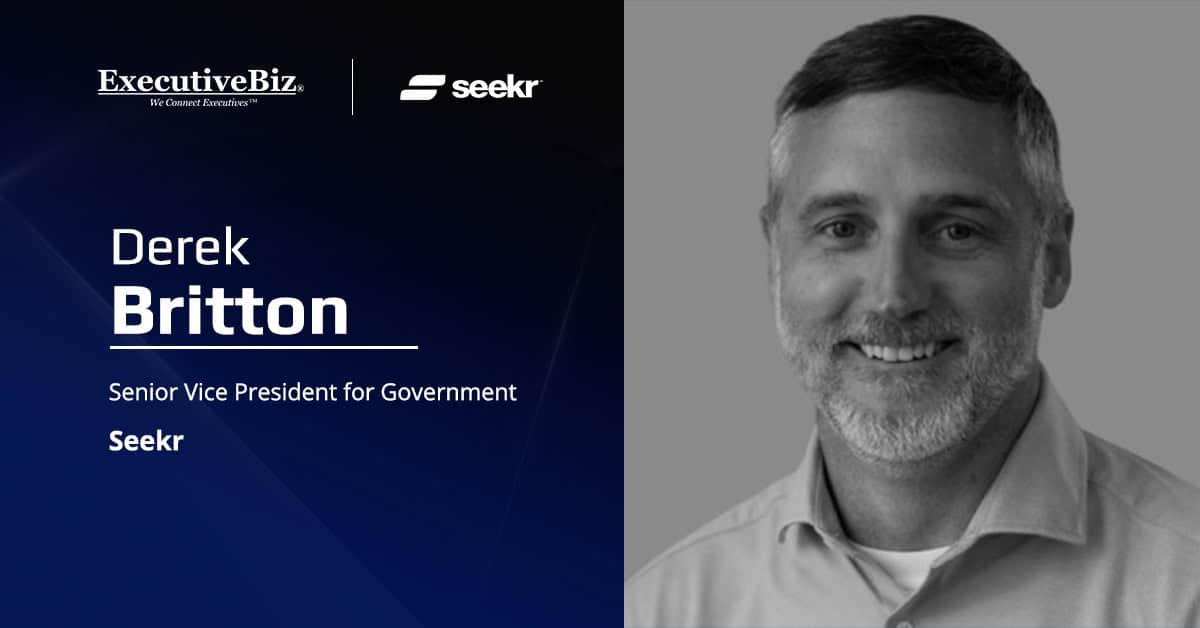
- Seekr SVP Derek Britton has said AI outputs should trace back to a rule, record or source
- He cited TSA’s automated scanning as an example of AI freeing up staff time
- The FedCiv Summit will explore AI adoption, cloud and more
Derek Britton, senior vice president of government at Seekr, said federal agencies should make artificial intelligence outputs defensible and auditable to expand automation into more consequential, high-stakes work.

Federal civilian agencies continue to navigate how technology investments align with mission priorities and operational readiness. The 2026 FedCiv Summit will feature discussions on AI adoption across government, data, cloud and compute infrastructure, cybersecurity and compliance-driven initiatives, and enterprisewide programs. Save your seat now for the Oct. 29 event to hear from senior government leaders and industry executives shaping the federal civilian technology landscape.
“The answer isn’t to aim low, but to build AI that can answer for itself no matter where you aim,” Britton said in an article published Friday on Nextgov/FCW.
How Should Agencies Build AI That Can Answer for Itself?
Britton said that this requires more than a human in the loop, meaning workflows must be transparent and explainable in terms people can understand. He said every output should point back to a specific record, rule, or verified source, and that a human should retain the real authority to assess, correct and overrule AI-driven decisions.
“And rules should only update when a change is proven, not silently in the background without human intervention,” he added.
What Are the Benefits of Automating More Consequential Government Work?
Britton pointed to the Transportation Security Administration’s use of AI-powered scanning technology as an example of automation applied to reduce busywork for agents. He said that when agents have more time to focus on complex issues, they can move travelers through security lines faster and direct attention to those who need it most. Britton said this illustrates that automation, when used well, does not replace judgment but frees up more time for it.
Britton said there is nothing inherently problematic about applying automation to simple, low-risk tasks, but doing so limits what AI can actually deliver for an agency. He noted that agencies should not shy away from applying the technology to more difficult, high-consequence functions, pointing to the General Services Administration’s Federal Elimination, Optimization and Automation Playbook, which outlines how natural language processing and document understanding could help agencies work through the unstructured data problems that have long slowed service delivery.
He noted that addressing defensibility and auditability could help agencies better take on the consequential work they have been sidestepping.
What Other AI Work Has Seekr Been Doing?
Britton’s remarks build on Seekr’s broader AI efforts in government and defense. In December, Seekr introduced SeekrGuard, a new evaluation and certification system built for organizations deploying AI in national security, critical infrastructure and other regulated environments. In a LinkedIn post, Britton said SeekrGuard will help “ensure the right AI model is used for the task at hand,” adding that “secure, accurate and transparent AI is a necessity in mission critical environments.”
Seekr has also expanded its work in defense. SNC and Seekr recently partnered to build and deploy AI-enabled capabilities across SNC’s multidomain mission systems to deliver real-time decision advantage to operators at the tactical edge. Separately, Seekr teamed up with General Dynamics Information Technology to develop agentic AI capabilities for federal missions.