
 Pat Host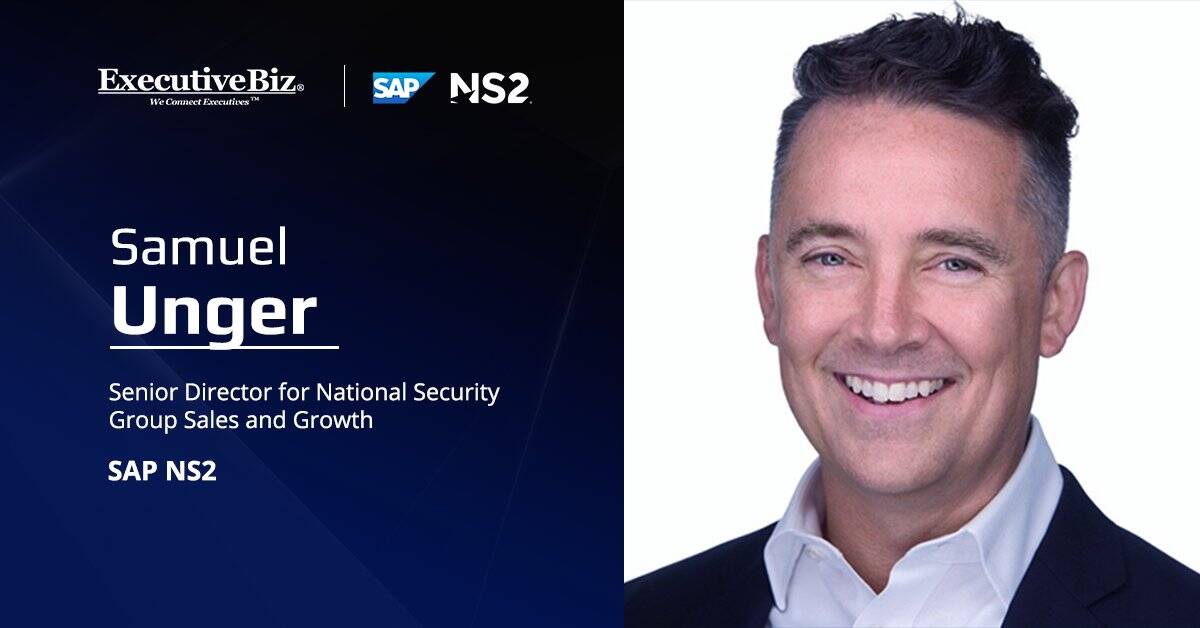
- Samuel Unger, SAP NS2 senior director for national security group sales and growth, is leading the acceleration of generative AI solutions within secure environments
- Unger is working with colleagues to ensure the building blocks for ethical, safe and secure AI are available across all domains
- He sat down with ExecutiveBiz for his latest Spotlight interview to discuss cloud computing, how to stand out in the bid process and how the Pentagon eliminating the JCIDS process is impacting acquisition
Samuel Unger is leading a bold new initiative at SAP NS2: the acceleration of generative artificial intelligence solutions within secure environments.
Unger, the company’s senior director for national security group sales and growth, is working with colleagues to ensure the necessary building blocks for ethical, safe and secure AI are available across all domains. This includes helping define data management strategies to ensure proper cataloging, governance and model management within SAP NS2’s Business Data Cloud—the core of the company’s AI ecosystem.
Unger is an experienced geospatial and satellite industry executive with leadership positions at industry stalwarts including Planet, BlackSky and the U.S. Geospatial Intelligence Foundation. One of his proudest accomplishments is supporting and enabling the EnhancedView major system acquisition for the National Geospatial-Intelligence Agency. Here hundreds of talented individuals worked with commercial remote sensing and imagery providers and the Office of the Director of National Intelligence to transform how the national security community leverages and utilizes commercial imagery, geospatial information and intelligence.
Fast forward to today: the commercial space economy has exploded as hybrid space architecture has evolved. Helping define, and refine, the strategies and acquisition that now serve as the foundation of the current marketplace was an incredible opportunity and success for Unger.
Unger sat down with ExecutiveBiz for his latest Spotlight interview to discuss how federal agencies can affordably adopt cloud computing while preserving mission assurance, how SAP NS2 sets itself apart from competitors in bidding, how the Pentagon eliminating the Joint Capabilities Integration and Development System process will impact contracting and the most pressing national security threats facing the U.S.
Discover the latest business opportunities in cloud, AI and other critical emerging technologies at the Potomac Officers Club’s 2026 Digital Transformation Summit on April 22! Learn the Pentagon’s latest technology modernization strategies from Kirsten Davies, Department of War chief information officer and 2026 Wash100 Award winner, during her illuminating keynote address. Secure your seat now!
ExecutiveBiz: What are some of the key barriers that remain in widespread federal cloud migration, and how do you think we can overcome them?
Samuel Unger: I believe the federal government has largely moved past the question of whether cloud is beneficial. Today, the real issue is how to adopt cloud in a way that cost effectively preserves mission assurance. In national security environments, systems support warfighters, intelligence operations, public safety and financial accountability. The tolerance for disruption is extremely low, so modernization must occur without jeopardizing continuity.
The biggest barriers are not purely technical—they are institutional and operational. Security accreditation timelines, complex compliance requirements and the need to protect sensitive data across multiple classification levels progress slowly. Many agencies operate hybrid environments spanning classified, controlled unclassified and public domains with less-than-optimal configurations, built upon significant customization. Moving capabilities across those boundaries requires deliberate planning, particularly around data strategies, and strong governance.
Legacy systems present another major challenge. Federal organizations rely on decades of interconnected platforms supporting finance, logistics, personnel and mission operations. These systems exchange data through thousands of interfaces, many of which were built long before modern integration practices. Attempting to replace them wholesale is risky and often impractical. Successful modernization typically begins with strengthening and cleaning the digital core: establishing authoritative data sources, modern integration layers and secure environments that can support incremental transformation.
Data sovereignty is equally important. For the federal government, particularly national security customers: data locations and access are critical operational questions. Environments must meet strict requirements for location, personnel and control. Purpose-built and secure cloud environments operated by cleared U.S. personnel and aligned with federal compliance frameworks allow agencies to modernize while maintaining confidence that sensitive information remains protected. Sovereignty, in this context, enables innovation, rather than constraining it.
EBiz: What do you think is the most overlooked part of the bid process and how does SAP NS2 set itself apart from competitors in this area?
Unger: One of the most overlooked, and increasingly consequential, aspects of the federal bid process is the government’s ability to recognize and accommodate truly commercial companies. While there is broad agreement and directives that national security missions leverage private-sector innovation, the acquisition system often struggles to reconcile commercial business models with traditional procurement frameworks.
I would argue that the agile acquisition reforms, such as other transaction authorities, commercial solution offerings and broad agency announcements, over the past decade are still subject to interpretations under a more traditional lens. This disconnect can unintentionally discourage participation by firms whose technologies are advancing fastest in areas such as cloud, cybersecurity and AI.
Commercial providers typically operate on standardized products, subscription pricing, continuous delivery cycles and globally-consistent terms. Their sales processes are designed for speed and scale. By contrast, traditional federal procurements emphasize comprehensive proposals, detailed cost breakdowns, unique contractual provisions and lengthy evaluation timelines. Attempting to force commercial offerings into these structures can distort pricing, delay deployment and undermine the efficiencies that make commercial technology attractive in the first place.
Pricing transparency is a frequent friction point. Commercial firms set market-based prices that reflect ongoing research and development investment and lifecycle support across a broad customer base. Requests for extensive cost data or expectations of government-unique pricing can conflict with corporate governance requirements, particularly for publicly traded companies. As a result, vendors may decline to pursue opportunities or limit the scope of what they offer, ultimately reducing competition and innovation available to the government.
Are you a GovCon technology executive? Then you cannot afford to miss the Potomac Officers Club’s 2026 Digital Transformation Summit on April 22. It’s curated just for you! Hear from Col. Jonathan McCall, Space Force deputy director for space and Advanced Battle Management System cross-functional team, and Col. Scott Klepner, Space Systems Command deputy program executive officer. They’ll participate in fascinating panel discussions on Operationalizing AI in High-Security Federal Environments and Mission Engineering at Scale: The Digital Backbone of Defense Modernization, respectively. Sign up today!
EBiz: How will the Pentagon getting rid of the Joint Capabilities Integration and Development System process impact how you provide goods and services to warfighters?
Unger: The two-word answer: expedited delivery. The move away from the traditional JCIDS process reflects a broader recognition that the pace of modern conflict and technological change demands faster capability delivery. Requirements processes that span many years, or even months, cannot keep pace with rapidly evolving threats, particularly in cyber and information domains.
While I respect its intent, and appreciate the legacy of the JCIDS process, I believe this was a much-needed change.
For industry writ large, this shift emphasizes efficiencies, agility and collaboration. Instead of waiting for comprehensive requirements documents, providers must be prepared to engage earlier with operators, prototype solutions quickly and iterate based on real-world feedback as with commercial models.
Capabilities need to be delivered in smaller, mission-focused increments that can be evaluated and refined continuously. Modular architectures, arguably the norm, become essential in this model. Systems must allow components to be deployed independently and upgraded without disrupting the entire enterprise and without adding creep, bloat and costs. Security must be built in from the outset so that new capabilities can be fielded rapidly without lengthy retrofits.
Interoperability is also critical. Military operations are inherently joint and often coalition-based, requiring systems that can share information seamlessly across services and partners. Open standards and flexible platforms enable collaboration while reducing the risk of fragmentation or vendor lock-in.
EBiz: What are the most pressing national security threats the U.S. is facing and how is SAP NS2 addressing these threats?
Unger: One of the most significant national security vulnerabilities the U.S. faces is the cybersecurity posture of the defense industrial base. Modern military capabilities are developed, produced and sustained by a vast network of contractors and suppliers, many of whom handle sensitive controlled unclassified information, or CUI.
Adversaries increasingly target this extended ecosystem, often focusing on smaller or less-protected organizations, to gain access to valuable data without directly attacking hardened government networks. While there are several actions SAP NS2 has taken over the years to continuously enhance the security of our cloud offerings and SAP solutions, I’d like to focus on one area that is top of mind: Cybersecurity Maturity Model Certification 2.0.
SAP NS2 environments, operations and support services are aligned with Defense Federal Acquisition Regulation Supplement 252.204-7012 and National Institute of Standards and Technology 800-171. These ensure our customers can meet evolving cybersecurity mandates and maintain contract eligibility across cloud, consulting and mission-critical engagements as we prioritize our CMMC 2.0 compliance posture and maintain our hard-earned certification.
SAP NS2 recognizes that the CMMC 2.0 framework is far more than a compliance requirement. It is a strategic effort to establish a consistent cybersecurity baseline across the entire defense supply chain. Sensitive information related to weapons systems, logistics, operational plans and emerging technologies flows through thousands of organizations. Without standardized protections, a single weak link can expose critical capabilities to espionage or disruption.
Nation-state actors are conducting persistent cyber campaigns aimed at stealing intellectual property, mapping vulnerabilities and positioning themselves to disrupt production or operations during a crisis. Access to design data or sustainment plans can allow adversaries to replicate U.S. capabilities, develop countermeasures or degrade readiness. In many cases, the theft of CUI can be just as damaging as the compromise of classified information because it reveals how systems function and where they may be vulnerable.