
 Charles Lyons-Burt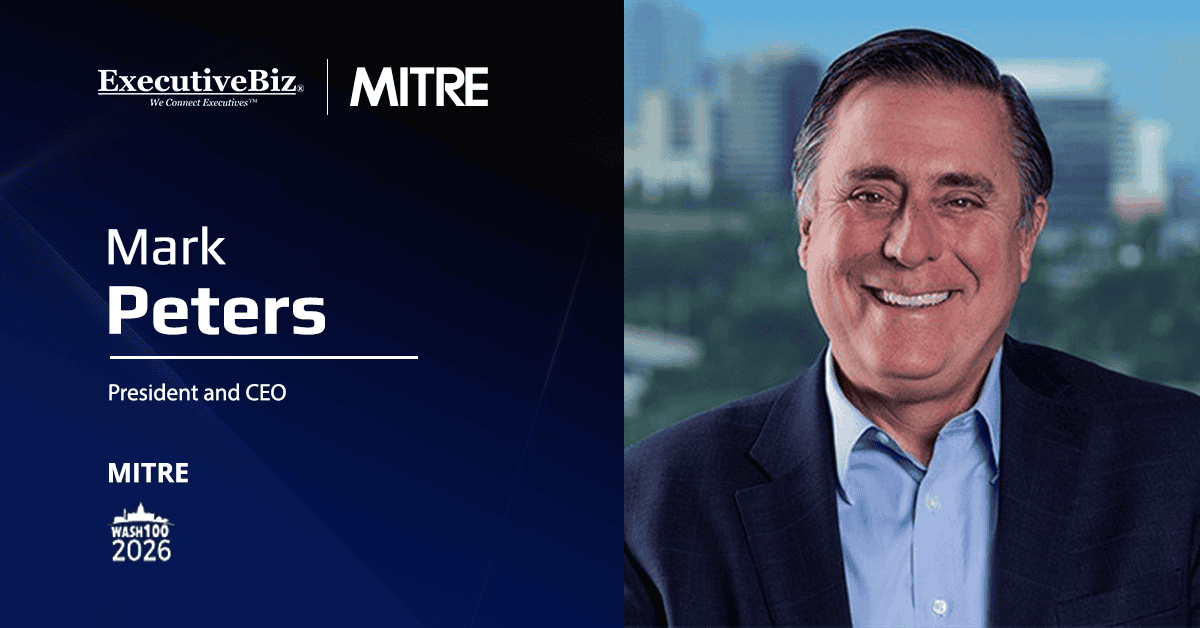
Mark Peters took the helm as president and CEO of MITRE at a time when the federal government’s ability to move ideas into action is under growing scrutiny. A two-time Wash100 Award winner, Peters brings deep experience leading large-scale research and national security organizations, including senior leadership roles at Battelle Memorial Institute, to one of the most influential not-for-profit technology organizations supporting the U.S. government.
Under Peters’ leadership, MITRE sits at the center of efforts to help agencies navigate complex technical challenges that span defense, intelligence, cyber and critical infrastructure. As an operator of federally funded research and development centers, the organization plays a distinct role in shaping how emerging technologies are validated, integrated and transitioned to industry. In this Executive Spotlight, Peters shares his perspective on the evolving demands placed on government innovation and MITRE’s role in strengthening the nation’s technology ecosystem.

Peters will be a panel speaker at the upcoming 2026 GovCon Executive Leadership Summit on February 26. He’ll be part of the New at the Top: Powering the Next Phase of Growth session, where new CEOs and company leaders will talk about how they’re setting a new course for their organizations. Other guests will include brand new chief execs Josh Wilson of LMI and Michael LaRouche of Serco. Register today!
ExecutiveBiz: What do you make of the recent push for commercial technologies and a speedier incubation-to-implementation pipeline for government tools and capabilities? Many officials and administrations over the years have paid lip service to this; how do we know when it’s really happening?
Mark Peters: The push is warranted and overdue because the U.S. no longer competes on innovation alone. We compete on speed, scalability and system-level execution. Inventing first does not matter if we cannot transition and deploy faster than our competitors.
This moment is shaped by converging structural pressures. Breakthrough technologies can sometimes struggle to transition from proof to scale, global competitors are accelerating innovation through tightly integrated state-backed systems, and our own regulatory and acquisition frameworks can introduce delays.
So how do we know progress is real? We will see it when innovations consistently transition into programs of record. Government adoption requires more than technical promise; it must align with mission needs, operational realities and long-term sustainability.
That is where federally funded research and development centers, or FFRDCs, like those MITRE leads, play a critical role. At the direction of the federal government, MITRE is built to tackle complex, high-risk challenges the market cannot yet price — and to apply the necessary rigor to help industry identify the right problems to solve. We operate as a neutral, trusted intermediary by bringing government, industry and academia together to rapidly build, test and validate new concepts in secure environments. When sponsors need proof of concept, we can quickly catalyze stakeholders to help deliver in weeks or months and then transition validated capabilities to industry to scale.
In effect, FFRDCs function as a national risk-reduction mechanism by absorbing uncertainty and providing our distinct mission engineering expertise that allows the government and industry partners to make smarter investments so industry can move with confidence. In parallel, we transfer technical solutions, inspired by our U.S. government sponsors’ most pressing needs, that can be leveraged and scaled by industry to more rapidly deliver capabilities to the battlefield, increase safety and resilience at home, or improve the delivery of citizen services – all the while increasing economic benefit to the nation. Scaling innovation at speed is a system-of-systems challenge, and MITRE’s view is that accelerating scale is not just a technological imperative, but an organizing principle for a stronger U.S. innovation ecosystem.
EBiz: Given the prevalence of IRAD at disruptive defense tech companies, there has been talk in the GovCon industry that more R&D should be taking place across the sector. As an operator of FFRDCs, what’s your take on this?
Peters: Industry IRAD is essential. It drives speed, competition and innovation, and it is often where breakthrough ideas originate. But market forces alone do not close the ‘valley of death.’ Many promising capabilities stall between prototype and adoption because they lack mission validation, integration pathways or a clear transition sponsor, especially for challenges that span agencies or require long-term investment.
FFRDCs complement industry IRAD by operating in that gap. We can help provide tooling up front so industry can better target their IRAD, and we focus on cross-cutting, high-risk problems that do not naturally attract private investment, such as systems integration, open architectures, interoperability and mission assurance. By providing independent assessment, operational testing and trusted technical judgment, FFRDCs help reduce the obstacles that keep promising technologies from transitioning into programs of record.
The strongest outcomes occur when industry innovation, government priorities and FFRDCs work together to move capabilities from concept to scale. More R&D is only valuable if it leads to real mission impact, and closing the valley of death requires not just investment, but coordination, validation and systems-level thinking.
Don’t miss Peters’ insights live at the 2026 GovCon Executive Leadership Summit. At the Feb. 26 event, network with the most influential players in the federal services industry; trade strategies and compare notes. Save your spot now!
EBiz: What’s a federal cyber vulnerability that’s under-discussed and needs more attention from industry partners and integrators?
Peters: One area that receives too little attention is operational technology, the systems that control physical processes in infrastructure, industrial environments and defense platforms. Unlike traditional IT, these systems were built for reliability, not cybersecurity, and connecting them to modern networks introduces new risks. A cyber incident in OT can quickly translate into operational disruption or physical damage, making it a unique and high-consequence threat.
MITRE’s recent extension of the D3FEND ontology to operational technology illustrates the need for systematic approaches. By mapping OT components, adversary behaviors and countermeasures, it provides a structured framework for agencies and industry partners to strengthen defenses. FFRDCs play a key role by helping government teams define real needs, collaborate with industry on practical protections and apply frameworks like D3FEND to reduce mission risk across the federal ecosystem.
EBiz: Government agencies often struggle to compete for top technical talent. How does that affect their ability to adopt new capabilities, and how can that gap be addressed?
Peters: Government agencies are working under real financial and structural constraints, and it’s challenging to attract and retain the highly specialized talent needed to keep pace with rapidly evolving technology. This can slow the adoption of new capabilities and make it harder to tackle complex, cross-agency problems.
FFRDCs like MITRE hire and retain experts in areas such as cybersecurity, data science, systems engineering and operational technology, with deep mission expertise spanning domains for our Nation’s security, health and prosperity, and then apply their knowledge across multiple programs and agencies. In fact, the value of FFRDCs from their inception was to develop and sustain deep technical experts in support of government and the public interest.
FFRDCs provide sustained, impartial expertise in service to what’s in the best interest of the nation. We take seriously our responsibility to train and empower the next generation, and the MITRE alumni network, from former interns to former senior leaders, extend our mission beyond the organization, building on their experience to advance the public good across government, industry and civil society.