

 Pat Host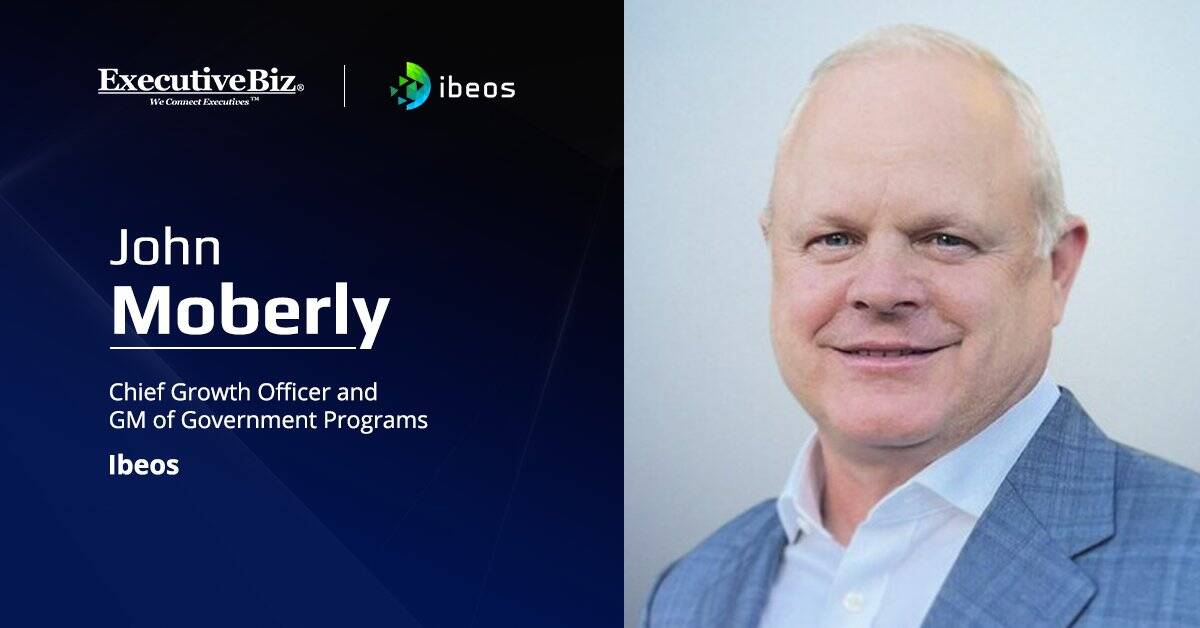
- John Moberly, Ibeos chief growth officer and general manager of government programs, pushes the technological envelope in high-performance space computing
- Ibeos is working with Microchip Technology to jointly develop the High Performance Space Computer processor with NASA funding
- He sat down with ExecutiveBiz to talk data centers, edge computing, prototyping and why Ibeos uses automotive-grade components in space systems
John Moberly strives to redefine what’s possible in revolutionary space technology. While an Army officer, he embarked on a unique career path developing and employing space capabilities as an Army space operations officer.
There he worked with highly classified capabilities and systems at the National Reconnaissance Office and led the programming of Army space and missile defense programs including the Terminal High Altitude Area Defense missile defense system. He also spent three years leading oversight of intelligence community acquisitions and research and development in what was previously called the office of the Under Secretary of Defense for Acquisition, Technology and Logistics, which has since been reorganized.
Moberly is now contributing to diverse space technology solutions and leading business areas and, most recently, startups. Today he’s chief growth officer and general manager of government programs at Ibeos.
Moberly recently sat down with ExecutiveBiz for his first Spotlight interview to discuss the big breakthrough national security space technology, the feasibility of data centers in space, the factors powering Ibeos’ rapid growth and innovative contracting vehicles in the space business.
Get the latest space artificial intelligence business opportunities directly from leading federal officials at the Potomac Officers Club’s 2026 Artificial Intelligence Summit on March 18! Hear directly from Chandra Donelson, Space Force chief data and AI officer and director of data, AI and software, on what the service needs from industry for AI requirements in space. Sign up today!
ExecutiveBiz: What is the next major breakthrough in national security space technology that will emerge over the next five years?
John Moberly: I think we’re already on the cusp of it—edge processing on orbit. There’s been a lot of discussion about space-based data centers and while they are a little further away from realization, edge processing works in conjunction with that concept and is needed now. The cloud isn’t going away or being replaced by the edge, but there are specific situations where edge processing is essential.
Three use cases stand out. First are time-sensitive missions, such as missile warning and missile tracking, where milliseconds matter and data must be sent from sensor to shooter and the decision-maker.
Second is network processing for large mesh networks in space. Third, and this is where much of our early work has focused, is deploying computer vision algorithms on processors for rendezvous, proximity operations and close-up missions. Those missions require autonomous operations because joystick-style control isn’t feasible due to latency, especially for docking and safe flight operations.
Edge processing will play a major role over the next several years and will work alongside both orbital and terrestrial cloud data centers as they come to potential fruition. Edge processors will likely be like the cerebrum of the brain where they will control, coordinate and regulate the rest of the data center activities.
EBiz: There’s been a lot of discussion about data centers in space. How feasible are they, and when might we start seeing them?
Moberly: There are significant physics challenges involved. People often point to the cold background of space as a cooling advantage, but you still need sophisticated heat pumps to remove heat. You’re also talking about extremely large solar arrays, potentially on the order of gigawatts and the size of a football field (57,600 square feet), which introduces vulnerability to micrometeoroids and other hazards as well as their deployment.
There are many technical challenges still to be solved, but we are supporting a few companies that are moving in that direction and we’re optimistic about the progress being made.
EBiz: What’s the most challenging aspect of transitioning from R&D and prototyping to actually fielding a new technology?
Moberly: That’s a great question. R&D and prototyping have traditionally focused on proving concepts, but today they need to shift toward reducing cost, increasing scalability and achieving production rates. The hardest part is scaling up manufacturing and delivery.
We’ve experienced tremendous growth over the past year and now the challenge is meeting delivery schedules and execution requirements. It’s a good problem to have, but it requires careful planning and a clear-eyed approach to scaling throughput.
EBiz: Can you quantify your growth and how are you scaling up?
Moberly: We’ve doubled revenue in each of the last two years and are on pace to nearly do that again, limited primarily by execution. We’re being deliberate about how we grow.
We currently have about 5,000 square feet of production and lab space, more than double what we had previously. We moved into a new facility in November 2024 and are already expanding again, taking over additional space in the building. At the same time, we’re completing an AS9100 facility-based certification, which will cover our full operation.
EBiz: How have you been able to double revenues over the past few years?
Moberly: Growth in proliferated multi-orbit architectures has been a major driver. Our key differentiator is taking automotive-grade components and modifying them for the power, thermal and radiation environments of space.
There are limits to what can be done with certain components, such as GPUs, but many can be made significantly more radiation tolerant. Our systems are radiation tolerant up to 37 MeV, which is an important threshold. We’re currently in a solar maximum period, and even in low Earth orbit, radiation must be accounted for if you want a three- to four-year mission life.
Want more live insights from top Department of War leaders on technology initiatives? Then you can’t afford to miss the Potomac Officers Club’s 2026 Artificial Intelligence Summit on March 18. It’s curated specifically for you! Hear an illuminating keynote address from Cameron Stanley, DOW chief digital and AI officer. Secure your seat now!
EBiz: What innovative contracting vehicles are you seeing the Pentagon and NASA use, and how has Ibeos responded?
Moberly: I’ve been involved in acquisitions from the government side, including some of the early other transaction authorities. Today, these are fairly common. However, I’m less focused on the contract vehicle itself and more on its acquisition strategy.
Innovative strategies, such as prize-based approaches, can be effective, but they still require strong program management. I’m particularly interested in the portfolio acquisition executive programs being stood up. A key aspect is their ability to move funding within a portfolio, something that historically required high-level approvals or congressional notification. These challenges won’t be solved overnight, but progress is being made.
EBiz: How has the declining cost of launch impacted Ibeos and do you expect launch costs to continue falling?
Moberly: Lower launch costs have driven the proliferation of multi-orbit architectures. As constellations mature, industries tend to move from vertically-integrated models to horizontal supplier bases, which are more cost efficient. We’re seeing that same shift in space.
As the number of satellites increases, cost-per-satellite decreases and mission assurance improves because systems are evaluated in aggregate. This creates more opportunities for suppliers. Continued launch cost reductions, driven by vehicles like SpaceX’s Starship and offerings from companies such as Blue Origin, will likely continue, similar to a Moore’s Law-style progression.
EBiz: How does Ibeos get to space? Do you fly on specific providers?
Moberly: We’re a supplier to satellite and space vehicle providers, rather than an operator. Our products include modular power systems, power distribution units, batteries and high-performance edge compute systems. Those capabilities align closely with the edge processing discussion we opened with.
EBiz: What separates Ibeos from competitors?
Moberly: Our ability to adapt automotive-grade components to operate reliably in the harsh space environment sets us apart. This requires extensive work across hardware, firmware and software. By integrating these elements, we’re able to deliver roughly 80 percent of mission assurance at an order-of-magnitude lower cost compared to traditional approaches.
EBiz: What capabilities do you specialize in?
Moberly: Our modular power systems and compute platforms are designed to support a wide range of missions. Flexibility is built into the architecture, whether the mission involves communications, data transport or other payloads.
For example, our power system supports configurations ranging from three to 10 cards, enabling management of multiple payloads, solar arrays and batteries. We’re applying these systems to lunar missions, including NASA’s Commercial Lunar Payload Services, or CLPS, program.
EBiz: Anything else you’d like to add?
Moberly: We’re just over 10 years old as a company and transitioned into a product-focused business over the last few years. We’ve grown without venture capital funding and currently have about 70 employees. We’re actively hiring, particularly Field Programmable Gate Array engineers.
What Does Ibeos Do?
Ibeos provides edge computing for spacecraft using GPUs that enable artificial intelligence processing. It also offers power distribution systems and batteries. These three product lines are driving its growth. About half of Ibeos’ business comes from traditional prime contractors, and the other half comes from emerging space startups.
Who Is John Moberly?
Moberly is the chief growth officer and general manager of programs at Ibeos, a developer of high-quality spacecraft avionics. These include power distribution and battery product lines and, now, an edge computing and space high performance computing product line.
What Does John Moberly Do at Ibeos?
Moberly helps Ibeos push the technological envelope in high-performance space computing. He leads overall growth at the company while ensuring its programmatic efforts stay on schedule.
Ibeos has developed the EDGE-1100 and Genie edge-processing solutions for space based on the AMD Ryzen graphics processing unit. They are specifically designed for the power, thermal and radiation environment of space.
Ibeos is working with Microchip Technology, an American public semiconductor corporation that developed the High Performance Space Computer, or HPSC, processor jointly with NASA funding. Ibeos will integrate this new RISC-V-based processor into Ibeos’ single-board computers for its next generation flight computer.
Edge processing primarily falls into two categories: enabling autonomous dynamic space operations using graphics processing unit-based computer vision algorithms and on-board processing for time-sensitive missions. Then the new HPSC will enable very high speed and performance networking and processing solutions on-orbit.