

 Jane Edwards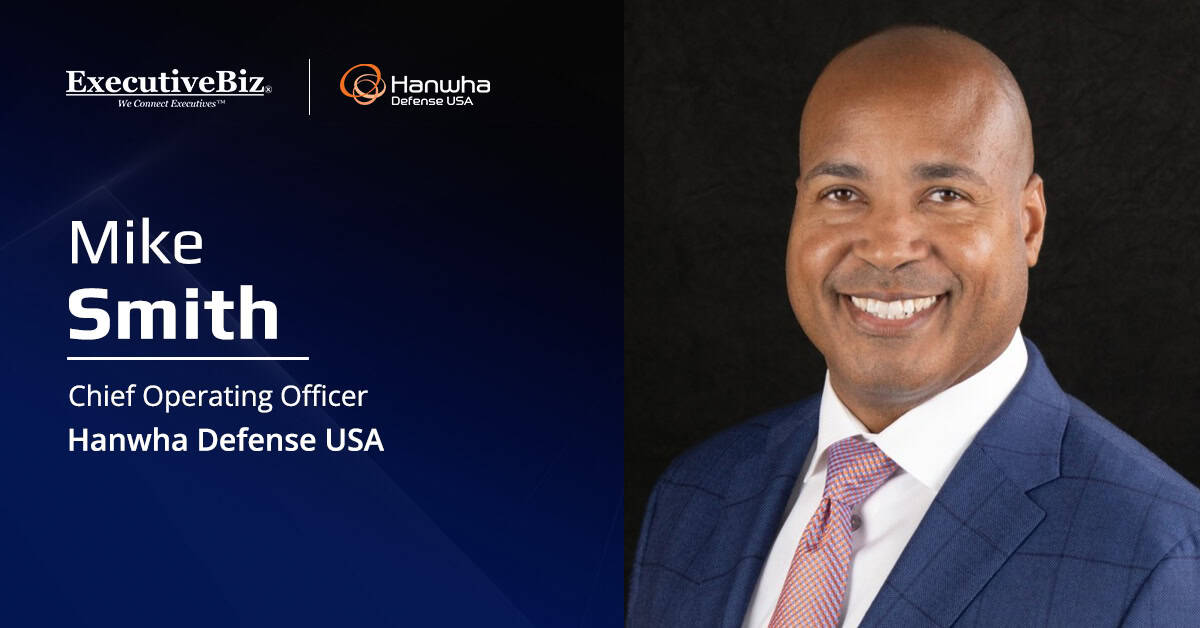
Mike Smith, chief operating officer of Hanwha Defense USA, discussed the company’s role in U.S. naval shipbuilding and the broader defense industrial base during a recent episode of the Rebuilding the Fleet podcast.

As discussion continues over how to expand U.S. shipbuilding capacity and strengthen the maritime industrial base, industry leaders like Hanwha Defense USA COO Mike Smith are shaping the conversation around execution, supply chains and future defense programs. The Potomac Officers Club will host the 2026 Navy Summit on Aug. 27. Register now to join the conversation.
Speaking with podcast hosts Austin Gray and Tim Glinatsis, Smith noted that the company is focused on expanding capacity, improving execution and strengthening the maritime industrial base.
How Does Hanwha Support US Submarine Construction?
Smith said Hanwha already has deep experience building submarines.
“We build submarines. We’re the only other company outside of the two primes that also build submarines, and we actually build them in whole,” Smith said. “They’re not nuclear-powered, but when it comes to the need to build a structure that meets the pressure requirements of a submarine, we actually do that.”
Rather than competing directly with General Dynamics Electric Boat or HII Newport News Shipbuilding, Smith emphasized opportunities to support the existing submarine industrial base.
“There are other elements that we can do which will allow … will relieve some of the pressure on EB and Newport News so they can focus on some of the more sensitive compartments and elements and modules of those submarines,” he said.
According to Smith, nuclear aspirations are challenging. He said he thinks there is a way for Hanwha to play a constructive role in that space and help bring greater performance certainty to both classes of submarines over the long term.
What Are the Challenges Facing US Shipbuilding?
Smith said one of the most overlooked challenges in U.S. shipbuilding is governance, particularly the lack of long-term demand signals from Congress. Without predictable visibility, he said, companies lack the confidence to hire additional workers or invest capital to expand facilities.
He warned that suppliers are a critical vulnerability in the maritime industrial base, explaining that many firms for which Navy work represents only a small share of their business still provide components essential to shipbuilding.
Smith said that if the challenges become too great, some suppliers may decide to cease operations, increasing the risk of single points of failure or leaving the industrial base with too few alternative options.
Against that backdrop, Hanwha Defense USA’s parent company, South Korea-based Hanwha Group, is playing a key role in the Trump administration’s efforts to rebuild U.S. shipbuilding capacity and train American workers. In August, the company announced a $5 billion infrastructure plan to add two docks and three quays at Hanwha Philly Shipyard as part of a push to increase the Philadelphia-based yard’s annual production capacity from roughly one ship to up to 20 vessels.
What Defense Programs Are Worth Watching in 2026?
Looking ahead to 2026, Smith said one of the most interesting defense efforts to watch in 2026 is the modular attack surface craft.
He highlighted the newly established Robotics and Autonomous Systems organization, saying it will be important to see under new leadership which programs advance and what new efforts emerge.
Smith also mentioned the U.S. Army’s Mobile Tactical Cannon program, which he said is aimed at maintaining the relevance of tube and cannon artillery in the Pacific theater through extended range.
In December, Hanwha Defense USA announced a cooperative research and development agreement with the Army to integrate a 58-caliber cannon into its K9 family of vehicles.