
 Pat Host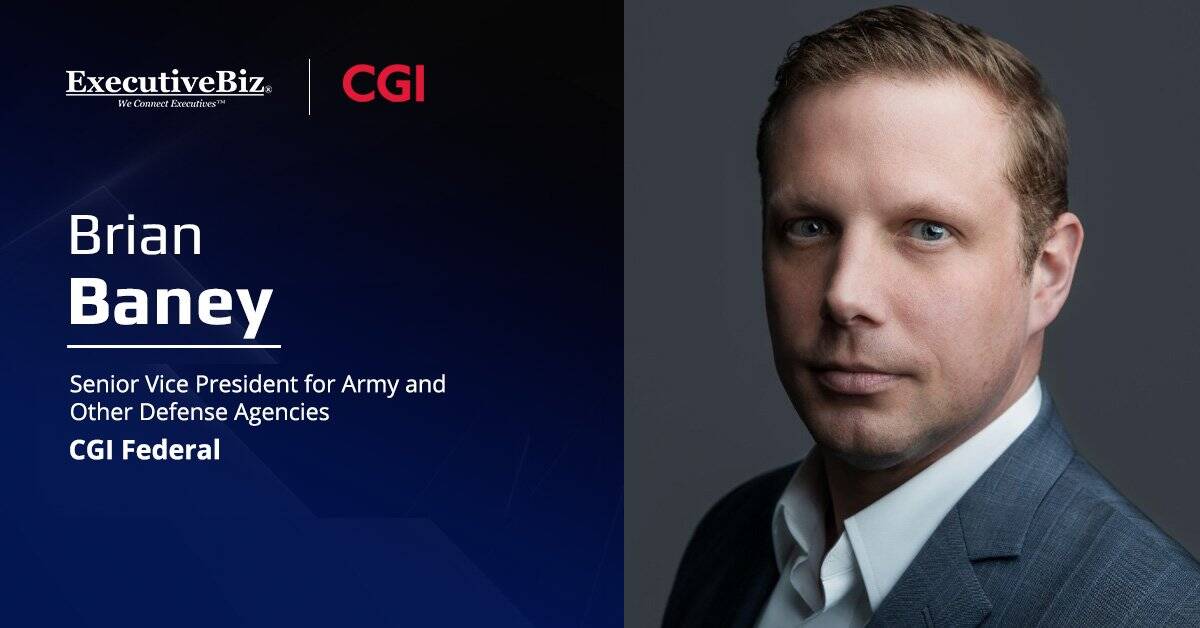
- Brian Baney, SVP for Army and other defense agencies at CGI Federal, is leveraging the company’s IP portfolio to provide logistics services at the edge
- This technologies will also provide maintenance, sustainment and tracking services in contested environments
- He sat down with ExecutiveBiz to talk GovCon trends influencing CGI Federal’s growth strategy, innovative contracting strategies and the most important emerging technologies
Brian Baney takes pride in the mission-critical work he and his teams perform for the Army. The senior vice president for Army and other defense agencies at CGI Federal was part of an initial team that helped build the organization responsible for the Army’s largest prototyping effort at the time.
Baney started his career as a policy analyst with the Department of Homeland Security, where he learned how to analyze possible scenarios and reach the best decisions and outcomes while understanding their operational implications. This job prepared Baney for helping the government make the right investments and decisions and prepared him a view of this process from the government’s perspective.
He is now helping CGI Federal leverage its strong portfolio of intellectual property that supports several logistics and asset visibility requirements. The company is integrating this technology to provide logistics, maintenance, sustainment and asset tracking capabilities at the edge, and most importantly, in contested environments.
Baney sat down with ExecutiveBiz for his second Spotlight interview to discuss the GovCon trends influencing its growth strategy, how the company is tackling explosive data growth in the federal government, innovative contracting strategies and the emerging technologies that will have the greatest impact on government business in the coming years.
Hear the latest business opportunities from top federal officials at the Potomac Officers Club’s 2026 Artificial Intelligence Summit on March 18! Get actionable intelligence directly from Cameron Stanley, the Department of War chief digital and AI officer, during his insightful keynote address. Secure your seat today!
ExecutiveBiz: What factors or GovCon industry trends are influencing your growth strategy as you look toward CGI Federal’s future?
Brian Baney: The defense market is evolving at an unprecedented pace, shaped by rapid technological change and shifting mission priorities. Several key trends are defining this environment, and we believe CGI Federal is well-positioned to address all of them:
Cybersecurity and Digital Transformation
Federal agencies are accelerating modernization under mandates such as Cybersecurity Maturity Model Certification 2.0 and zero trust architectures, creating a strong demand for secure, scalable solutions. In an era dominated by cyber threats, data proliferation and emerging technologies, CGI Federal is investing in advanced software and data engineering, combined with robust cybersecurity frameworks, to deliver mission resilience. We focus on how we can integrate security into every layer of delivery, so compliance and agility become synonymous.
AI and Automation
Globally, CGI has committed $1 billion to invest in AI, demonstrating the high priority the company places on the technology. AI and automation are becoming foundational to procurement, program management, and mission execution. AI isn’t always the solution itself, but it can enable our technology and solutions to be more effective and decisive. We are constantly exploring ways to embed AI into solutions so that it enhances efficiency, reduces costs and, most importantly, improves decision-making and provides deeper insights. From predictive analytics to intelligent workflows, these capabilities position our clients for success in a data-driven future.
Total Asset Visibility
The Department of War is prioritizing total asset visibility to strengthen audit readiness and optimize supply chains. CGI Federal has long led in this space through its Marine Corps Platform Integration Center, or MCPIC, platform, which integrates passive radio frequency identification, item unique identification tags and internet of things technologies to deliver near-real-time asset tracking, disconnected operations and emerging digital twin capabilities. These innovations compress decision cycles, reduce logistics friction and improve readiness across distributed environments, supporting DOW customers with their supply chain, maintenance and accountability challenges.
Our growth strategy is clear: combine innovation, cybersecurity, AI-driven solutions and client-centric delivery models. This approach ensures CGI Federal remains a trusted partner in advancing federal missions while sustaining long-term growth. Specifically, CGI Federal is focused on efficiency, digital and tech-first, and resultant data integration.

EBiz: One of the most pressing concerns about data in today’s digital landscape is the sheer amount of it there is to be processed and sorted. What do you see as some of the more viable solutions to tackling this challenge?
Baney: The exponential growth of data in federal environments demands solutions that combine automation, AI and advanced analytics. CGI Federal deploys AI-enabled digitization platforms to automate classification, normalization and anomaly detection even within secure or classified environments. Containerized AI models allow us to accelerate mission outcomes while maintaining compliance with data residency and security requirements.
Beyond AI, data orchestration and interoperability frameworks are essential. CGI leverages integrated platforms to unify data across silos, enabling real-time insights and reducing manual intervention. Techniques such as entity resolution, automated cleansing and metadata-driven governance ensure data integrity and regulatory compliance. Our goal is to transform data from a liability into a strategic asset that supports predictive analytics, informed decision-making and operational resilience.
EBiz: What types of new and innovative contracting vehicles are you seeing from Pentagon customers? How have these impacted how you deliver products and services to them?
Baney: We are seeing our clients increasingly adopting flexible, innovation-focused contracting vehicles to accelerate delivery and reduce acquisition bottlenecks. Even with the most common governmentwide acquisition contracts, the focus is on speed to delivery. Examples include Small Business Innovation Research, other transaction authority agreements, commercial solutions openings and large-scale indefinite delivery/indefinite quantity vehicles such as the Army’s Marketplace for the Acquisition of Professional Services and the Missile Defense Agency’s Scalable Homeland Innovative Enterprise Layered Defense programs.
Each of these contracts or agreements prioritize speed and agility, increase access to innovative and emerging technologies and look to bypass some of the traditional Federal Acquisition Regulation constraints. When used correctly, the contracts enable CGI Federal to significantly increase its access to customers so that we can creatively and innovatively support their missions.
Internally, this shift requires adapting delivery models to support iterative development, rapid prototyping and modular solutions. By leveraging these approaches, we deliver advanced capabilities, such as AI-driven analytics and secure cloud solutions, faster and more efficiently, while maintaining transparency and accountability.
We are also looking to increase our use of performance-based contracting, where success is measured by defined performance goals rather than process milestones. Measuring outcomes in government services is more difficult than in the commercial sector, because commercial metrics like revenue and profit are not all that important. The government measures value by the efficient and effective execution of its mission.
EBiz: Which emerging technologies do you anticipate will have the greatest impact on the federal landscape in the next few years?
Baney: CGI Federal believes that several technologies will redefine the defense mission in the coming years:
AI and Machine Learning
These technologies are the foundation for predictive analytics, autonomous operations and decision superiority. We are beginning to see how generative and predictive AI will support all domains and capabilities by accelerating planning and analysis, strengthening cyber defense and improving payment integrity. The government must be prepared to enable this growth by adopting robust governance and security measures.
Advanced cloud and edge computing: Multicloud ecosystems with secure edge computing will enable real-time processing and support contested, disconnected and classified missions. This enables analytics and decision dominance where the data is generated. This will bring enhanced capabilities in logistics, fires and command-and-control spaces.
Total Asset Visibility
IoT-enabled sensing and geospatial visualization will deliver end-to-end visibility across supply chains and maintenance—improving readiness and cost control. CGI’s MCPIC lineage illustrates practical TAV at enterprise scale.
Cybersecurity
Cybersecurity will become a mission enabler, ensuring that tactical and enterprise systems remain resilient against increasingly sophisticated adversaries while supporting real-time decision-making in contested environments. As digital transformation accelerates, cyber defense will underpin supply chain visibility and asset tracking, safeguarding data integrity for logistics and audit readiness. Over the next decade, cybersecurity will evolve from a compliance requirement to a strategic capability, enabling interoperability, protecting sensitive intelligence, and sustaining mission readiness across all domains
CGI Federal is investing in these areas through strategic partnerships, workforce upskilling, and platform-first delivery models. Our approach ensures emerging technologies are integrated responsibly, with a focus on security, compliance and measurable mission outcomes.
Who Is Brian Baney?
Brian Baney is senior vice president for Army and other defense customers at CGI Federal. He has more than 20 years of federal experience, driving customer engagements in digital transformation, defense procurement and acquisition, and automation and analytics.
Baney is a corporate strategy and business development leader with expertise in growth and development, management, operations and organizational improvement.
What Is CGI Federal?
CGI Federal is a U.S. professional services and technology firm with about 8,000 professionals in more than 60 locations. The company has expertise in financial management, cybersecurity, system integration and other key technologies. CGI Federal serves key federal realms such as civilian, defense, healthcare, national security and space.