
 Charles Lyons-Burt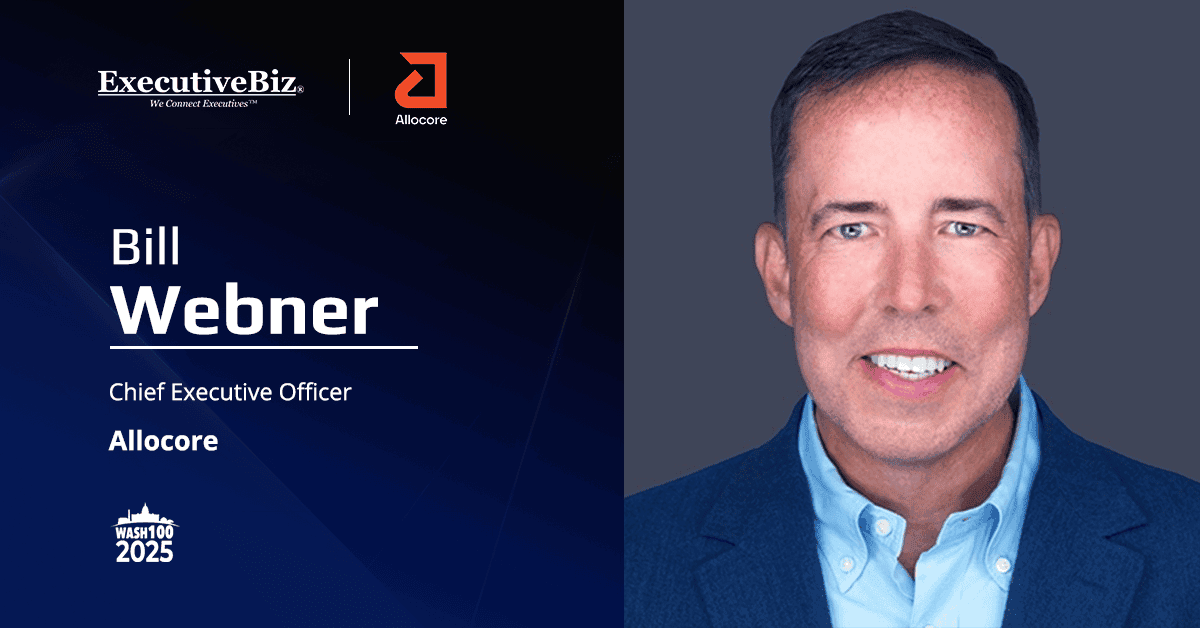
When we last spoke with Bill Webner, the government contracting industry mainstay and multiple Wash100 Award winner, his organization Allocore had just rebranded. For the last 14 months or so, the company has been hard at work bringing its cloud software for government loans, grants and fraud prevention to customers through a major acquisition, FedRAMP High authorization, an AWS partnership and much more.
Coming off these successes, Webner sat down with us to talk about how the federal government can modernize its lending infrastructure using proven commercial technology. In this Spotlight interview, he discusses the challenges facing government IT systems, recent policy reforms creating new opportunities and why the federal lending sector represents an ideal testbed for agile modernization.

Meet and hear from other top GovCon change-makers like Bill Webner at the 2026 GovCon Executive Leadership Summit on Feb. 26! This Potomac Officers Club event will be a meeting of the minds for CEOs, C-suite leaders and other top industry voices. Attend panels on defense technology, acquisition reform, Golden Dome and all of the hot-button issues currently driving GovCon. Register now!
We also spoke with Allocore executive Kathryn Kienast for a Spotlight interview last year.
ExecutiveBiz: What are the biggest technology challenges facing federal lending programs today?
Bill Webner: The federal government manages over 130 distinct lending and credit programs—supporting everything from small business growth to disaster recovery to homeownership. These programs collectively handle hundreds of billions of dollars and affect millions of Americans. Yet many run on aging, fragmented platforms with manual processes that slow fund disbursement and increase risk.
The challenge isn’t a lack of mission clarity or commitment from agency staff. It’s that decades of custom-built systems and siloed workflows have created brittle legacy infrastructure with mounting technical debt. These systems weren’t designed for the digital-first world we live in today, where citizens expect the same seamless experience from government that they get from their banks or fintech apps.
What makes this particularly urgent is that private-sector lenders don’t wait years to modernize—they deploy modern software in six to 12 months with continuous evolution. Federal lending has unique requirements, but core processes like intake, eligibility verification and disbursement map closely to commercial systems. The technology exists. The gap is in how we procure and implement it.
EBiz: How are recent policy reforms changing the modernization landscape?
Webner: We’re seeing a convergence of reforms that fundamentally change how agencies can approach modernization. The Trump administration’s April executive order prioritizing commercially available products joins several other key initiatives: FAR 2.0’s proposed updates encouraging agile procurement, OMB M-24-15’s FedRAMP improvements, expanded other transaction authorities and new customer experience mandates.
One of the most meaningful shifts in FAR 2.0 is how agencies evaluate vendors. Past performance requirements have long been barriers for newer entrants with proven technology. Now agencies can use live product demonstrations and functional testing to assess solutions in real time. For lending programs, this is transformative—agencies can watch platforms process applications, verify documents and detect anomalies under real-world conditions rather than relying on proposals alone.
This makes procurement more competitive and outcome-focused. It also allows commercial products already proven in other sectors to compete on capability rather than just contracting history. Combined with frameworks like Treasury’s FM QSMO marketplace—where Allocore was recently approved—agencies now have clearer pathways to adopt modern solutions without starting from scratch.
EBiz: Why is federal lending an ideal sector for demonstrating agile modernization?
Webner: Federal lending programs check all the boxes for successful commercial-first transformation. They’re high-volume systems processing millions of applications annually. They follow standard, repeatable workflows that map well to configurable platforms. They’re public-facing, which means improvements directly shape citizen perception of government services. And outcomes are measurable—you can tie modernization directly to speed, accuracy, fraud prevention and mission impact.
The Small Business Administration demonstrated this during Covid-19. Faced with urgent need to process emergency loans at massive scale, they implemented a commercial cloud-based solution in weeks, not years. Since launching in May 2020, that system supported origination of more than 7 million PPP loans while significantly reducing fraud, waste and abuse. It proved that speed and integrity aren’t tradeoffs when you use the right tools and agile acquisition approaches.
That example should be the template, not the exception. With the right acquisition strategy, agencies can pilot commercial platforms, validate performance under real conditions and scale quickly. Vendors can offer phased deployments and outcome-based pricing that build trust and demonstrate value before major commitments.
EBiz: How is Allocore supporting this shift toward modernization?
Webner: We’re focused on unifying fragmented government systems into modern, secure, cloud-based infrastructure that brings commercial-grade innovation to federal missions. Our platform powers loans, grants and fraud prevention programs with the same sophistication you’d find in commercial banking—real-time fraud detection, digital onboarding, mobile-first design, analytics—all built to integrate with modern APIs and data standards.
We recently achieved FedRAMP High authorization for our cloud products, which signals to agencies that our platform meets the most stringent federal security requirements. We’ve also launched an AI platform powered by AWS to accelerate federal lending modernization, and we’re rolling out next-generation loan servicing software that addresses gaps in legacy systems. These aren’t just technical upgrades—they’re mission enablers.
What differentiates our approach is that we don’t measure success by scale alone. We measure it by how quickly, safely and confidently a citizen can access funds they’re eligible for. That philosophy—purpose before performance—keeps our work grounded in real-world impact rather than just checking technical boxes.
EBiz: What advice would you give agency leaders considering modernization initiatives?
Webner: Start by embracing the flexibilities now available through FAR 2.0, expanded OTAs and Small Business Innovation Research processes. These aren’t theoretical—they’re real tools that shift procurement from custom development toward product evaluation. Ask vendors to demonstrate, not just describe, how their platforms meet mission needs. Require live demos. Test functionality. Build partnerships with vendors who bring both technical strength and public-sector fluency.
Not every system is suited for agile acquisition, but lending programs are. Use them as testbeds. Pilot commercial platforms with phased deployments and risk-sharing models. Validate performance, then scale. The technology exists and is already proven in adjacent sectors—the barrier isn’t capability, it’s willingness to move differently than we have in the past.
Most importantly, remember that modernization isn’t about making websites run faster. It’s about changing how people become aware of programs available to them and how easily they can access help the government is meant to provide. When a small business owner needs emergency funding, when a family qualifies for assistance—those moments matter. The technology should never be the barrier. That’s the standard we should hold ourselves to.
Who Is Bill Webner?
Bill Webner is a proven government contracting executive who spent 13 years at Booz Allen Hamilton and nearly a decade at the government solutions arm of Capgemini, where he was first vice president and then president, chair and CEO. He joined Summit Technology Group in 2024, and helped assist its rebrand to Allocore in Q4 of that year. Webner is the recipient of two Wash100 Awards, the highest distinction of honor in the GovCon industry.
What Is Allocore?
Allocore is a software company founded in 2007. It first operated under the name Summit Technology Group but was rebranded in November 2024 as Allocore. The company offers a unified platform working to combine government loan, grant and fraud prevention mechanisms. Their platform aims to “power loans, grants and fraud prevention programs with the same sophistication you’d find in commercial banking—real-time fraud detection, digital onboarding, mobile-first design, analytics—all built to integrate with modern APIs and data standards.” Allocore has partnered with AWS, Carahsoft, Experian, Thomson Reuters and others and their platform received FedRAMP High authorization in 2025.