

 Pat Host
- Rocket Lab met a number of quick turnaround timeframes set by the USSF
- These included launch on 24 hours notice and spacecraft commissioning in 72 hours
- Dig into the Case for Interoperable Optical Networks at the 2026 Air and Space Summit!
Rocket Lab has completed and declared mission success for its role in the U.S. Space Force’s Victus Haze Tactically Responsive Space mission, the company announced Tuesday.
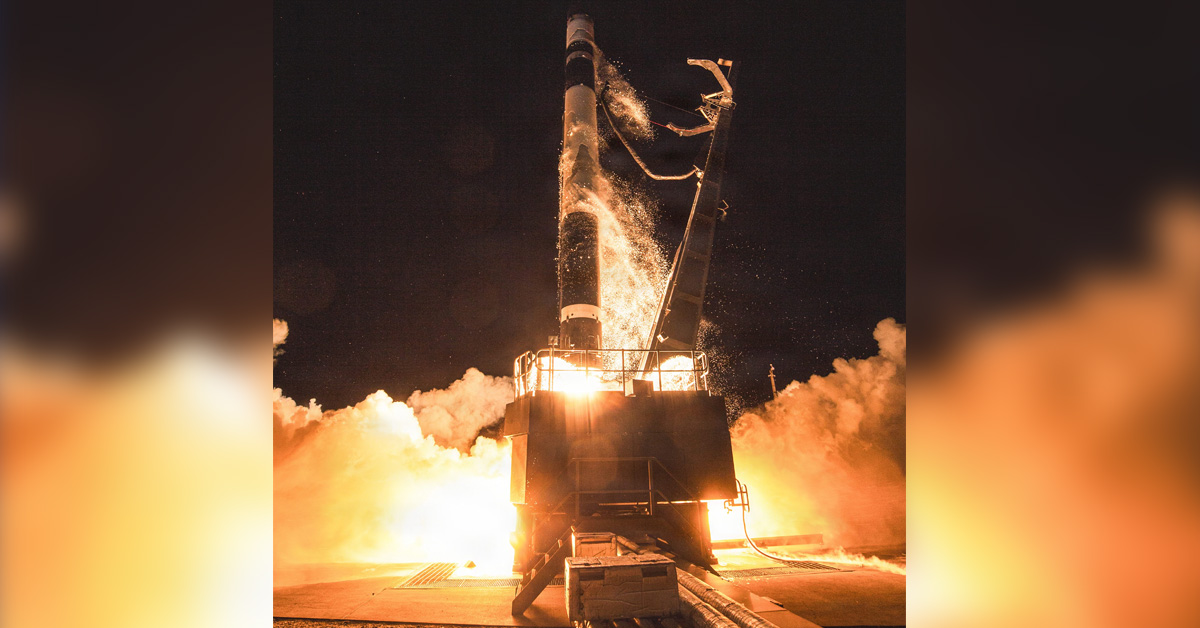
Victus Haze required Rocket Lab to design, build and test one of its Pioneer spacecraft and launch it on its Electron launch vehicle within 24 hours’ notice. It also required the firm to commission the spacecraft within 72 hours before performing challenging rendezvous and proximity operations on-orbit within 84 hours.
The mission culminated with Rocket Lab pursuing, monitoring, approaching and photographing another target spacecraft in a performance of a fast threat-response scenario.
Get the latest partnership opportunities in advanced space technologies at the Potomac Officers Club’s 2026 Air and Space Summit on July 30! Evaluate encryption, standards and scalability for future networks and how to secure real-time data relay across multi-domain architectures at the Case for Interoperable Optical Networks panel discussion, featuring top industry and government officials. Secure your seat today!
What Was Unique About Rocket Lab’s Approach to Victus Haze?
Rocket Lab’s approach to Victus Haze was unique because typical space missions depend upon a variety of contractors for satellites, rockets and space operations, Rocket Lab provided all three for Victus Haze. This is the first time, according to the company, that a single prime contractor has delivered an entire all-in-one mission for the TacRS effort.
Peter Beck, Rocket Lab founder and CEO, said the company’s performance in Victus Haze set a new standard in responsive space.
“Delivering a fully integrated and complete mission capability when the clock is ticking is a proud moment for the Rocket Lab team in a long history of delivering mission success for the United States and its allies,” Beck said. “Now that the primary mission is complete, we look forward to continuing to push Pioneer on orbit under new and complex Space Force task orders to deliver new capabilities.”
Rocket Lab, on June 19, launched the Victus Haze mission in 16 hours, 42 minutes after receiving the notice to launch from the USSF. It completed spacecraft commissioning within 38 hours, more than 30 hours ahead of the service’s 72-hour deadline.
The company executed rendezvous and proximity operations on orbit in fewer than 59 hours, which was 25 hours ahead of the USSF’s 84-hour deadline.
Are you a GovCon technology executive? You cannot afford to miss Potomac Officers Club’s 2026 Air and Space Summit on July 30. Get exclusive investment insights to tailor your offerings for increased contracting success from our keynote speaker lineup of esteemed federal technology officials:
- Tom Ainsworth, Air Force acting assistant secretary for space acquisition and integration
- Matt Anderson, NASA deputy administrator
- Anthony Baity, Air Force assistant deputy chief of staff for logistics, engineering and force protection
- Gen. John Lamontagne, Air Force vice chief of staff
- Dr. Eliahu Niewood (pending confirmation), Air Force director for integrated capabilities
Buy your ticket now for this highly-regarded GovCon conference!
What Was Victus Haze?
Victus Haze was a TacRS space mission to provide the USSF with data, technology and operational experience to regularly achieve rapid response space missions. Victus Haze was a multi-launch, multi-vehicle mission conceived to develop the U.S. ability to quickly acquire, launch and operate space vehicles on operationally-relevant timelines in response to critical on-orbit challenges.
This was the second of two launches for Victus Haze. A previous mission launch delivered True Anomaly’s Jackal space vehicle via a SpaceX Falcon 9 rideshare on May 3.
Victus Haze also had partnerships with other industry stakeholders:
- A Defense Innovation Unit teaming arrangement on Rocket Lab’s effort to leverage its commercial market expertise with its commercial solutions opening and other transaction authority to quickly award.
- A SpaceWERX partnership on the True Anomaly effort to award a Strategic Funds Increase, or STRATFI, which enabled a second end-to-end system that boosted overall mission utility.
- An exquisite Lawrence Livermore National Laboratory optical payload hosted on the Rocket Lab space vehicle.
- A partnership with the Space Domain Awareness Tools, Applications and Processing Lab under Space Systems Command’s Delta 85.
- A teaming arrangement with the Aerospace Corp.
What Is Tactically Responsive Space?
Tactically Responsive Space is a USSF effort to develop the industrial base skills and capacity to launch and deliver advanced space technologies to orbit with as little advance notice as necessary. Victus Haze used two rockets and two satellites for additional testing and learning, according to the Center for Strategic and International Studies think tank.
What Is Rocket Lab?
Rocket Lab is a vertically-integrated company that provides launch services, spacecraft, payloads and satellite components to government, commercial and national security customers. It recently acquired Tysons Corner, Virginia-based Iridium in an estimated $8 billion cash and stock deal to add spectrum and on-orbit communications services to its product offerings.