
 Pat Host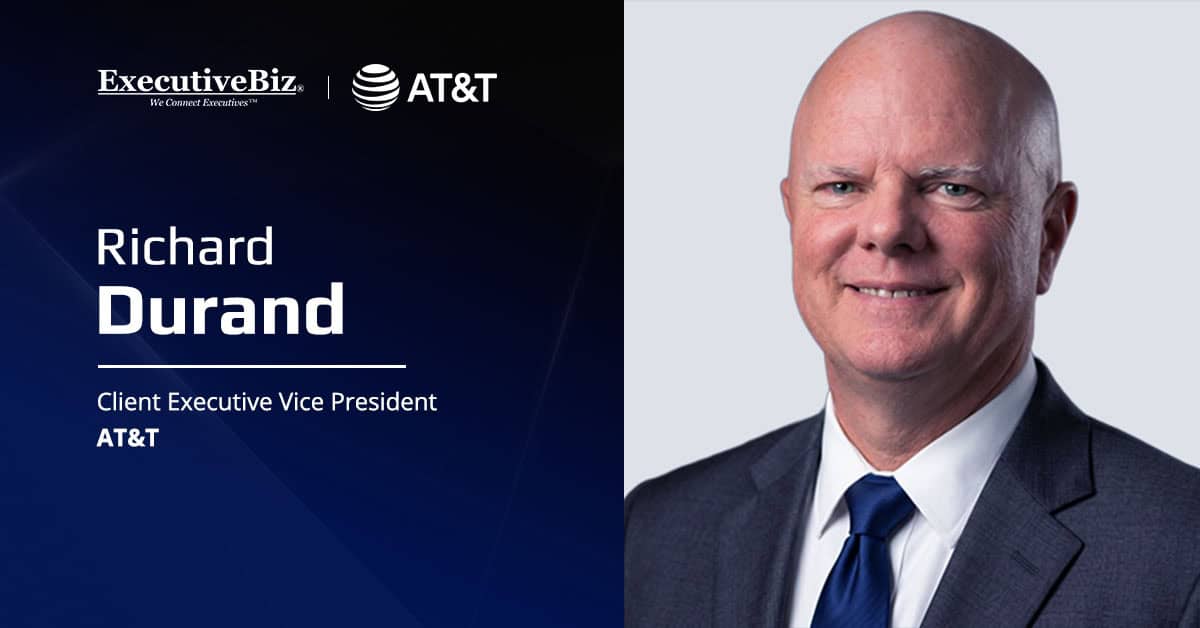
- AT&T EVP Richard Durand has spent more than 30 years supporting national security customers with transformational information and network technology solutions.
- He was recently appointed to the Intelligence and National Security Alliance’s board of directors after previously serving on its advisory committee.
- Durand sat down with ExecutiveBiz to discuss AI-native networking, prioritizing security while embracing COTS technologies and the future of wireless communications.
The mission-focused nature of GovCon is magnetic to Richard Durand. The AT&T client executive vice president and Navy Reserve veteran has spent more than 30 years at the company supporting national security customers by designing, deploying and operating transformational information and network technology solutions.
Federal agencies have challenging problems while executing critical national security missions. That’s where Durand comes in. He directly supports a broad range of technical disciplines including converged mobile, voice and data networks, cloud enablement, data analytics and AI, helping federal customers achieve their technology goals in service of the nation.
Durand, who has spent over nine years as client EVP, oversees a highly skilled team delivering strategic technology services focused on network transformation, infrastructure modernization, wireless communications and more.
He sat down with ExecutiveBiz for his latest Spotlight interview to discuss navigating the intelligence community’s complex wireless communication priorities, which commercial off-the-shelf technologies could fuel the latest intelligence technology advancement and how federal customers continue to use land-based wireline and fiber communication to support their missions.
Check out a Spotlight interview with Durand from March 2022 on the role of 5G in national security.
Dive into new business opportunities in cybersecurity, AI and data at the Potomac Officers Club’s 2026 Intel Summit on Sept. 24! Network with other ambitious GovCon executives and score that big contract. Engage with senior intelligence leaders in an environment designed for collaboration and clarity. Build your expertise on how technology is transforming the fast evolving intelligence space. Sign up now!
ExecutiveBiz: How do you navigate the complexity of the IC’s competing priorities and concerns around wireless communications?
Richard Durand: I am aligned to AT&T’s national security group and lead our team that supports many of our IC, foreign affairs and other national security clients. One of AT&T’s foundational principles is: we start with the customer first, period. That’s really our guide for navigating the complexities of which you’re referring.
That doesn’t mean it’s always easy. The IC is not homogeneous. Each organization has its own mission focus and priorities based on its charter. Some agencies are focused on enterprise IT operations and how to support their mission more efficiently through technology. Others are focused on supporting unique operational missions around the globe.
As you can imagine, deploying wireless capabilities in the IC comes with significant challenges, which have only increased given today’s global threat environment. There are government policies that restrict radio frequency-emitting devices inside certain agency facilities. So while we absolutely support wireless capabilities across the IC, that doesn’t mean everyone is walking around inside these buildings with mobile devices.
We continue to take an “outside-in” approach. We’re seeing faster adoption on the operational mission side globally than we are on the enterprise IT side, although some agencies are leaning in more than others. Ultimately, it comes back to understanding the customer’s mission, identifying the problem they’re trying to solve and determining where wireless technology makes sense for that use case.
EBiz: How would you characterize the relationship between the IC and commercial markets for 5G and next-generation application tools? What commercial off-the-shelf capability could drive the next major intelligence technology advancement?
Durand: Anyone who’s been around the federal government for a while understands there will always be mission requirements that commercial off-the-shelf technology, or COTS, simply can’t address. But over time, government research and development budgets and government-led technology development have diminished outside of some very niche areas.
As a result, the government is clearly moving toward greater adoption of commercial technologies and the current administration has been very direct about that interest. That said, there are still areas where commercial technology alone won’t be enough. In wireless, specifically, one of the next major shifts for the IC will likely be the convergence of advanced standalone 5G networks with embedded AI and agentic AI capabilities.
This evolution is often described as “AI-native networking.” It moves beyond simple connectivity toward autonomous, intelligent and secure data processing at the tactical edge. We’re seeing discussions across the industry around bridging advanced 5G and future 6G environments through capabilities like enhanced uplink performance for AI workloads, private standalone 5G with network slicing for dedicated low-latency environments and tighter integration with satellite and non-terrestrial networks.
That combination of terrestrial and satellite connectivity will be especially important for supporting operations in remote, underserved and austere environments.
EBiz: How do you protect the sensitive security requirements of intelligence agencies while embracing commercial off-the-shelf technologies?
Durand: Over time, a lot of this will evolve through quantum-resilient encryption. Today, the government is already working closely with industry to protect sensitive data using government encryption standards.
Ultimately, the government must balance risk against operational need. Depending on the use case, agencies may decide they require protections above and beyond what’s already built into commercial 5G standards. That said, every generation of wireless technology has incorporated stronger security capabilities through standards bodies like the Third-Generation Partnership Program, or 3GPP.
We’ve come a long way from the early generations of wireless. I was recently at a symposium where people were confirming that there are still some 2G networks operating somewhere in the world. We’ve already retired our 3G network in the U.S. Each new generation has improved native security, but in many government scenarios, customers will still require additional layers of protection.
Are you a GovCon technology professional? Then you cannot afford to miss the Potomac Officers Club’s 2026 Intel Summit on Sept. 24. Get actionable business intelligence in capabilities at panel discussions on open-source data, agentic AI, open-source intelligence and more. Tailor your solutions for federal needs by attending illuminating keynotes by top federal intel officials. Engage with sponsors shaping the future of intelligence technology. Secure your seat today for this highly-anticipated GovCon forum!
EBiz: What’s wireline? Is that basically landline?
Durand: Yes. In our world, we generally talk about wireless and wireline. Increasingly, though, we refer to wireline as fiber because that’s the underlying infrastructure to which most legacy terrestrial networks are transforming.
EBiz: I’ve asked several questions about wireless communications, but what about wireline? How are your customers continuing to use wireline and fiber-based communications to support their missions? And where does AI fit into that?
Durand: It’s interesting because wireless and wireline are often discussed separately, but the industry is really moving toward converged networks. AT&T is well-positioned there because we have significant fiber and spectrum assets.
Ultimately, all wireless communications transition onto fiber infrastructure as quickly as possible because fiber provides significantly greater bandwidth and much better economics than wireless or satellite alone. Fiber remains the primary choice for fixed government locations, whether large agency headquarters or smaller facilities.
At the end of the day, customers simply want seamless connectivity. They want to turn on their computer, tablet or phone and have it work. Government customers, of course, are also deeply concerned with what’s happening underneath the hood: how the network operates, how it’s secured and its resiliency.
That’s why we provide flexible solutions based on the mission requirement. For example, if we’re connecting a large government facility, fiber may serve as the primary connection while fixed wireless or satellite acts as a backup or tertiary capability.
We continue to support a wide range of fiber-based services, including legacy Multiprotocol Layered Switching, aka MPLS, networks, Layer 2 Ethernet, AT&T Dedicated Internet and software-defined wide area network, or SD-WAN, solutions that are increasingly replacing older MPLS environments because they provide comparable quality with better economics.
We really think about this as a converged networking strategy. Whether the customer is accessing the network wirelessly, over fiber or through cloud connectivity, the goal is to make it all work seamlessly together.
As for AI, it now touches nearly everything we do. You can’t go an hour without AI coming up in meetings, the news or daily life. AT&T’s work in AI is rooted in a long history of innovation dating back nearly 150 years to Alexander Graham Bell’s first phone call and later Bell Labs, which helped pioneer breakthroughs in computing, information theory, signal processing and communications.
Today, AT&T isn’t out selling a ‘whiz-bang’ AI product. What we are doing is building and operating networks capable of supporting AI workloads for customers.
Internally, AI has become critical to how we operate as a communications technology company. We use AI across network operations, cybersecurity, customer experience, software development, internal productivity and decision support. We’re also rolling out AI capabilities across our employee base to accelerate work, simplify processes and support employees in new ways.
It’s really a story of continuous evolution—from the first phone call to machine learning to today’s AI-enabled operations that improve how we serve customers and run our business.
EBiz: In your role at AT&T, how else do you and your team support customers in executing their missions?
Durand: It really comes back to that foundational principle: we start with the customer first, period.
AT&T has a very broad portfolio of enterprise products and services, many of which are tailored specifically for federal customers. But, as you know, many government agencies have highly-unique missions and often don’t have the internal resources or expertise to manage every aspect of these increasingly complex environments.
That’s where we come in. Beyond delivering connectivity and services, we augment those capabilities with cleared personnel who understand customer environments, meet all security requirements and can work side-by-side with government teams.
We frequently have personnel embedded with customers, operating networks, supporting cyber operations and helping execute mission requirements. We do this globally. Running and maintaining these networks is complicated work, but it’s critically important. My team and our broader national security organization take a great deal of pride in supporting those missions.