
 Pat Host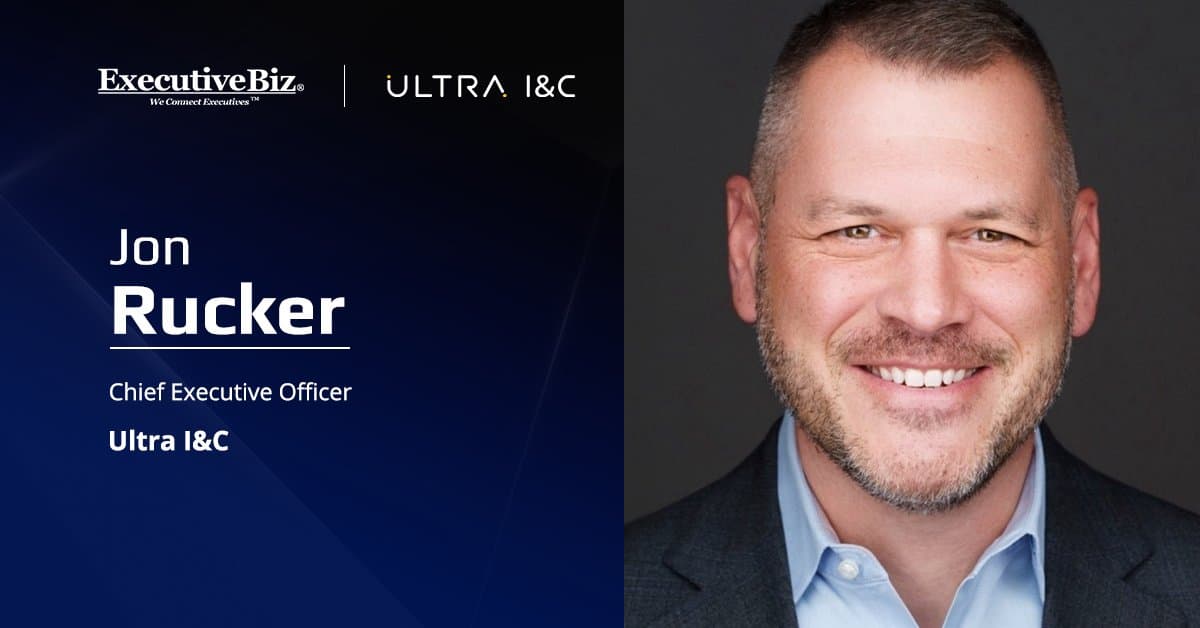
- Jon Rucker, CEO of Ultra I&C, believes clarity and alignment are force multipliers
- He learned over his long GovCon career that executives need to be disciplined in execution while moving at the speed of innovation, an essential balance
- Rucker sat down with ExecutiveBiz to talk mission continuity and resilience, AI and closing data integration gaps
Jon Rucker believes that clarity and alignment are force multipliers. The Ultra I&C CEO and two-time Wash100 Award winner has built a company culture that pairs urgency with accountability because, as he tells it, everything traces back to the customer and operator in the field.
Rucker, a veteran GovCon executive with leadership stops at industry stalwarts Lockheed Martin, CACI and SAIC, learned over his career that executives need to be disciplined in execution while still moving at the speed of innovation. This balance doesn’t happen by accident.
Firms move faster when they understand the problem early and stay closely connected to the customer through development. At Ultra I&C, that means building technology that is modular, interoperable and validated in real-world environments, so it can accelerate capability without compromising the trust operators place in the company.
Rucker sat down for his latest Spotlight interview to discuss how to close the biggest remaining interoperability or data integration gaps, how Ultra I&C approaches connecting disparate systems and data without increasing operator complexity, how the company is helping operators overcome mission environments oversaturated with data and how Ultra I&C is accelerating the process of turning concepts into fielded capabilities.
Check out our previous Spotlight interviews with Rucker:
- On Ultra I&C’s exciting recent projects and initiatives (December 2025)
- Why humans must be kept in the loop for ethical AI use (May 2023)
Discover trusted data sharing across classification domains and modernizing multi-level security architectures for warfighters at the From Data to Decision panel discussion at the Potomac Officers Club’s 2026 Air and Space Summit on July 30! Get the latest business opportunities and investment insights from top Pentagon officials, including:
- Steve “Bucky” Butow, Defense Innovation Unit senior advisor to the director and executive committee member
- Dr. Merrick Watchorn (pending confirmation), Air Force chief cyber, quantum and cognitive information services architect
- Col. John Ohlund, Air Force Advanced Battle Management System Cross Functional Team lead
ExecutiveBiz: With Ultra I&C positioned as an enabler of powering decision-making across multiple domains and layered systems, what do you see as the biggest interoperability or data integration gaps that need to be solved? What will it take to close them?
Jon Rucker: Our purpose as a company is to power decision and we do that by closing the gap between domains and systems to bring speed, relevance and accuracy to the warfighter.
One of the biggest challenges today is that critical mission data still resides across disconnected systems, platforms and domains that were never designed to work together, let alone at the speed modern operations require. Operators are often forced to bridge those gaps manually, which slows decision-making in environments where time matters most.
Another challenge is that the volume of data continues to grow dramatically, but the ability to move, secure, interpret and prioritize that data in contested environments hasn’t kept pace. The future fight will depend on trusted data reaching the right decision-maker at the right time, with confidence.
Closing those gaps requires real commitment to open architectures, common interoperability standards and solutions that integrate across existing infrastructure without adding burden to the operator. It also requires tighter collaboration between industry and government to accelerate integration and fielding timelines.
EBiz: Continuing on the theme of system and data integration, how is Ultra approaching connecting disparate systems and sensor data without increasing the complexity for operators and end users?
Rucker: Our philosophy is that technology should reduce complexity, not add to it. Operators already manage enormous amounts of information under pressure, so we focus on solutions that securely connect existing systems, efficiently move data and surface actionable information in real time.
Success, for us, is measured by how much faster and more confidently an operator can make a decision. We built solutions under our software stack, Apex, that gives operators what they truly need with an open architecture.
Boost your technology revenues in FY 2027 with the Potomac Officers Club’s 2026 Air and Space Summit on July 30! Our stellar keynote speaker lineup of the top Pentagon and NASA officials will prepare you with the knowledge to win more, and larger, technology contracts:
- Gen. John Lamontagne, Air Force vice chief of staff
- Matt Anderson, NASA deputy administrator
- Tom Ainsworth (pending confirmation), Air Force acting assistant secretary for space acquisition and integration
- Anthony Baity, Air Force assistant deputy chief of staff for logistics, engineering and force protection
- Dr. Eliahu Niewood (pending confirmation), director of integrated capabilities
EBiz: Mission environments continue to evolve. As an example, they’ve become more distributed, more contested and almost oversaturated with data. How is Ultra helping operators overcome these challenges and maintain the advantage in a degraded environment?
Rucker: Resilience is one of the defining requirements of the modern battlespace. Operators can no longer assume persistent connectivity or uncontested network access. Ultra I&C is focused on enabling mission continuity in those environments, delivering technologies that move, secure and interpret critical data even when networks are degraded or denied.
We’re also investing in capabilities that reduce cognitive burden by prioritizing mission-relevant information, so operators can act with speed and confidence, despite the complexity around them. We leverage AI with human-on-the-loop capability to sort the most important inputs from the user, clearing information from oversaturated environments.
EBiz: Developing advanced defense technology hasn’t historically been “agile,” and with the push to bring capability to the field at the speed of readiness, companies across the defense tech ecosystem are trying to accelerate delivery to the warfighter. How does Ultra accelerate the process of turning concepts into fielded capabilities?
Rucker: Speed comes from staying closely aligned to the mission and the customer throughoutdevelopment. The earlier and more thoroughly you understand the operational problem, the faster you can iterate toward something meaningful and deployable. We’ve built our organization to combine deep technical expertise with continuous user feedback and we focus on integrating with existing systems, so customers don’t have to replace entire infrastructures to adopt new capability.
Equally important is culture. You need teams that are empowered to make decisions quickly and comfortable taking calculated risks based on real operator input.