
 Charles Lyons-Burt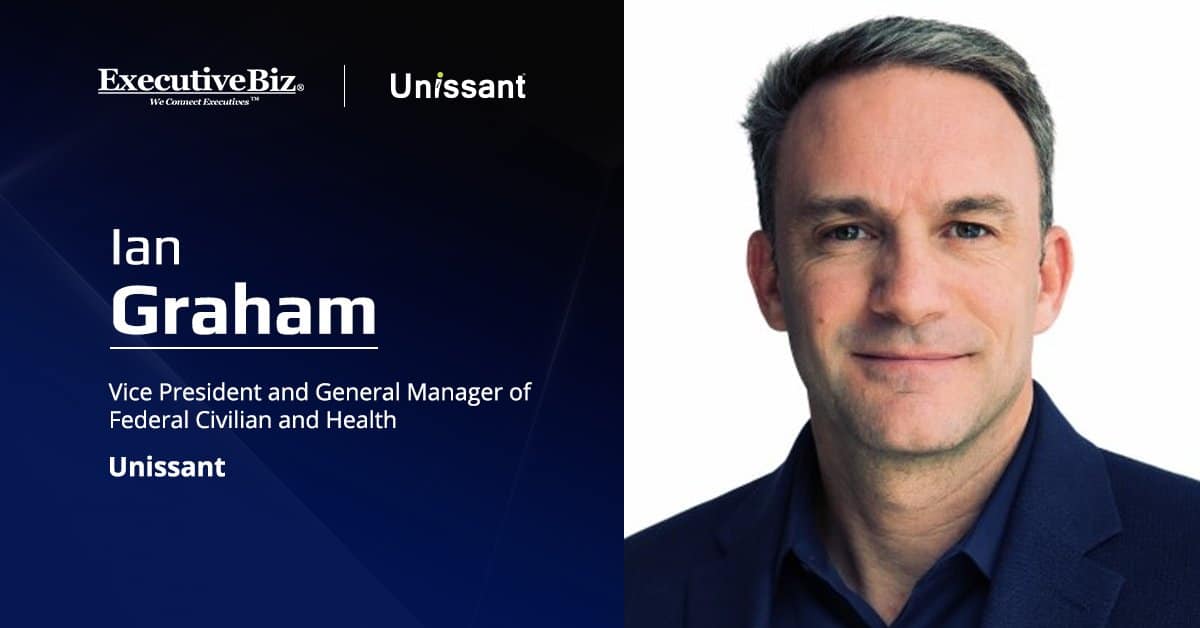
Over a career spanning more than 25 years, Ian Graham has led federal technology, data and modernization initiatives supporting missions ranging from military readiness and disaster response to public health and patient safety. As vice president and general manager of federal civilian and health programs at Unissant, he now leads teams focused on helping agencies modernize operations and make better use of data and AI.
Before joining Unissant in 2023, Graham held leadership positions at NetImpact Strategies, Octo and CACI, helping federal agencies advance health IT modernization, data analytics and digital transformation efforts. His experience includes work supporting agencies through major national events and mission challenges, including post-9/11 readiness initiatives, environmental response efforts following Hurricane Sandy and the BP oil spill, patient safety programs and COVID-19 data analysis.
In this Executive Spotlight interview, Graham discusses how agencies can move AI beyond short-term pilot programs, evolving attitudes toward AI-enabled decision support, Unissant’s mission-focused culture and the company’s long-term growth strategy.
ExecutiveBiz: The government is slow to adopt and consume AI. When they acquire it, it’s a proof of concept and only lasts for 90 days. How are you maturing the AI, expanding it or growing it to get it beyond that proof of concept?
Ian Graham: We see that pattern across the government. AI efforts tend to stall when they’re deployed as isolated pilots, rather than as part of how the organization actually runs. A 90-day proof of concept can show that a model works. It does not prove that an agency can govern it, accredit it, integrate it into the workflow, or get users to trust it in a live mission environment.
Our approach is to treat AI as an enterprise capability, which starts with having a deep understanding of the mission. Our teams are not coming in with a generic tool and looking for a problem. We have senior technologists who understand how the mission runs, where the data comes from, who needs to use it, what has to be auditable, what security and compliance constraints apply, and where a human has to remain accountable. That mission knowledge is what allows AI to move from a demo into something people can actually use.
To set up for scale, we build for repeatability from the beginning. We’ve established a governed AI mission operating fabric composed of interoperable AI accelerators called Unissant MissionWorks. This creates reusable architecture, services, controls and governance patterns so agencies do not have to rebuild the AI stack every time a new use case emerges. That is the difference between a pilot and an enterprise capability.
We have seen this in our national security work, where Unissant helped move from fragmented AI efforts to a shared-services model that allows multiple applications to consume common AI capabilities through a governed architecture. That model supports production use cases such as policy search, report summarization, multilingual analysis and threat-indicator detection. The impact has been measurable: three generative AI applications are live in production, one threat-analysis workflow moved from 24 to 48 hours to under 15 minutes, and once the common services and governance model was in place, onboarding additional AI applications moved from roughly six months to as little as three weeks.
n federal health, the same principle applies. AI only creates value if it is tied to the work agencies actually need to perform. In one mission environment, we have applied AI-driven policy management to help align cybersecurity policies with laws and regulations, reduce compliance errors and accelerate policy adoption. It is a good example of why AI in regulated environments has to be designed around security, auditability, compliance and user trust from the start.
So for us, maturing AI beyond a proof of concept comes down to customer trust, mission knowledge and technical execution. That is what allows us to design AI for real mission use from day one and then turn the first successful use case into reusable architecture, controls and services that can scale across the enterprise.
EBiz: What has changed in the last six months in terms of government risk tolerance around AI-enabled decision-making?
Graham: These days, the question is almost as much about what has changed in the last six weeks. I do not think agencies have suddenly become comfortable with more risk. I think they have become more precise about the conditions under which AI risk is acceptable.
A year ago, many conversations were still centered on the potential of generative AI. Today, agencies are focused on how to deploy it responsibly in real mission environments. They are asking: What is the use case? What data is being used? What source material supports the output? Who can access it? How is it reviewed? What happens if the model is wrong? How do we audit it? And most importantly, is the AI supporting human judgment, or is it becoming the basis for an action?
That is the real shift in risk tolerance. Agencies are more willing to move forward when AI is framed as governed decision support, when the controls are built in from the beginning, and when there is a repeatable path to monitor, audit and improve the capability over time.
For us, responsible AI means designing provenance, security, access controls, compliance alignment, guardrails and human oversight into the architecture before it is put into mission use. The goal is not autonomous decision-making without accountability. The goal is trusted AI-enabled decision support that users can understand, monitor and rely on.
We have learned that by doing this work in real mission environments. For example, we have helped a federal customer establish a governed AI model where multiple applications can use common AI services through approved architecture, security controls and oversight. That does not just increase confidence in the technology. It increases confidence in the operating model around the technology.
Overall, we’re seeing that agencies are willing to move faster when the mission use case is clear, the right controls are in place, human oversight is preserved and they are working with partners who have already shown they can operationalize AI responsibly in complex federal environments.
EBiz: Tell me about Unissant’s culture and values and what appeals to you about the company.
Graham: Unissant is mission‑obsessed. That shows up every day in how we make decisions and how we execute our work in support of our federal customers. There is a clear focus on outcomes, not just deliverables, which is exactly where our customers are heading as they modernize and become more data‑driven.
Unissant grew up over the past 20 years as an IT-focused company, but when I ask our team members why they do what they do, their answers are always about the mission and how data can help real people. Our folks know why they do what they do. They can be deep in the weeds and still stay anchored to the larger purpose of their work, and they understand that data is a mission asset, not just a technical problem to solve.
What stands out to me about Unissant is the combination of that outcome‑focused discipline with real momentum. The company is growing and moving with purpose, and that energy is directed at the right challenges, helping agencies turn data, analytics and AI into better decisions and better services.
I have spent time in both entrepreneurial settings and very large organizations. What I value most is being in a place where people can move quickly, stay close to the mission and see the impact of their work. Unissant has that balance. It is structured enough to scale and to meet the rigor our government customers expect, but still agile enough that individuals and teams can innovate and make a visible difference.
EBiz: Can you share about Unissant’s growth outlook for the next five years? What meaningful steps have to be taken to achieve it?
Graham: I think Unissant’s growth outlook over the next five years is reflected in how we responded to the past year. During a period of federal market uncertainty and increased scrutiny on spending, a lot of companies went into wait-and-see mode. We took the opposite approach and leaned in.
We continued investing in our people, our customers, our solutions, and our growth because we believe the areas where Unissant is strongest are exactly where government is headed.
In federal health, that means helping agencies improve interoperability, claims and clinical workflows, policy management, payment integrity, data exchange, and decision support in highly regulated environments. In national security, it means helping agencies move faster with secure mission systems, advanced analytics, responsible AI, and operational workflows that support investigators, analysts, officers, and mission users in the field.
The common thread is that our growth is built around taking the mission knowledge we already have, the trust we have earned with customers and the technical capabilities we have proven in real environments, and turning that into repeatable value. Our AI-enabled accelerators are part of that. They allow us to capture what we have learned in production and apply those lessons faster across new programs and mission areas.
The meaningful steps ahead are about continuing to invest with discipline. We have to keep building a workforce that is both mission-literate and AI-fluent. Our teams need to understand the technology, but they also need to understand the agency’s mission, the data, the users, the compliance requirements and the outcomes the customer is trying to achieve. That combination is what allows us to move beyond isolated modernization efforts and deliver capabilities that actually change how work gets done.
If we continue to invest in our people, strengthen our customer relationships, mature our reusable capabilities and stay relentlessly focused on mission outcomes, I believe the growth will follow.
Who Is Ian Graham?
Ian Graham is vice president and general manager of federal civilian and health programs at Unissant. He has more than 25 years of experience leading federal technology, data and modernization programs, with previous leadership roles at NetImpact Strategies, Octo and CACI. Graham specializes in helping agencies apply data, analytics and emerging technologies to mission challenges across health, civilian and national security environments. He holds a bachelor’s degree from James Madison University.
What Is Unissant?
Unissant is a federal technology contractor that provides artificial intelligence, data analytics, cybersecurity and digital modernization services to government agencies. The company supports customers across health, civilian and national security markets, with a focus on helping agencies improve decision-making, strengthen mission performance and deliver better services through technology and data.