
 Gabriella DeCesare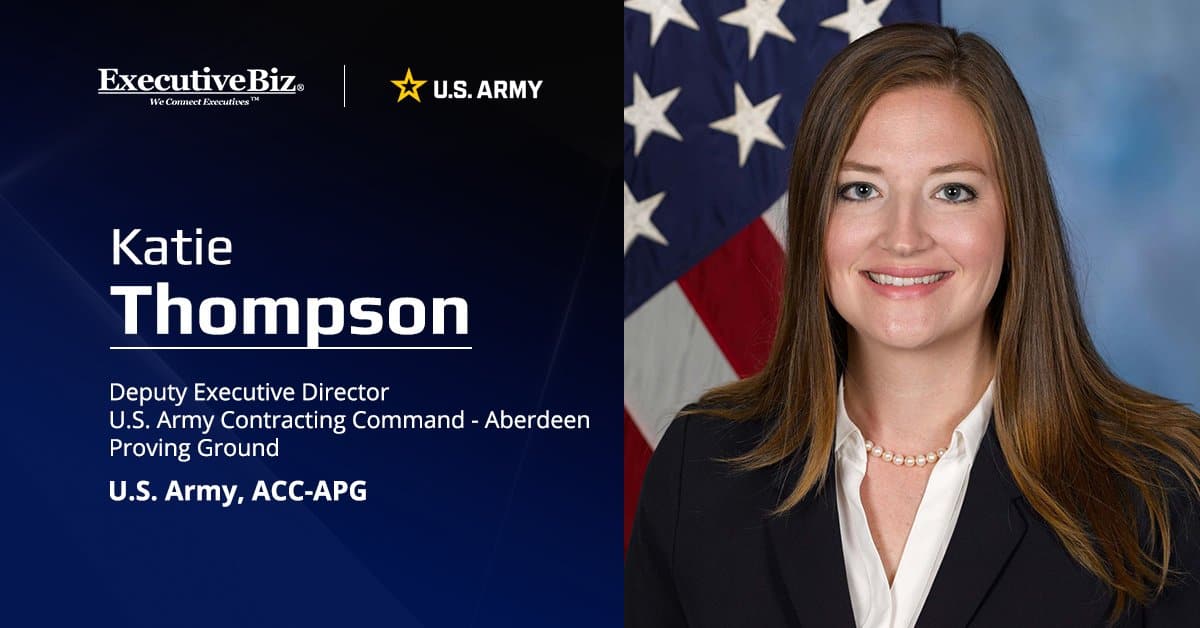
Army contracting is undergoing a major shift as the service works to move capabilities to soldiers faster, reduce procurement timelines and create acquisition strategies tied more directly to mission outcomes.
Katie Thompson, deputy executive director of Army Contracting Command-Aberdeen Proving Ground, said her highly anticipated upcoming keynote at Potomac Officers Club’s 2026 Army Summit will focus on how ACC-APG is rethinking acquisition to better support operational results. That includes outcome-based contracting, smarter procurement strategies and a renewed emphasis on reducing lead times.

“My keynote is really going to focus on how Army Contracting Command-Aberdeen Proving Ground is changing the way we think about acquisition in order to move capability to soldiers faster,” Thompson said.
The Army’s acquisition transformation is occurring amid a broader Pentagon-wide push to accelerate capability delivery and strengthen the defense industrial base. Senior defense leaders have increasingly emphasized the need to shorten procurement timelines, leverage commercial innovation and field emerging technologies at the pace required by rapidly evolving threats.
As the Army accelerates acquisition reform and modernizes how it delivers technology to the force, understanding the latest contracting priorities has become essential. The 2026 Army Summit on June 18 will provide a unique opportunity to hear directly from Katie Thompson during the event’s opening keynote as she discusses acquisition transformation, procurement reform and the strategies ACC-APG is implementing to move capabilities to soldiers faster. Register today to gain firsthand insight into the future of Army contracting and connect with the leaders driving modernization across the service.
How Is ACC-APG Changing Its Approach to Acquisition?
According to Thompson, ACC-APG is working to build a culture of “common sense contracting” that empowers acquisition professionals to think critically, engage industry earlier and develop contracts that incentivize innovation and performance.
Rather than focusing solely on process compliance, the command is placing greater emphasis on measurable outcomes, operational impact and speed of delivery. Thompson said ACC-APG is also looking at how to maximize procurement dollars through enterprise approaches, stronger negotiations and better use of the Army’s buying power at scale.
The shift aligns closely with the Army’s ongoing effort to transition from process-centric acquisition models toward outcome-driven procurement strategies.
“We’re talking about things like outcome-based contracting, reducing procurement lead times and building smarter acquisition strategies that are tied directly to operational results, not just process compliance,” Thompson said.
The service’s modernization priorities, including network transformation, artificial intelligence, long-range precision fires, contested logistics and next-generation command and control, have increased pressure on acquisition organizations to adopt more agile contracting approaches. As a result, contracting commands are increasingly being asked to serve as strategic enablers of modernization rather than solely as procurement administrators.
Why Should Industry Pay Attention to the Army Open Solicitation?
Thompson highlighted one under-discussed opportunity for industry—the Army Open Solicitation, a continuously open solicitation vehicle designed to help innovative technologies reach Army decision-makers faster.
“One area people should really be paying attention to is the Army Open Solicitation, or AOS,” Thompson shared, “What makes it different is that it dramatically reduces the amount of bureaucratic overhead typically associated with getting a new idea in front of the government.”
AOS reduces friction for companies seeking to introduce new capabilities to the Army which could be especially valuable for small businesses and nontraditional contractors that may not have large proposal teams or experience navigating lengthy acquisition processes.
For GovCons, AOS represents a clearer pathway to move from concept to capability and gain visibility with Army buyers.
The Army Open Solicitation also reflects a broader Department of War effort to attract nontraditional defense contractors and commercial technology providers. Similar to initiatives such as the Defense Innovation Unit’s commercial solutions opening process and expanded use of other transaction authorities, AOS is designed to lower barriers to entry and make it easier for emerging technology companies to engage with the defense market.
As the Army seeks to incorporate advances in AI, autonomy, software and data analytics, officials increasingly recognize that many of the most innovative solutions are being developed outside traditional defense contracting channels.
How Will AI and Automation Shape Army Contracting?
ACC-APG is also looking to artificial intelligence and automation to reduce execution timelines and eliminate repetitive administrative tasks.
“In contracting we’re really focused on acquisition speed and furthering our use of AI tools and automation to support that,” Thompson said, “These technologies are helping us significantly reduce execution timelines and time spent on repetitive tasks.”
By using these tools, Thompson said contracting professionals can spend more time on higher-value work such as negotiations, critical thinking and collaboration with customers and industry. For contractors, this signals a future in which procurement cycles become faster, more data-driven and more focused on measurable performance.
As the Army streamlines contracting processes and empowers contracting officers to make faster decisions, staying current on evolving procurement strategies is a competitive necessity for GovCon leaders. At the 2026 Army Summit, attendees will hear directly from Thompson as well as many other senior Army acquisition and modernization leaders discussing the policies, priorities and reforms reshaping the defense acquisition landscape.
Why These Changes Matter for the Defense Industrial Base
For GovCons, the Army’s contracting transformation is part of a broader shift in how future business opportunities may emerge. Contractors that can demonstrate operational impact, adapt to evolving requirements and engage through flexible acquisition pathways gain a competitive advantage.
“Industry needs to stay agile and be willing to engage through flexible acquisition pathways and iterative development approaches,” Thompson emphasized.
The changes also suggest that traditional procurement timelines could continue to shrink as the Army seeks to accelerate modernization across key priority areas, including AI, autonomy, cybersecurity, network modernization and contested logistics. For industry, success may depend less on navigating lengthy acquisition processes and more on delivering scalable solutions that address urgent operational needs.
“I would also encourage companies not to be afraid of proposing ideas that challenge the status quo,” Thompson said. “Some of the best innovations come from industry bringing forward approaches the government may not have initially considered.”
What Should Contractors Do to Stay Competitive?
Thompson said companies that want to stay competitive must remain agile and understand the Army’s acquisition priorities.
“The companies that will be most successful are the ones that understand the Army is increasingly looking for speed, adaptability and measurable outcomes, not just traditional long-cycle procurement models,” said Thompson.
Industry should also be thoughtful about where its solutions fit, target the right opportunities and take advantage of flexible pathways like AOS.
As the Army modernizes its acquisition enterprise, companies that can deliver innovative, mission-ready solutions quickly will be best positioned to support the service’s evolving priorities.
To learn more, join Thompson and other senior Army, government and industry leaders at the 2026 Army Summit on June 18, where attendees will gain exclusive insight into contracting modernization, acquisition priorities and the technologies shaping the future force. Register now to stay ahead of the Army’s rapidly changing procurement environment and build connections with the decision-makers driving the next generation of defense acquisition.