
 Kristen Smith
- HII’s ROMULUS was selected for the Navy’s next phase of MUSV evaluations
- Successful MUSV demonstrations could position ROMULUS for future production awards
- The selection highlights growing Navy interest in autonomous maritime capabilities
HII’s ROMULUS has advanced to the at-sea testing phase of the U.S. Navy’s Medium Unmanned Surface Vessel initiative, positioning the USV for potential follow-on production opportunities.
“HII is proud that ROMULUS USV has advanced to the U.S. Navy’s Medium Unmanned Surface Vessel evaluation phase, a milestone that reflects HII’s longstanding track record for delivering mission-ready autonomous capabilities that support the U.S. Navy’s evolving operational requirements,” Andy Green, HII executive vice president and president of mission technologies, said in a statement published on the company’s website Monday.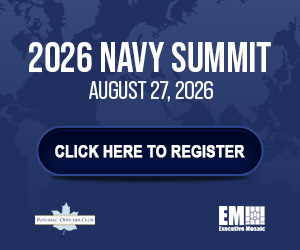
As the Navy continues to evaluate autonomous maritime technologies, the Potomac Officers Club’s 2026 Navy Summit on Aug. 27 will provide a forum for defense leaders and industry executives to discuss autonomous systems and other innovations shaping future naval operations. Register now!
The Navy announced on Friday that HII is one of seven companies selected to participate in at-sea demonstrations supporting the MUSV family of systems development effort. Companies whose vessels successfully complete testing will receive $15 million and become eligible for follow-on production. The demonstrations are scheduled to begin in June and conclude by October.
The selection comes weeks after HII confirmed the delivery of two ROMULUS-25 prototype unmanned surface vessels for the U.S. Marine Corps under a Defense Innovation Unit contract.
Which Companies Were Selected for MUSV Demonstrations?
In addition to HII, the Navy selected Sea Machines, Leidos, Saronic Technologies, Galliano Marine Services, PacMar Technologies and Birdon to advance to the demonstration phase.
The service said the MUSV marketplace initiative is intended to accelerate the fielding of unmanned maritime capabilities by leveraging mature commercial technologies and expanding opportunities for traditional and nontraditional shipbuilders.
The effort supports the mission of the portfolio acquisition executive for robotics and autonomous systems, which is focused on delivering capabilities that increase operational persistence, expand naval power and create operational challenges for adversaries.
What Capabilities Does ROMULUS Provide?
HII said the ROMULUS family of unmanned surface vessels is designed to support U.S. Navy, Marine Corps, joint force and allied missions requiring sustained autonomous maritime operations.
Potential mission sets include intelligence, surveillance and reconnaissance; counter-unmanned aircraft operations; mine countermeasures; strike missions; and launch and recovery of unmanned underwater and aerial vehicles.
ROMULUS is powered by HII’s Odyssey Autonomous Control Solutions autonomy software suite.
“Demonstrated across programs supporting the U.S. Navy, U.S. Marine Corps, U.S. Coast Guard, and allied partners, Odyssey enables intuitive command and control of autonomous platforms and swarms across domains, enhancing fleet lethality, survivability, and operational effectiveness,” said Green, an eight-time Wash100 Award recipient.
How Has HII Advanced the ROMULUS Portfolio?
The recently delivered ROMULUS-25 prototypes are 27-foot interceptor vessels designed to travel up to 1,000 nautical miles and carry payloads weighing up to 1,000 pounds. ROMULUS-25 is part of a broader family of autonomous surface vessels that includes ROMULUS-151. In April, HII announced plans to expand production of the ROMULUS-151 by adding four vessels to an existing unit under construction.