
 Charles Lyons-Burt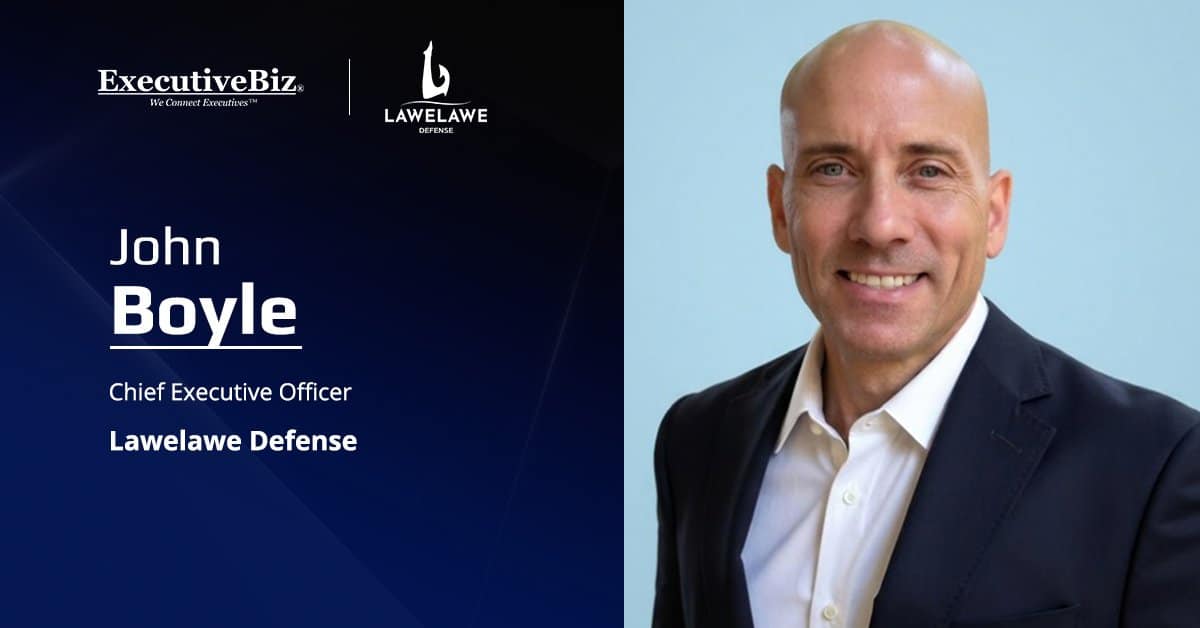
John J. Boyle is part of a new generation of GovCon CEOs reshaping how federal contractors compete in an era defined by cost pressure, modernization mandates and accelerating technological change. As CEO of Lawelawe Defense, or LDI, Boyle is leading a deliberate shift from a traditional sole-source growth model to a fully competitive, infrastructure-driven enterprise strategy built for long term scale.
With over a decade of C-suite leadership across IBM, MANTECH, Cherokee Federal, and now LDI, Boyle has delivered more than 20 billion dollars in revenue under his leadership while building governance discipline, predictive operating models and culture-driven performance systems that mirror top tier public companies. A recent graduate of the UC Berkeley CEO Academy, he integrates modern leadership principles with financial rigor, positioning his organization to pivot before government priorities force change.
Boyle recently engaged with ExecutiveBiz for a Spotlight interview where he shared his thoughts on how to successfully operate in and navigate a challenging, changing federal market, especially as a mid-tier or up-and-coming entity.
ExecutiveBiz: The federal market is shifting fast with cost pressure, procurement reform, and modernization mandates. What are GovCon companies getting wrong right now?
John Boyle: Most companies are still optimizing for access instead of competitiveness. For years, many firms relied on contract vehicles or sole-source pathways to drive growth. That model worked in a stable environment. It does not work when agencies are under pressure to cut cost, demand innovation and justify every dollar.
The real shift is this: You must be competitive even when you do not have to be.
At LDI, we are deliberately moving from a primarily sole-source posture to a competitive enterprise model. That means investing in solution architects, proposal rigor, pricing analytics, contract vehicles, compliance systems and delivery discipline. It is more expensive up front. It is also more durable.
The hardest part of this shift is accepting higher short term cost in exchange for long term dominance. The next decade will reward companies that build infrastructure before the government forces them to.
ExecutiveBiz: You have led high-growth enterprises and now a company transitioning its model. What does it actually take to pivot before the government changes?
Boyle: You cannot pivot if you are defending yesterday’s success. When I arrived, the question was not how do we grow. It was how do we future proof.
That required three hard moves.
First, invest in competitive muscle even when margins are tight.
Second, upgrade governance and financial visibility so growth does not create chaos.
Third, tell the organization the truth about where the market is headed.
Government priorities are moving toward efficiency, accountability, and measurable outcomes. If you wait for the RFP language to change, you are already late. The CEO’s job is to move the company before the customer forces the move.
ExecutiveBiz: Large primes dominate much of the federal space. How does a mid-tier or emerging enterprise truly compete at scale?
Boyle: By acting like a large company before you are one. Scale is not just revenue. It is operating discipline.
We implemented board-level governance cadence, standardized delivery frameworks, predictive financial modeling and customer satisfaction tracking tied directly to compensation. Those are big company behaviors.
We also built alliances strategically instead of transactionally. If you want to compete with top 10 firms, you must understand their playbook and then outperform them in speed and focus. In this market, size alone does not win. Agility with discipline does.
ExecutiveBiz: Many companies talk about culture, but margins in GovCon are tight. How do you connect culture to performance in a way that boards care about?
Boyle: Culture only matters if it produces results.
At Lawelawe, employee engagement is measured and tied to delivery outcomes. Customer satisfaction is measured and tied to recompete probability. Financial performance is tied to disciplined capital allocation.
When engagement improves, retention improves. When retention improves, program stability improves. When program stability improves, customer confidence improves. That is not soft. That is math.
Through executive education at Berkeley, I refined how to connect leadership behavior to enterprise performance. Culture is not about being nice. It is about building a system where people consistently perform at a high level.
Boards care about predictability. Predictability comes from disciplined leadership.
ExecutiveBiz: If you were advising a board of a top GovCon company today, what would you tell them their CEO must be prepared to do over the next five years?
Boyle: The next five years will reward CEOs who are willing to disrupt their own business model.
They must invest ahead of revenue.
They must modernize operating models before margins force it.
They must build leadership depth beyond themselves.
They must understand technology well enough to make capital decisions without chasing hype.
Most importantly, they must align purpose with performance. In federal contracting, mission matters. But mission without execution fails. The next era of GovCon will be led by enterprise architects, not contract managers.
Who Is John Boyle?
John Boyle is CEO of Lawelawe Defense, where he leads strategy, growth and delivery for the Native Hawaiian-owned federal contractor. He previously served as president and chief growth officer at Cherokee Federal and held senior leadership roles at MANTECH and IBM, building and scaling large federal technology businesses across defense, intelligence and civilian agencies. Boyle has more than three decades of experience driving enterprise sales, capture strategy and digital modernization initiatives in government markets.
What Is Lawelawe Defense?
Lawelawe Defense is an SBA-certified 8(a) Native Hawaiian-owned small business that delivers enterprise IT, cybersecurity, data analytics, digital solutions and program management services to federal agencies. The company is part of the broader Lawelawe portfolio, which supports nonprofit initiatives benefiting Native Hawaiian communities. Lawelawe Defense focuses on mission support areas such as systems engineering, network operations, data center modernization and healthcare IT.