

 Charles Lyons-Burt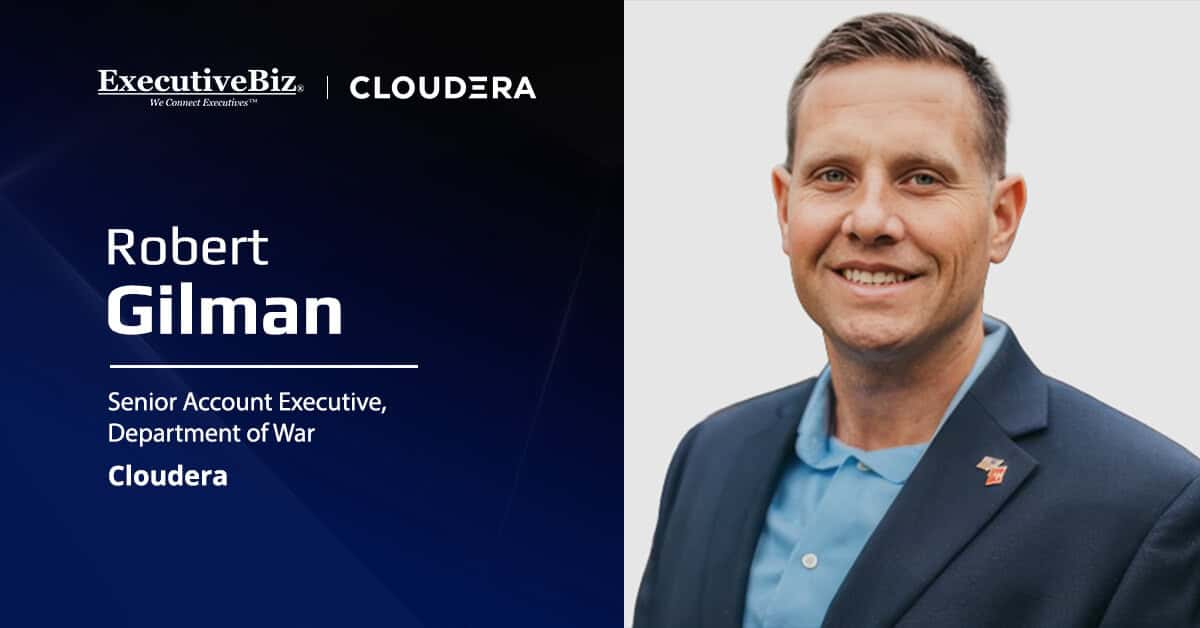
As government agencies accelerate artificial intelligence adoption, they face a critical challenge: how to modernize without compromising the security, sovereignty and compliance requirements that define mission-critical environments. For organizations operating across classified networks, disconnected systems and highly regulated environments, the path forward depends on bringing advanced capabilities directly to the data rather than moving sensitive information to external platforms.
Robert Gilman, senior account executive for the Department of War at Cloudera, recently sat down to discuss how agencies are navigating this evolving landscape. In this Spotlight interview, he explores why airgapped environments are becoming a catalyst for innovation rather than a constraint, how private AI is helping organizations balance speed with control, and what role modular architectures, governance frameworks and secure deployment models play in enabling the next generation of government AI initiatives.

Potomac Officers Club’s Summer Service Series of DOW-focused events all feature important conversations about smart AI implementation. Don’t miss the defense tech insights found at the 2026 Air and Space Summit on July 30 and the 2026 Navy Summit on August 27.
ExecutiveBiz: How are public sector leaders rethinking the relationship between innovation speed and digital sovereignty as modernization efforts accelerate across mission environments?
Robert Gilman: For most public sector organizations, operating seamlessly across mission environments isn’t a realistic goal. Strict data classifications, regulatory requirements and national security considerations create clear boundaries that can’t be crossed without introducing unacceptable risk.
That’s why airgapped environments, often perceived as a barrier to innovation, are actually foundational to making innovation possible in the first place. In practice, they’re what make safe innovation possible. When you’re working with classified intelligence, operational plans or sensitive citizen data, that level of isolation isn’t optional; it’s foundational.
What’s changing is how leaders approach innovation within those constraints. Rather than treating speed and sovereignty as competing priorities, agencies are increasingly recognizing that the two can reinforce each other, especially with the rise of Private AI. By running AI models entirely within environments they control, whether on-prem, in private clouds or in fully airgapped systems, agencies can accelerate adoption without compromising security.
This “bring AI to the data” model is what unlocks progress. It also directly addresses one of the biggest barriers to adoption: security. In fact, 77 percent of organizations still lack the foundational data and AI security practices needed to fully protect models and pipelines. By keeping AI inside controlled environments, agencies can move forward without introducing that risk.
We’re already seeing this in action. Intelligence teams are running natural language processing models directly on classified datasets within airgapped environments to surface patterns and accelerate analysis, without that data ever leaving the enclave. In this model, speed and sovereignty aren’t at odds, they’re mutually reinforcing.
EBiz: As agencies evaluate modern analytics and AI solutions, how are they balancing the convenience of commercial delivery models with the need for government’s requirements around control and compliance?
Gilman: This is where the gap between commercial innovation and government realities becomes most clear. Many SaaS-based solutions are built on the assumption that data can move freely between environments. For agencies operating in airgapped or highly regulated settings, that simply isn’t feasible.
As a result, the conversation is shifting toward private AI and deployment flexibility. Agencies are placing greater emphasis on solutions that allow them to run analytics and AI within environments they control, whether that’s single-tenant, on-prem, private cloud or fully disconnected systems. The goal isn’t to reject innovation, but to adopt it in a way that aligns with mission and security requirements.
Private AI plays a key role here by enabling agencies to access advanced capabilities without exposing sensitive data to external platforms. Instead of relying on multi-tenant SaaS, agencies can bring those capabilities into their own environments, including airgapped systems, while maintaining full visibility and control.
At the same time, governance must remain consistent. Security policies, lineage tracking and audit controls need to extend across every environment. We’re seeing this approach take hold across both defense and civilian agencies, where organizations are deploying AI within secure environments to improve outcomes, whether that’s intelligence analysis, fraud detection or case management—without compromising compliance.
EBiz: What role are modular platforms and containerization playing as agencies bring AI and data capabilities into more complex environments?
Gilman: Government environments have always been distributed, but they’re becoming more complex as data lives across cloud systems, secure facilities and the tactical edge. In many cases, those environments also have limited or no connectivity, which makes traditional deployment models difficult.
Modular platforms and containerization are helping solve that. By packaging AI models and data services into portable units, agencies can deploy them directly into different environments, including airgapped systems, without having to rebuild everything each time.
That flexibility matters. Instead of trying to move sensitive data, agencies can move the capability to where the data already lives. In defense scenarios especially, where connectivity can’t be guaranteed, that approach supports faster and more reliable decision-making.
There’s also a broader operational benefit. Organizations adopting these architectures are seeing better use of their infrastructure and more flexibility in how they scale. Just as importantly, they’re avoiding long-term lock-in to a single vendor or environment, which gives them more control as mission needs evolve.
EBiz: From a risk management standpoint, how are agencies making sure modernization efforts strengthen core security and governance controls?
Gilman: In these environments, modernization has to do more than add new capabilities; it has to reinforce the controls that are already in place. One of the biggest priorities is maintaining a clear chain of custody for data, models and code. That means strong lineage tracking, cryptographic validation and audit logs that make it easy to trace where something came from and how it’s been used.
This becomes especially important as AI plays a larger role in decision-making. If an insight is being used in intelligence analysis or an investigation, agencies need to understand exactly how that output was generated and what data it’s based on.
At the same time, we’re seeing a move away from manual configuration toward more standardized approaches like infrastructure-as-code and policy-as-code. These help ensure consistency across environments and reduce the risk of misconfigurations over time.
Zero trust is still a core principle as well, even in airgapped systems. Identity-based access, least-privilege controls and segmentation all remain essential. On top of that, agencies are paying closer attention to how models and code are brought into these environments, using secure ingestion pipelines to validate and control what gets introduced.
The agencies that are doing this well are applying these controls consistently across every environment. That consistency is what allows them to modernize without weakening the systems they rely on.
EBiz: Looking ahead, how should agencies think about measuring success as they balance innovation with sovereignty and security?
Gilman: Success in this space is increasingly defined by whether agencies can operationalize AI where it matters most, inside the environments where their most sensitive data resides. That’s where private AI is becoming a key differentiator.
Rather than measuring success purely by speed of deployment, agencies are taking a more holistic view. They’re looking at whether AI capabilities can run effectively across airgapped, on-prem, edge and cloud environments while maintaining consistent governance and compliance.
Private AI enables that by allowing agencies to deploy capabilities directly within secure environments, ensuring that innovation doesn’t come at the expense of control. The ability to bring AI to the data—especially in airgapped systems—is becoming a core benchmark for modernization success.
In the end, the agencies that are getting this right are those that can scale AI across all mission environments without compromising sovereignty. When that happens, innovation, security and operational effectiveness are no longer competing priorities, they become part of the same strategy.