
 Charles Lyons-Burt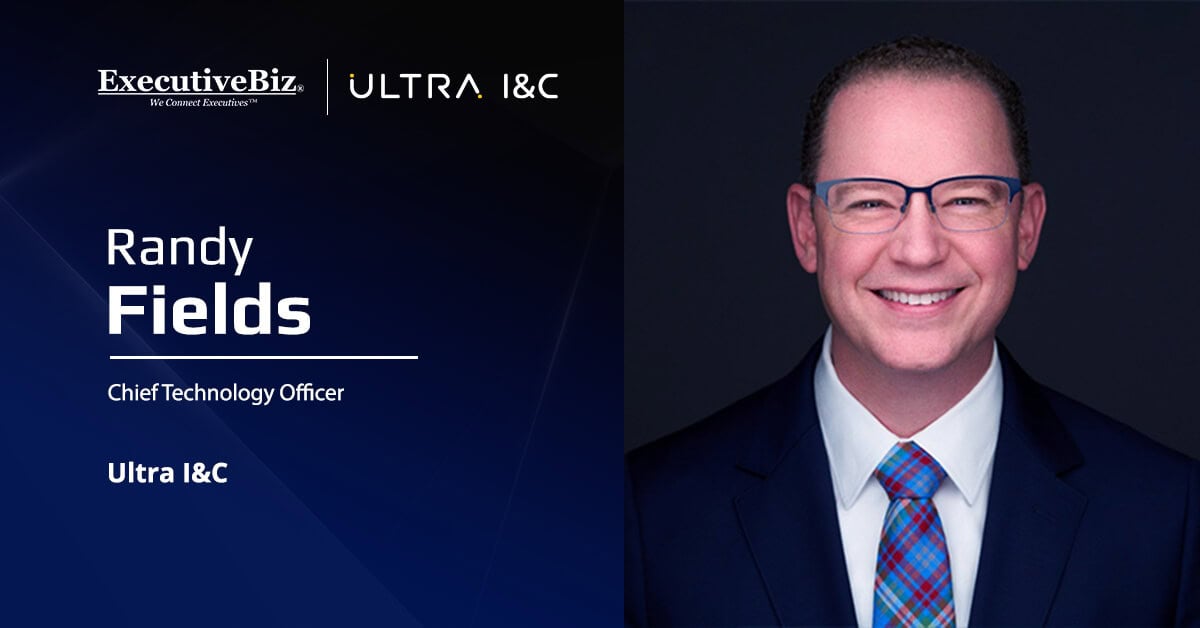
Randy Fields has seen defense technology from both sides of the mission. A Navy veteran who first served as an enlisted cryptologic technician and later returned as a reserve officer, Fields says that operational feedback, not just new features, is what drives better outcomes for the warfighter.
Before joining Ultra I&C as chief technology officer and vice president, Fields held senior technology and leadership roles at companies including Cubic and Northrop Grumman, where he worked across large-scale C5ISR, software and systems integration efforts. Those experiences, combined with time in uniform, shaped his focus on reducing cognitive burden for operators and closing the gap between development and real-world use.
In this Executive Spotlight interview, Fields discusses why he sees Model Context Protocol as a practical way to AI-enable legacy systems, how data provenance underpins trust in AI-driven decisions and why Ultra I&C’s approach to data rights and operator ownership is designed to avoid vendor lock while accelerating fielding.

Fields is a frequent speaker at Potomac Officers Club events—the premier forums for government-industry dialog. Don’t miss its annual AI event, the 2026 Artificial Intelligence Summit, which will highlight acquisition opportunities in AI at the Department of War and beyond and will feature keynote speaker Cameron Stanley, CDAO at the DOW. Register for the March 18 event now!
ExecutiveBiz: Let’s talk about the fast-changing AI market, especially in areas like counter-UAS and multisensor fusion. What’s one big change in AI over the last year that will most impact how we detect, track and defeat emerging threats?
Randy Fields: A big change is the push to make systems work together instead of acting like standalone apps. Think about the apps on your phone. Almost none of them talk to each other to give the user the best experience. In defense, it’s similar. Everyone delivers their application, but not enough people think about how it stitches together and how it reduces burden for the warfighter.
In AI, there’s been a big push for something called Model Context Protocol, or MCP. It’s basically a wrapper that can go around legacy applications to help enable AI and agentic workflows without rebuilding everything from scratch. If you tried to take everything that’s fielded and make it AI-enabled the hard way, it’s too expensive. The wrapper approach lets you do very specific things safely. Maybe you want to start or restart an app, pull a status or monitor health. You don’t want to give some defense applications “too much.”
Another issue is cognitive burden. We keep giving warfighters another app, and another app, and another app, and nobody owns the impact of that load. MCP starts to enable orchestration, so we can supplement the warfighter with agents that do very specific jobs.
People hear “agents” and think of movies, full conversations and all of that. We’ll get there someday. Right now, value is in having something that watches your systems and tells you what you need to know. If an app crashes, the agent can flag it. If comms are down, it can tell you, “Don’t go do this mission yet, you’re not connected.” That reduces cognitive load, helps build trust and lets the warfighter adopt AI without breaking big, complex systems.
EBiz: You described Model Context Protocol as a wrapper for legacy systems. How does MCP function in practice, and why is it important now?
Fields: Model Context Protocol is a wrapper to enable legacy apps to become AI-enabled. It becomes connective tissue between legacy capabilities and new, more exquisite systems. Everybody gets excited about the newest platform, but a lot of what we operate today is still the F-15s, the F-16s and other fielded systems. The question is how you connect the new to the old without adding complexity to the warfighter.
That’s why we’ve been standardizing our applications around MCP at Ultra I&C. It helps us connect to other systems and reduce complexity for the operator. We’re trying to be a great connector in that environment.
EBiz: Is MCP an Ultra I&C product or a broader industry direction that you’re aligning to?
Fields: It’s an industry direction. Google, Red Hat, Microsoft, the major players are using MCP. Defense apps are often years behind where commercial industry is going. We made a decision to enable our applications immediately so they can be wrapped with MCP and support experiments quickly.
Our standalone applications still work in their standard modes, but we add the MCP wrapper so we can interact with the broader ecosystem. If you want to participate in modern architectures and you’re not adopting MCP, you’re going to be in a bad spot.
EBiz: GenAI has obviously been huge. How will cybersecurity have to evolve to stay ahead of potential threats posed by AI tools?
Fields: Cybersecurity has to evolve to protect the data we’re making decisions on. With large language models, you can poison models and you can get hallucinations. In defense, we can’t have hallucinations. We need specificity, and we need trust.
For us, it starts with protecting data and maintaining data provenance. We have a tool called Rain(™), an AI/ML tool that helps protect the data and preserve provenance. If you or I make any change to any field, we can recreate what happened with 100% accuracy. That supports trust in models. If a sensor is behaving oddly, you can determine whether it was a training issue, a data issue or a change someone made.
You also need non-repudiation so you can track every step. Without that, you can’t build trust, and if you can’t build trust, operators won’t use your tools. We take a trust mindset to data. It also helps you move across classification levels because you can trust the data moving through guards. That helps break data stovepipes that slow decision-making.
EBiz: Data rights are becoming a strategic lever in acquisition. How does your approach to data rights enable the department and what impact does that have on stability, interoperability and time to fielding?
Fields: We’ve seen companies treat mission data like it’s their own. That breaks trust from the start. We believe the government’s data is the government’s data. We provide the capability to do something with it, and we believe in transparency and strong data rights, not just for software, but for hardware too.
We provide government purpose rights and full data rights to our systems so the warfighter can work with them when we’re not there. We don’t want to hold anyone hostage and say, “You have to call us.” We want operators to be able to work on it, supported by tools that can answer questions from documentation. If they still need us, great, we’ll help. But closed data rights create vendor lock. We actively try to avoid that. We want customers to choose us, not get stuck with us.
One more point: being open enables partnerships. Vendors trust us with their data because they know we’re not trying to trap them. That interoperability focus helps break stovepipes.
A good example is a partner called Hidden Level. They make an exceptional counter-UAS sensor, especially when it comes to identifying small drones and distinguishing birds from drones, which is hard. What they didn’t have was an enterprise dissemination system for their detections. They came to us, and we integrated in about two weeks. Now we can take their detection, characterize it and disseminate it out fast, down to milliseconds.
That trust at the API level let us move that data into formats and ecosystems the warfighter needs, including Link 16, and distribute it broadly. That’s what interoperability should look like.
EBiz: You’ve emphasized fully open, user-controlled systems from the start. What does true operator ownership look like in practice, and how is Ultra I&C doing it differently than traditional defense primes?
Fields: One big thing we’re trying to change is the field service reps, or FSR, model. A customer often asks, “How many FSRs does it take to operate this system?” It should be none. There’s nobody from Apple sitting in my house while I use my phone.
We challenge ourselves to reduce FSR count by adding troubleshooting tools and AI tools that enable the operator to run the system without us there. If they call us, it should be because the tools couldn’t solve it, not because the system requires a person next to it.
We focus edge-first. Operators aren’t always connected. A lot of people build cloud-first, but in the field you can’t assume connectivity. We put the AI tools right next to the system so the operator can interact with it locally, like they would talk to a person, and troubleshoot problems. When it reconnects to the cloud, it gets even better, but it has to work disconnected.
A lot of the industry leans into a services model. We can’t scale that. We can’t have enough people forward. Products have to stand alone and be warfighter-focused. The theme for us in 2026 is simplicity and reducing cognitive workload. I’ve been in the field recently, and the number of applications we ask people to become experts in is crazy. If industry doesn’t focus on simplicity, we’re doing warfighters a disservice.
EBiz: You’ve mentioned the industry’s reliance on a services model a few times. For readers who may hear that term used in different ways, how do you define a services model, and why does it create challenges in operational environments?
Fields: The easiest way to start a defense business is often a services model, putting people into roles the government needs. The government might need a skill set and bring in contractors to fill that gap. The problem is that model tends to grow. It becomes more people, more seats, more cost.
And when you put people forward, especially into harm’s way, the logistics tail gets huge. Food, housing, security, support. The footprint expands, and the cost rises. Warfighters don’t want another person to feed forward. They want products that are simple, reliable and fast, so they can move quickly without waiting on a specialist to troubleshoot.
Services are valuable for solving hard problems and standing up capabilities. But in the field, the goal should be minimal services, so the warfighter can operate, adapt and maneuver without carrying that logistics burden.
EBiz: Ultra I&C talks about creating commercial systems that can be fielded today, not five years from now. What’s an example where you closed the gap between development and fielding, and what made the speed possible?
Fields: We focus heavily on warfighter engagement and structured feedback from the field. Recently we hosted an Army group, including senior leaders and chief warrant officers, to get direct input. Different groups tell you different things. Senior leaders might say, “This is slow.” Enlisted users might say, “This is hard to use.” Chiefs will tell you, “This broke.” That’s the feedback you need, even if it’s uncomfortable.
We also have continuous ATOs for core applications, which helps us move fast. We’ve had approvals in a single day to connect to systems and get data out.
Then we support operators with AI tools that incorporate feedback and make the system easier to troubleshoot and operate. That matters in real life. If an operator can chat with a tool and solve a problem, that’s one less time someone gets woken up in the middle of the night to troubleshoot.
One example: a user told us they needed to translate a report into French in the field. We added an AI-enabled capability in one sprint and pushed it back out. They were amazed. We told them it was a prototype, and then they told their friends. Suddenly we had requests for more languages. That’s what speed looks like when you have trust, feedback loops and delivery mechanisms that can keep up with mission need.
Who Is Randy Fields?
Randy Fields is chief technology officer and a vice president at Ultra I&C. A U.S. Navy veteran, he began his military career as an enlisted cryptologic technician and later returned to service as a Navy Reserve officer, bringing an operational perspective into his technology leadership. Across more than two decades in defense and software, Fields has held senior engineering and executive roles at companies like Cubic and Northrop Grumman focused on delivering mission outcomes, improving how systems are fielded and strengthening the link between operators and the teams building their tools.
What Is Ultra I&C?
Ultra I&C is a defense technology company that develops mission-focused capabilities spanning areas such as AI/ML-enabled software, tactical communications and edge-oriented systems designed to operate in contested or disconnected environments. The company’s approach emphasizes interoperability, operator usability and faster pathways to fielding, with a focus on helping customers integrate capabilities without adding unnecessary complexity for the warfighter.