
 Pat Host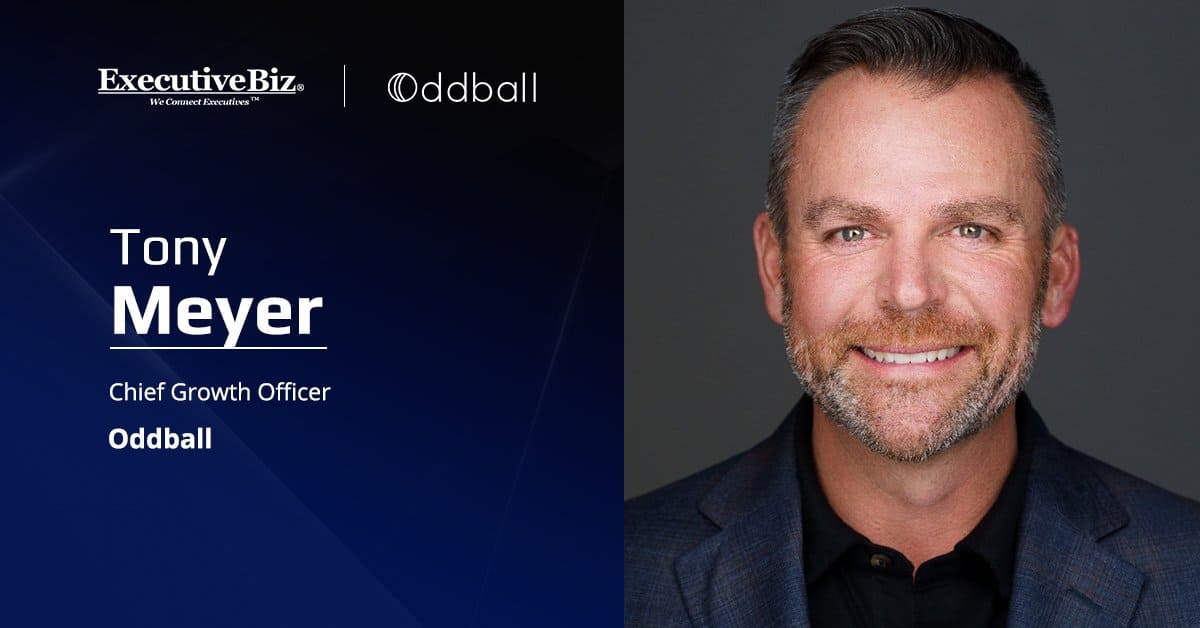
- Tony Meyer, Oddball chief growth officer, has built the company’s growth approach around both delivering results on today’s contracts and winning future competitions.
- He is helping launch Oddball Labs, an innovation hub to propel the company into its next chapter.
- Meyer sat down with ExecutiveBiz to talk federal IT, AI and the company’s evolution from focusing on small business contracts to targeting larger and longer contracts with a new customer.
The federal IT market is in the middle of a real inflection. Artificial intelligence is changing how work gets delivered, procurement models are shifting, agency priorities are being reshaped, and every part of the government is being asked to do more with less—better outcomes, faster and at lower cost.
The contractors who will matter in five years are making very different bets than the ones that mattered five years ago. Oddball Chief Growth Officer Tony Meyer believes this is the moment that separates the companies that will lead the next decade from the ones that will quietly fade. He’s built Oddball’s growth approach around operating on two horizons at the same time.
Meyer describes it as two kinds of work that the company values equally: delivering outstanding results on today’s contracts and making real investments in capability, technology, partnerships and customers ahead of where the market is going. Inside Oddball, the forward-looking work has a name: Curve 2. It is the shorthand the team uses for the capabilities, customers and technologies that will define the company’s next chapter and it is treated as just as essential as the delivery work that keeps the lights on today.
He is helping Oddball launch Oddball Labs, an innovation hub built specifically to push the company onto its next chapter. Labs is funded by the strength of today’s business, but its mandate is explicitly forward: developing capabilities that do not exist yet, testing emerging technologies against real mission problems and positioning Oddball for the kinds of opportunities it wants to win three to five years from now.
Meyer sat down with ExecutiveBiz for his first Spotlight interview to discuss how Oddball keeps its culture aligned with its vision, how the team is preparing for the next wave of federal IT competition rather than the next contract, and how Oddball’s growth strategy has evolved as the velocity of change in the federal market keeps picking up.
Get the latest high-tech business opportunities at the Potomac Officers Club’s 2026 Cyber Summit on May 21! Hear directly from Aaron Bishop, Department of War chief information security officer and acting principal chief information officer, during his informative keynote address. Get actionable business intelligence to win more contracts in 2026. Secure your seat today!
ExecutiveBiz: What practical steps do you take as a leader to keep your culture healthy and aligned with your vision?
Tony Meyer: It starts with hiring the right people. At Oddball, we lean into our identity—we call ourselves “oddballs,” and we look for people who are self-starters, knowledgeable and enjoyable to work with. More than that, we look for people who are curious about where things are going. You can teach almost any technical skill, but intellectual curiosity about what’s next—that’s either there, or it isn’t.
From there, a lot of it comes down to balancing two kinds of work that we consider equally important. One is delivering exceptional work on our contracts day in and day out: that’s what earns us the right to keep growing. The other is investing in what comes next: evaluating emerging technologies, building new capabilities, cultivating new customer relationships, shaping the Oddball of three to five years from now. Neither is more important than the other and most of our best people do both, depending on what the moment requires.
EBiz: As a leader, how do you see your own role in that balance?
Meyer: Honestly, it depends on the day, and I think that’s true for most of our leaders. There are days I’m working on things that won’t show results for a year or more: partnerships, new market entry, what Labs is becoming. There are days I’m head-down and helping the team execute on something a customer needs right now. The culture only works if everyone, including leadership, is willing to do both when the moment calls for it.
The people I’m most proud to work with at Oddball are the ones who keep the whole operation humming. Our delivery teams, our program managers, our engineers on the ground with customers—that’s where Oddball’s reputation actually gets built, and that reputation is what gives us the runway to invest in what’s next.
EBiz: How do you prepare organizations for long-term strategic competition rather than short-term contracts?
Meyer: This is one of the biggest shifts we’re making as a company and it’s probably the topic I spend the most time on. Short-cycle task-order work—vehicles like CEDAR and its follow-on SPRUCE at the Department of Veterans Affairs—is fast-paced and reactive. The procurement drops, you have days or weeks to respond, and you move. That’s a real skill and our teams are very good at it.
But the opportunities that are going to define Oddball’s future aren’t going to be won that way. Longer-term, full-and-open competitions. Larger programs. New agencies. Work that requires you to show up with a solution the customer didn’t know they needed yet. You cannot win those starting the day the request for proposal drops. The work has to start one, two, sometimes three years earlier.
We’ve built our growth model around early solutioning—getting deep with subject matter experts, partners and customers well before anything is formally on the street. Understanding where the customer’s environment is headed, not just where it is today. Identifying problems they haven’t yet decided to solve. Shaping solutions that, by the time an RFP drops, feel obvious. That’s how you compete when you’re one of many qualified companies: you make yourself the one that saw the problem coming first.
EBiz: What are CEDAR and SPRUCE?
Meyer: CEDAR was a contract vehicle through the VA under the office of the chief technology officer and SPRUCE is its follow-on. Both focus on digital modernization services—often smaller, targeted projects that emphasize software development and innovative approaches to improving efficiency and the user experience for veterans. That work matters and we’re proud of what our teams have done through those vehicles.
But CEDAR and SPRUCE are small business set-asides and Oddball is no longer a small business. So while those vehicles helped shape who we are, they aren’t where our future growth is going to come from. They represent a style of competing—short cycles, quick turns, task-order work—that was exactly right for Oddball a few years ago.
The work ahead of us looks different. Longer-term, full-and-open competitions. Larger programs. New customers like the Department of War that requires a different mindset and a different kind of preparation: investing in capability, partnerships and customer relationships well before a procurement drops. Both kinds of work are legitimate, but we’re spending more and more of our energy on the latter, because that’s where Oddball needs to be playing next.
EBiz: How do you balance existing infrastructure with rapid technological innovation?
Meyer: That’s exactly what Oddball Labs is for. Labs is our Curve 2 engine: the deliberate bet that Oddball can’t just be a company that executes well on the work that exists today. We also have to be a company that’s building the capabilities that the government is going to need to buy tomorrow.
AI-enabled delivery. Mission software. Emerging approaches to human-centered design at scale. Things that aren’t line items in most current contracts, but are where the market is clearly headed.
Labs purposely operates at a different velocity than the rest of the company. It gets to experiment and fail fast. It gets to work on problems whose answers aren’t obvious yet and whose payoff might be a year or two away. That’s not how you run a delivery program, but it’s exactly how you stay relevant as the ground shifts underneath you.
Are you a technology executive? Then you cannot afford to miss the Potomac Officers Club’s 2026 Cyber Summit on May 21. Dive into “harvest now, decrypt later” risk exposure and cryptographic agility across federal systems during the Quantum Computing and Post Quantum Cryptography panel discussion, featuring Davon Tyler, Department of Education CISO. Sign up today!
EBiz: How has your growth strategy evolved in response to budget shifts and procurement reform?
Meyer: Our core philosophy hasn’t changed. Budget shifts and procurement reform are real, but they’re also noise on top of a signal. The signal is what the government actually needs, and right now, what the government needs more than anything is help doing more with less.
Better outcomes for citizens, delivered faster and at a lower cost to taxpayers. That’s true across every agency we work with and every agency for which we want to partner. The tactics change, the vehicles change and administrations change, but that underlying demand is only going to intensify. If you manage your company quarter to quarter based on the noise, you end up swerving. If you manage it based on the signal, you end up prepared.
You can either get distracted by the noise or stay focused and continue executing. As a team, we’ve chosen to stay focused.
But staying focused doesn’t mean standing still. We are evolving as a company, and deliberately. We’ve transitioned from a small business to a large one, which changes the game completely—the vehicles we competed on as a small business don’t apply to us anymore, the kinds of opportunities we pursue are larger and longer, and the competitive set is different.
We’re expanding beyond our core customers—VA, the Securities and Exchange Commission and the Centers for Medicare and Medicaid Services—into new markets like the DOW, where the problems are different and the technology bets matter more. We’re also investing in capabilities, both through Labs and through our core delivery teams, that we believe are going to define the next generation of federal IT work.