
 Pat Host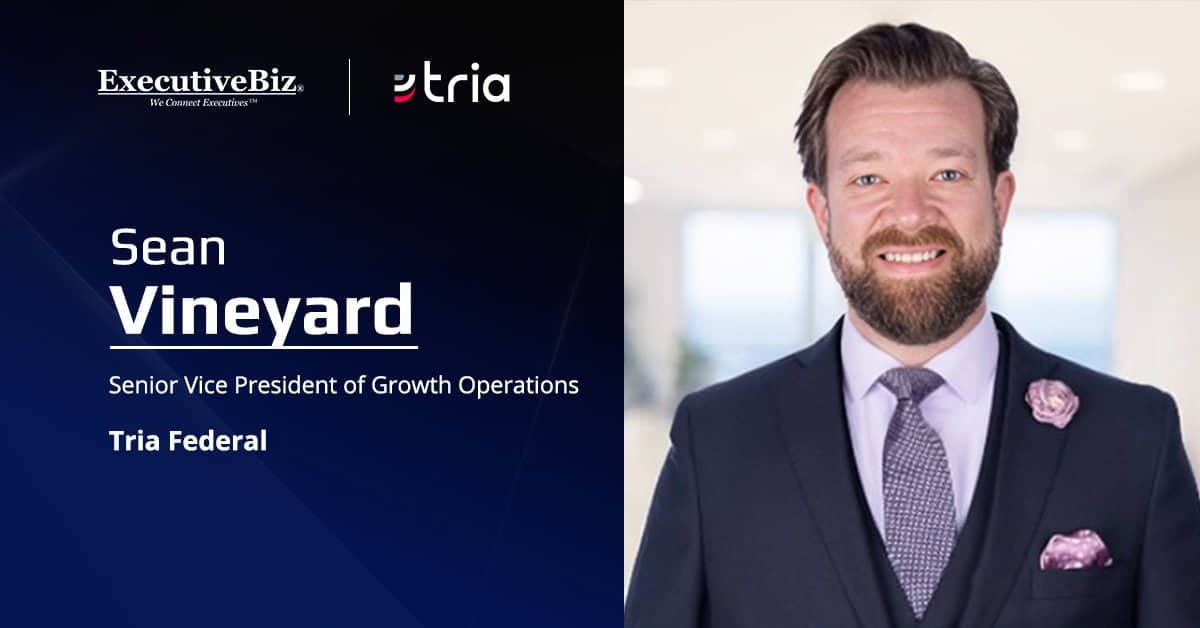
- Sean Vineyard, senior vice president of growth operations at Tria Federal, is leading an internal effort to use AI to enhance how the company’s teams operate
- The effort is focusing on three key areas: growing capacity, accelerating speed and improving quality.
- He sat down with ExecutiveBiz to talk AI, strategies for long-term success in contracting and prioritizing which contracts to pursue.
Tria Federal’s Sean Vineyard is helping the company level up with artificial intelligence. The firm’s newly-promoted senior vice president of growth operations is leading an internal effort to use AI to enhance how Tria Federal’s teams operate, focusing on three key areas: increasing capacity, improving speed and elevating quality.
AI won’t replace people at Tria Federal. Instead, it allows teams to focus more on the work that is high-value to their customers.
Tria Federal has developed an AI product called Tria Forge, a customer-facing application. It allows users to build AI agents through a simple interface, similar to drag-and-drop functionality, without needing deep technical expertise.
GovCon is compelling to Vineyard because its work impacts people both across the U.S. and globally. Coming from a military family, it’s meaningful to him to support this mission.
The most meaningful accomplishments in Vineyard’s career have been helping customers like the Department of Health and Human Services and the Department of Veterans Affairs achieve better results. Focusing on improving outcomes and problem solving early in his career helped lead him to growth roles.
Vineyard sat down with ExecutiveBiz for his first Spotlight interview to discuss why human input is essential to trust in AI, how he prepares organizations for long-term competition, rather than short-term contracts, and how he prioritizes contracts to pursue.
Get the latest Pentagon spending priorities for emerging technologies at the Potomac Officers Club’s 2026 Cyber Summit on May 21! Hear directly from Katherine Sutton, Department of War assistant secretary for cyber policy, and Aaron Bishop, DOW acting principal deputy chief information officer and chief information security officer, during their illuminating keynote addresses. Buy your ticket now!
ExecutiveBiz: How do you think about trust, explainability and accountability when AI influences operational outcomes?
Sean Vineyard: Human oversight is still critical. Trust, whether with AI or people, is earned over time.
Early on, it’s important to validate outputs consistently. Whether an AI agent is recommending decisions or producing deliverables, those results need to be reviewed and confirmed.
As confidence builds and accuracy is proven, you can gradually expand the scope of what AI is allowed to do. But maintaining a human-in-the-loop approach ensures that outcomes align with expectations and provides accountability.
EBiz: What has changed in the last six months regarding government risk tolerance around AI?
Vineyard: There’s been a noticeable shift. Broadly speaking, there’s now greater recognition that AI is necessary to do more with fewer resources.
A few years ago, that wasn’t universally accepted. Now, there’s strong demand to understand how to deploy AI both effectively and ethically.
Agencies are also working through the complexity of the market. There are many tools claiming AI capabilities and it takes effort to determine which ones truly deliver value. That’s led to increased focus on education, training and thoughtful implementation.
We’re also seeing more investment in enterprise licenses and a stronger desire for collaboration between agencies and vendors. As familiarity grows, that will shape how AI is ultimately used across government.
EBiz: What is an enterprise license, and why does it matter?
Vineyard: An enterprise license allows an agency to adopt a technology broadly and efficiently as its value becomes clear.
Instead of each office procuring the tool separately, the agency can deploy it at scale. This speeds up adoption and ensures consistency.
Typically, these licenses are managed centrally, often by a CIO or IT organization, which provides stronger security controls and governance. So you get both efficiency and centralized oversight.
Want to hear the latest innovative ways the DOW is using AI in cybersecurity? Then you cannot afford to miss the Potomac Officers Club’s 2026 Cyber Summit on May 21! Dig into scaling defense across complex environments at the Combating Advanced Persistent Threats panel discussion, featuring Davey Gibian, DOW deputy chief digital and AI officer for warfighting mission area, and Daryl Haegley, Air Force technical director for control systems cybersecurity. Secure your seat today!
EBiz: How do you prepare organizations for long-term strategic competition, rather than short-term contracts?
Vineyard: It comes down to understanding the complexity of the problems being solved. Some challenges can be addressed quickly, but others take years due to their scope and the number of stakeholders involved.
As long as you stay focused on solving real problems, it becomes easier to manage expectations. The timeline should reflect the complexity of the mission, not just contract cycles.
EBiz: How do you prioritize which contracts to pursue?
Vineyard: We’re a technology-first company, and most of our work is in the federal health space or adjacent areas.
We prioritize opportunities where we have strong expertise: technology-driven, mission-critical environments where uptime and reliability are essential. These are not “nice-to-have” systems, they are essential to agency operations.
We do support work outside those areas, but our resources are focused on opportunities where we can have the greatest impact and deliver the most value.