

 Pat Host
- Project Overmatch focuses on delivering reliable comms for a distributed force
- It will leverage C3 systems to enable kinetic and non-kinetic fires in contested realms
- Get access to actionable Project Overmatch business intelligence at the 2026 Navy Summit!
Project Overmatch is shaping up to be one of the Navy’s most transformative command-and-control and acquisition programs in service history. Not only will the effort leverage resilient command, control and communications, or C3, systems to enable kinetic and non-kinetic fires in the contested environments of modern warfare, but it uses innovative acquisition strategies and vehicles to deliver cutting edge technologies at an unprecedented pace.
As the Navy’s contribution to the Pentagon’s Combined Joint All-Domain Command and Control, or CJADC2, Project Overmatch focuses on delivering reliable communications for a widely-distributed hybrid force. It has a goal of enabling the seamless execution of mission-critical operations while providing a decision-making edge through a robust digital ecosystem.
The goal is to ensure reliable C2 for autonomous operations and provide secure and resilient communications to support mission execution and contested logistics. Let’s dig into the five biggest Project Overmatch developments from the last few years.
Discover new business opportunities in AI at the Potomac Officers Club’s 2026 Navy Summit on August 27! Explore delivering advanced C2 across the battlespace and enabling integrated fires through tactical networking and data fusion at the Connective Tissue panel discussion! It features top Navy officers and industry experts including:
- Bryan Lopez, Navy department of the chief information officer director of emerging technologies
- Mark Campbell, Legion Intelligence senior business development executive
- Dr. Nick Weir, Legion Intelligence vice president for mission engineering
- Amina Al Sherif, Google Public Sector head of AI
What Are the Five Biggest Project Overmatch Updates?
1. New Program Manager Takes Over
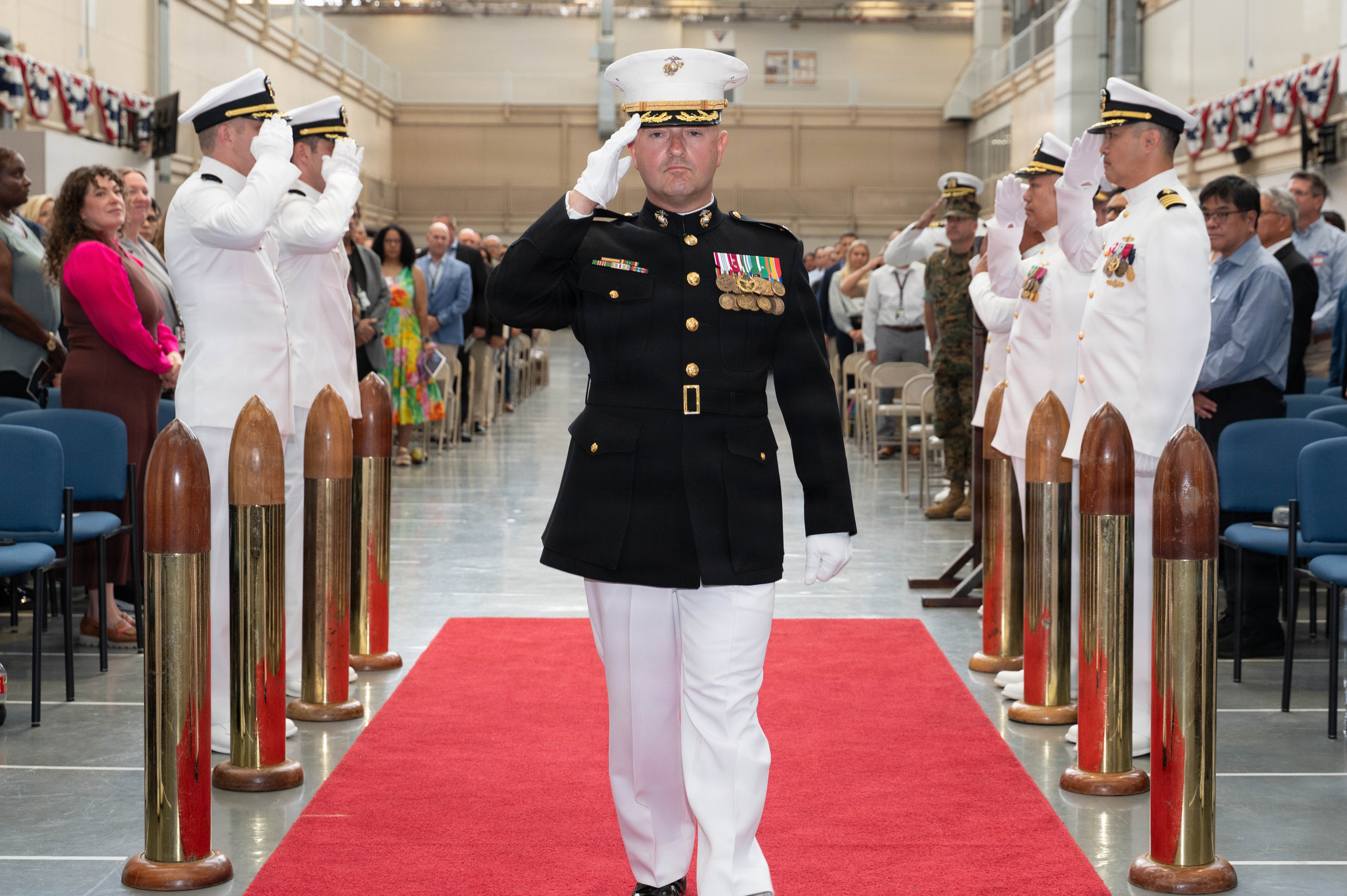
Project Overmatch received a new leader when Col. Craig Clarkson became program manager in June. He replaced Capt. Remil Capili, who retired after 33 years in the Navy.
Capili, as the previous Project Overmatch leader, helped the organization make strides toward improving the Navy’s C2 systems and data architectures, according to a service statement. Project Overmatch, under Capili’s guidance, also helped the Navy operationalize AI throughout the fleet and create a modern development, security and operations pipeline for key software.
Clarkson previously served as commander of Marine Corps Tactical Systems Support Activity.
“I’m excited for the opportunity to serve with a high-performing team that has a well-earned reputation for excellence,” said Clarkson.
2. Navy Taps Project Overmatch Chief to Lead New Drone Effort in Acquisition Shakeup
A key leader in Project Overmatch was selected by the Navy in December to head a new acquisition shop to help the service accelerate unmanned system purchases, according to USNI News. Rebecca Gassler, who had served as Project Overmatch deputy director, became the first portfolio acquisitions executive for robotics and autonomous systems.
The PAE for RAS oversees nearly 50 unmanned efforts among the Navy and USMC. These include the Modular Attack Surface Craft, swarming small unmanned surface systems and the Orca Extra Large Unmanned Underwater Vehicle.
Gassler has extensive engineering experience in the Navy. In addition to her two stints with Project Overmatch, she has also served as acting director for development and integration and technical director of Program Executive Office for Integrated Warfare Systems, or PEO IWS.
3. Prescient Edge Contract Award
A northern Virginia firm in April received a $11 million contract to contribute specialized technical support to Project Overmatch for the end-to-end testing, refinement and rapid operationalization of its robotic autonomous systems, according to a Pentagon statement.
The one-year, sole source contract to Prescient Edge includes four one-year options which, if exercised, would bring the overall potential value of the award to about $59 million. Prescient Edge provides research, development and engineering services for the integration of UxS, data science and C5ISR services to the Pentagon, intelligence community and other federal agencies.
Prescient Edge acquired Edge Analytic Solutions in January 2025 to improve its presence in the defense and intelligence market. The firm in May was awarded a spot on a Naval Information Warfare Center Pacific multiple-award contract potentially worth $350 million supporting intelligence, surveillance and reconnaissance systems, information operations and cybersecurity missions.
Are you a GovCon technology professional looking to boost your revenues in AI? Then you cannot afford to miss the Potomac Officers Club’s 2026 Navy Summit on August 27. Dig into the hottest topics in GovCon like digital modernization and autonomous systems from our all-star keynote lineup of top Navy officials, including:
- Hung Cao, acting secretary
- Lt. Gen. Joseph Matos, Marine Corps deputy commandant for information
- Vice Adm. Brad Skillman, deputy chief of naval operations for integration of capabilities and resources, N8
- Barry Tanner, acting chief information officer
- Vice Adm. Michael Vernazza, Naval Information Forces commander
Sign up now for this eagerly-anticipated GovCon forum!
4. Navy Creates Innovative Training and Sustainment Plans
Project Overmatch, five years into its existence, is providing capabilities throughout the Navy’s fleet as more than 80 ships are deploying with Overmatch-powered capabilities, according to a Navy statement.
Project Overmatch is based on a unique and novel approach that can create a challenging learning curve for sailors. This is because of its accelerated development and deployment with updates continuously pushed out to learners.
As a result, the Navy created comprehensive and methodical training and sustainment plans. The service as of January trained 590 sailors on five different Project Overmatch systems and developed eight instruction courses in 2025 itself. It also worked with 20 ships in 2025 to install and train crews on capabilities like resilient communications, increased battlespace awareness and AI-supported warfighting.
“We have absolute faith in the flexibility and creativity of the sailors in the fleet to take the tools we’re providing, master them and apply them during operations today,” said Cmdr. Rebecca Adams, fielding lead for Project Overmatch. “The future fight will require adaptation at speeds that the legacy acquisition and fielding system can’t keep up with.”
5. Navy Secures Partnership Agreements With Five Eyes Partners
Project Overmatch in early 2025 made a significant accomplishment when it established a formal project agreement with the U.S.’ Five Eyes intelligence partners: Australia, Canada, New Zealand and the U.K. The Navy said this demonstrates the service’s dedication to improving joint operations, accelerating distributed maritime operations and bolstering global security.
The agreement allows the Five Eyes national to embed Cooperative Project Personnel directly within the Project Overmatch team, helping speed up the development of interoperable technologies. The milestone shortly follows Project Overmatch and Naval Information Warfare Systems Command’s contributions to the RIMPAC 2024 exercise, where Project Overmatch and NAVWAR technologies demonstrated technologies to improve allied interoperability and decision-making in real world scenarios.