
 Pat Host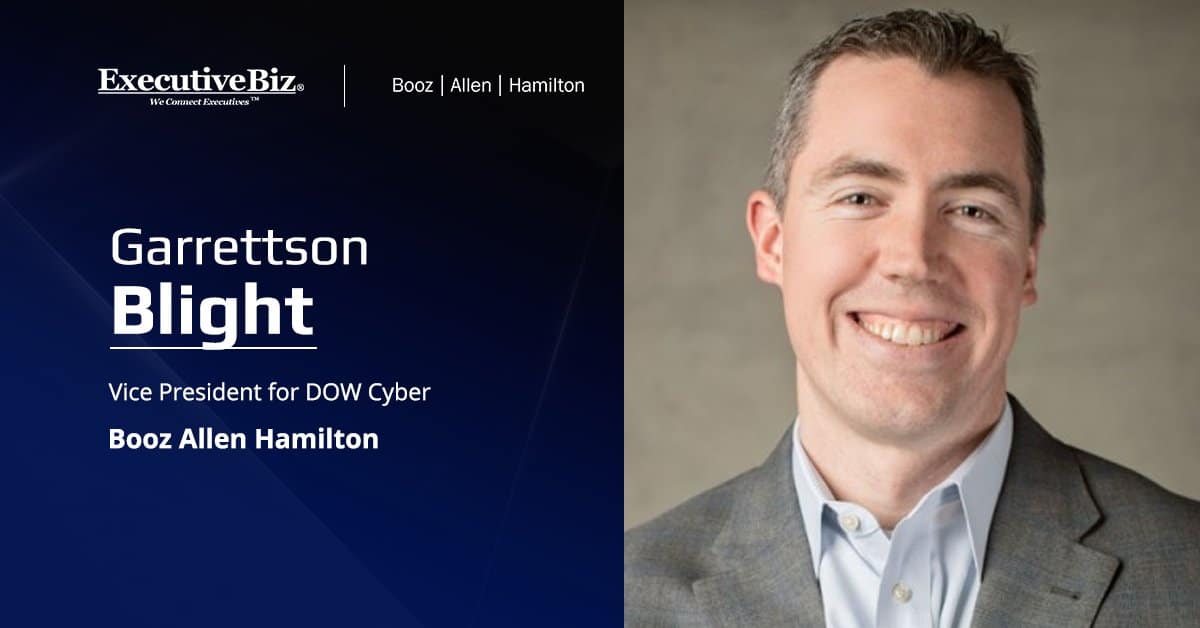
- Garrettson Blight, Booz Allen vice president for DOW cyber, uses his passion for national service to help solve the toughest government challenges.
- He views the impact of AI on the future of cybersecurity as the defining operational question of the decade.
- Blight sat down with ExecutiveBiz to talk AI, cyber, risk management, autonomy and the Pentagon’s Thunderdome zero trust initiative.
Garrettson Blight‘s passion for national service is helping him solve the toughest government challenges.
Blight currently serves as Booz Allen Hamilton vice president for Department of War cyber, where he is helping transform our domestic, partner and ally services operations in the cyber domain. Blight previously served as a Navy surface warfare officer on an Aegis cruiser during Operations Iraqi Freedom and Enduring Freedom.
Blight remains diligent in supporting Booz Allen’s advanced technology efforts through his leadership in solving the pressing challenges to our most critical missions. He sat down with ExecutiveBiz for his first Spotlight interview to discuss the most critical national security changes, how artificial intelligence is impacting cybersecurity and how Booz Allen is supporting new DOW initiatives such as applying zero trust in operational technology and transformational risk management reform.
Bolster your expertise on advanced AI initiatives at the Potomac Officers Club’s 2026 Cyber Summit on May 21! Dive into AI-driven threat detection and anomaly identification and aligning AI with zero trust and federal mandates at the AI in Cyber Defense panel discussion, featuring Leslie Nettles, Centers for Medicare and Medicaid Services acting deputy chief information security officer. Secure your seat today!
ExecutiveBiz: With your experience in national security, what are the most critical changes that you are seeing today?
Garrettson Blight: We are at a point of disruption in the world where we will continue to see rapid acceleration and change over the next decade through both technological and societal change.
Specifically, I see three important areas of focus in combat that have changed the landscape: autonomy in warfighting, cyber impact to critical warfighting infrastructure, and how AI is accelerating capabilities and decisions on the battlefield. The military is leaning into this with a renewed acquisition strategy to rapidly adjust to this changing demand in warfighting.
As a nation, we need to continue to invest and innovate in these three areas to keep our military supremacy. Booz Allen remains on the forefront of change and is partnering with the Pentagon to advance capabilities in each of these areas.
EBiz: You mentioned change. We heard from the DOW’s chief information office this past year that risk management reform is needed to meet the Pentagon’s need for adopting commercial technology. How is Booz Allen supporting that change?
Blight: For the past 20 years, Booz Allen has supported policy reforms in this area, and we continue to do that today. Over the past five years, we have led the way through prototyping and then scaling global risk reductions to cyber threats by applying zero trust across all of the DOW. We continue to extend these new defenses across all critical infrastructure.
Over the past 10 years, we have also led the development of automated systems across the DOW. This has reduced costly and manual analysis of risk management framework documentation, accelerated system speed to mission and automated continuous security monitoring. With recent advances in AI, it is time to review legacy policies and architectures that have constrained further innovation adoption.
Booz Allen is working with the DOW to propose new architectures and AI-enabled applications to modernize this infrastructure and yield efficiencies for incorporating dual-use technologies. Our investments in agentic AI are revolutionizing these processes.
Looking to win more, and larger, contracts in 2026? Then you can’t afford to miss the Potomac Officers Club’s 2026 Cyber Summit on May 21! Get the latest cyber and advanced technology partnership opportunities from Aaron Bishop, DOW CISO and acting principal deputy CIO, during his illuminating keynote. Sign up today!
EBiz: Last year, the DOW published guidance on how to apply zero trust to operational technology. With the work that you have done on the Thunderdome program in the DOW, how do you see things changing in the future?
Blight: Operational and Internet of Things technologies, and weapons systems are the logical extension of zero trust. We have solved the IT challenges in applying zero trust architectures globally and now we can extend it to other connected systems. We are proud to lead the industry in this regard as proven through the Thunderdome program.
Thunderdome was highlighted recently in congressional testimony as exemplifying the strategic shift required for effectiveness, interoperability and minimizing the adversary attack surface. To ensure military readiness through forward basing, supply chain assurance and combat-ready military platforms in all geographic theaters, the connected infrastructure of these systems need to be secured with the same assurance as our backbone systems. The adversary tacticsaccelerated from AI tooling make this an industry imperative to protect the nation.
EBiz: Regarding AI, the cybersecurity industry has seen a lot of changes for both offense and defense in recent months. How do you think AI will impact the future of cybersecurity?
Blight: This is the defining operational question of the decade. The impact is immense to both the speed and construct of conflict, but we need to frame our understanding the right way. While AI can accelerate procedures, it also has the potential to redefine military doctrine.
AI is collapsing the traditional observe, orient, decide and act—or OODA—loop in conflict and speed is the new currency. AI accelerates all workflows, both offensive and defensive. Organizations that have made the transition to AI defenses will be prepared, but those that have not begun the transformation journey are not adequately addressing the risk of the modern threat. Hardening systems is still necessary, yet defending them requires new advances. It takes AI to defeat AI.
Defensively, the construct of a cyber fusion center has morphed over the past decade and continues to evolve. Automation and orchestration of security data flows was advanced five to seven years ago, but is now a basic need for a mature fusion center.
To reduce risk, a fusion center needs to optimize data pipelines. It also needs to unlock the autonomic insights generated from agents conducting an independent triage of data and dynamically modify their technical policies to automatically take action. Through this method, networks can “self-heal” through quarantining, and other functions, to protect operations. The future is the implementation of automation in our security processes.
This transformation is already underway in the industry. Most defenses still remain stagnant in the standard process of detect, alert, triage and react. If your defense can’t operate at machine speed, there’s a gap within your system, which opens yourself to exposure. We’re in a new period of time where acting, and executing, in an instant is the new expectation.
Booz Allen is innovating in this space by complimenting our network modernization services and leading with commercial AI-enabled technology. We built Vellox, an AI-native suite of products to fight AI with AI, to accelerate traditional cybersecurity functions. These products are trained on adversary tradecraft by our elite cyber operators to accelerate defensive operations.
AI products are proliferating attacker-enabling tools beyond traditional nation-state adversaries and have commoditized cyber offense capabilities. As cyber defenders, our teams protect U.S. federal, defense and intelligence agencies alongside Fortune 500 and Global 1,000 companies. From national missions to critical infrastructure, it is imperative that we as an industry move at AI speed to counter the threat.