

 Elodie Collins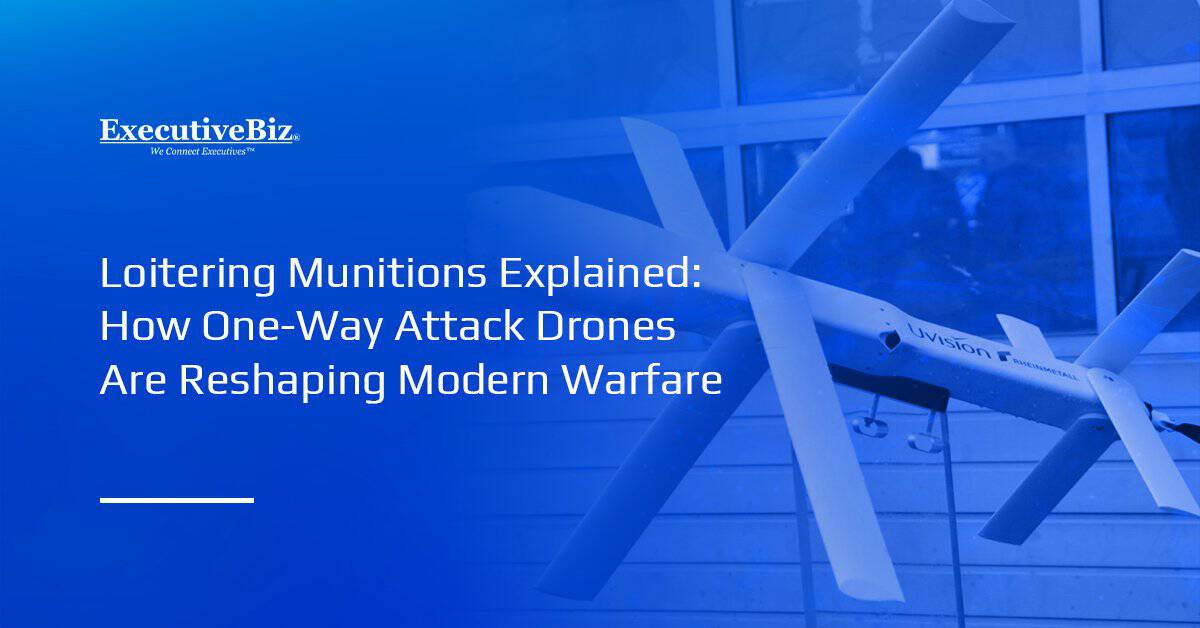
- Loitering munitions have emerged as a major threat to military forces and critical infrastructure
- The U.S. Army is developing and fielding new loitering munition platforms through programs such as LUCAS and LASSO
- The 2026 Army Summit on June 18 will host a panel on the proliferation of loitering munitions on the modern battlefield
Loitering munitions have become one of the most urgent threats to U.S. military ground forces and assets.
Over the years, Russia and Iran have increasingly deployed armed unmanned aerial systems that can stay in the air for long periods, search for targets and deliver effects. Also called one-way attack drones or kamikaze drones, loitering munitions have transformed how wars are fought.

Join Army decision-makers and industry innovators as they discuss loitering munitions and other emerging threats to American warfighters at the Potomac Officers Club’s 2026 Army Summit on June 18. Marc Andersen, assistant secretary of the Army for financial management and comptroller, and Jeff Waksman, the service’s principal deputy assistant secretary for installations, energy and environment, are among the event’s keynote speakers. Get your tickets today!
How Have Russia & Iran Utilized Loitering Munitions?
Russia has made loitering munitions a major part of its strategy since the beginning of its invasion of Ukraine in 2022.
In May, Ukrainian President Volodymyr Zelensky revealed through the messaging app Telegram that the Kremlin deployed nearly 4,000 strike assets, including over 2,300 drones, against Ukraine’s civilian infrastructure, including residential buildings, in the span of seven days, The Kyiv Post reported.
Moscow initially purchased Shahed drones from Iran, but the Kremlin now mass-produces its own one-way attack UAS domestically using smuggled Western and Chinese components, according to the Center for Strategic and International Studies.
Iran has also relied heavily on its Shahed-136 UAS to strike critical infrastructure and military facilities in the Middle East. According to the Council on Foreign Relations, Tehran has deployed thousands of one-way attack drones at Israeli and American bases in the region.
Most Iranian drones are intercepted, but some have evaded air defense systems.
One UAS attacked a command center in Kuwait in March, killing six American soldiers. Drone attacks have also destroyed radars and communications and air defense systems in Kuwait, Qatar, Jordan, Bahrain, Saudi Arabia and the United Arab Emirates, the Wall Street Journal reported.
Loitering Munition Global Demand Growing
Russia and Iran are not the only nations that have deployed loitering munitions in warfare. GlobalData said via an Army Technology article published in October that Ukraine is expected to spend $825 million annually on loitering munitions over the next 10 years.
Many countries, including the United States and China, are also developing and purchasing their own loitering munitions. By 2035, GlobalData forecasts that the global military loitering munitions market will reach $2.5 billion.
Why Is the Use of Loitering Munitions Rising?
There are multiple reasons why militaries around the world are opting for precise mass offensive weapons, such as loitering munitions. Drones are significantly worth less than traditional missiles and weapons platforms that cost over a million dollars to fire.
Militaries can also purchase large numbers of unmanned systems from the commercial sector. The Drone Dominance program, launched by War Secretary and two-time Wash100 winner Pete Hegseth in December, aims to accelerate the Pentagon’s acquisition of one-way attack drones. As of February, the Pentagon has awarded 25 companies a spot in the program.
Conflicts in Ukraine and Iran also showed that drones can saturate and overwhelm air defense systems. CSIS noted that Russia has lost drones at rates of 75 percent in attempts to deplete Ukraine’s arsenal of expensive Western interceptors.
Additionally, drones are easy for soldiers to use and adopt. Gen. James Rainey, the former head of the Army Futures Command, told Defense One in 2023 that loitering munitions can be integrated into the U.S. military’s ammunition system “with a very minimal amount of training,” unlike military vehicles and platforms that require facilities with specialized training equipment.
US Army Development of Loitering Munitions
To keep pace with the requirements of the modern battlefield, the Army has also launched initiatives to develop and deploy loitering munitions.
LUCAS
Operation Epic Fury marked the first time that the U.S. military deployed the Low-cost Uncrewed Combat Attack System, or LUCAS, a long-range, one-way attack aerial platform made in the United States, DefenseScoop reported in March.
LUCAS was made by reverse-engineering the Iranian Shahed and was produced by SpektreWorks. It has a modular design with anti-jamming capabilities and can be launched with a catapult, mobile ground and vehicle systems, or through rocket-assisted takeoff.
Navy Capt. Tim Hawkins, a spokesperson for the U.S. Central Command, told The War Zone in December that LUCAS costs about $35,000 per platform, but the technology can deliver the same effects as more expensive, traditional long-range U.S. systems.
For comparison, cruise missiles cost over $1 million apiece.
The platform is capable of flying beyond the line of sight, which is critical in CENTCOM’s vast area of responsibility, Hawkins added.
A U.S. official also shared with TWZ that LUCAS is designed for “autonomous coordination” to operate as part of a swarm or network-centric strikes.
LASSO
The Low Altitude Stalking and Strike Ordnance, or LASSO, program is meant to equip mobile brigade combat teams with loitering munition capabilities to destroy enemy armored vehicles, defilade or personnel targets with minimal collateral damage, according to a call for solutions the Army issued in 2025.
The Army has previously selected AeroVironment’s Switchblade 600 drones for the first increment of the program, according to Breaking Defense. The unmanned platforms are capable of traveling dozens of miles and loitering for over 40 minutes before delivering effects.
However, the Army wanted to add more technologies to its loitering munitions arsenal. Over the past several months, the service has awarded new contracts for new technologies to be developed and fielded under LASSO. These platforms are:
- Mistral and UVision’s HERO-90
- Textron Systems’ Damocles
- AV’s Switchblade 400
- Teledyne FLIR’s Defense Rogue 1
Who Are the Speakers in the 2026 Army Summit’s Panel on UAS?
The Potomac Officers Club is dedicating a panel on proliferating drone use in modern warfare at the 2026 Army Summit on June 18. The panel will explore the Army’s strategy to deploy loitering munitions to deliver cost-effective fires against enemy targets and address the threats of low-cost drones to U.S. military assets and personnel in contested environments.
Speakers at the Emerging Technologies at Scale: Reconfigurable Air Defense and Cost-Effective Fires panel include:
- Rodney Davis, the Army’s capability program executive aviation
- Mike Tomlinson, vice president of Army aviation, missiles and fires at SAIC
More speakers will be announced soon!
Other panels at the summit include:
- From Pilot to Production: Accelerating Commercial Capabilities at Scale
- Tech Stack After Next: What’s Still Needed to Enable a Hyperconnected Battlefield
- Future of the Tactical Edge
- Winning the Next Decade: Building the Architecture of Modern Military Advantage
- From Data to Decision: How AI is Transforming the Army Today
- Continuous Modernization Incorporating Wireless Spectrum, SD-WAN, Open Ecosystems and Cybersecurity
The 2026 Army Summit offers attendees insights into ongoing and upcoming military initiatives, changing defense procurement requirements, and evolving national priorities. There will also be plenty of opportunities for attendees to network and partner with the leaders of the defense industrial base. Sign up today to secure your seat.