
 Pat Host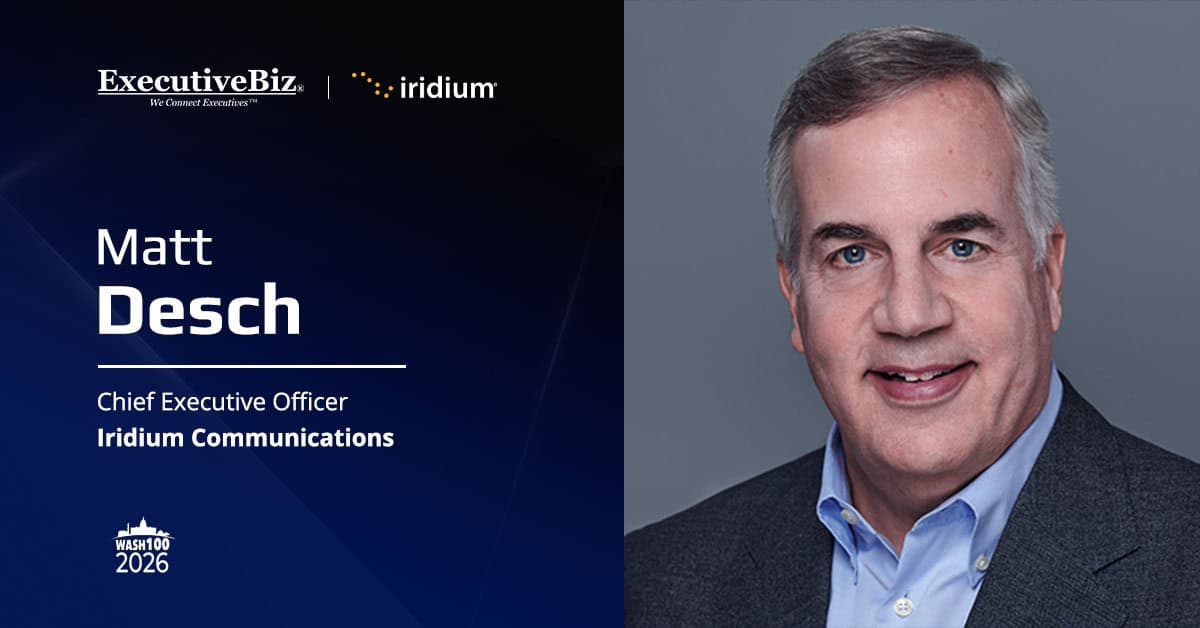
- Iridium recently made two moves, demonstrating Desch’s knack for meeting emerging needs
- The company acquired Aireon for space air traffic surveillance and Satelles for secure PNT
- Desch sat down for a Spotlight interview to discuss space, PNT, satcom and M&A
Matt Desch has a knack for seeing technology shifts early. While the Iridium CEO and 12-time Wash100 Award winner recently grabbed headlines for his market-shaping sale of Iridium to Rocket Lab, two quieter moves demonstrate just as clearly how Desch positions his firm to meet emerging needs.
Iridium in July acquired Aireon, a space-based provider of air traffic surveillance from space that he was part of creating when they launched their second-generation network, Iridium NEXT. Iridium in 2024 also bought Satelles, a developer of secure satellite-based time and location services, that he also had a hand in creating and incubating 12 years earlier.
These two companies have become some of Iridium’s fastest growing product areas in the market. In Aireon’s case, it became clear to Desch that aviation safety could be revolutionized from space and now Aireon has become a major part of Iridium’s future growth.
GovCon serves as a foundation for Iridium’s commercial business. While government is only about 20-to-25-percent of Iridium’s business, according to Desch, it is a critical customer that inspires and invests in capabilities that Iridium repurposes for commercial operators.
We last caught up with Desch in 2018 to discuss the company’s early partnership with SpaceX. ExecutiveBiz was eager to catch up with Desch for a Spotlight interview about how Iridium is preparing for the shift toward proliferated low Earth orbit satellite constellations, its role supporting resilient positioning, navigation and timing for defense users, a lesson about mergers and acquisitions for other CEOs he learned from the Rocket Lab sale and advice for companies trying to break into the government satcom market.
Discover how to tap into the Pentagon’s $149 billion research and development budget by attending the Potomac Officers Club’s 2027 Defense R&D Summit on Feb. 4. Uncover essential advanced space technologies like proliferated satellite architectures, space domain awareness and edge computing. Make your voice heard during illuminating question-and-answer sessions following thought-provoking panel discussions. Secure your seat today!
EBiz: How is Iridium positioning itself in the broader shift toward proliferated LEO constellations, especially as new commercial and government players enter the market?
Matt Desch: As many know, we were the “OG” in LEO satellite communications, going back to the mid-1990s. Our network has now been in operation for almost 30 years and has performed an important role for the government—not just our government, but many other allied governments—and commercial operators all around the world.
We’ve been using that experience, based primarily at our Satellite Network Operations Center in Leesburg, Virginia, whose team is the most experienced and competent LEO operators in the industry, to perform some of the same functions for the Space Force with the Space Development Agency’s new LEO network. We’re building and operating their ground infrastructure and operations centers.
We plan to do the same thing for other national security missions, exploiting our experience and our network, which is connected to many of these other networks, to perform valuable functions for government customers.
EBiz: How do you see Iridium’s role evolving in supporting resilient PNT as an alternative or complement to the Global Positioning System for defense users?
Desch: Our PNT capability is global, a thousand times more powerful than GPS, and cryptographically secure. It’s now been implemented into an application-specific integrated circuit for fast integration into all kinds of critical infrastructure and other important applications that are subject to GPS jamming and spoofing.
It provides an alternate signal for position, but also a critical timing source for all kinds of digital applications.
We’re at least five to 10 years ahead of anything else in the market, while other solutions are expensive or terrestrial-based and regional. We believe the timing was perfect for us to introduce this service a few years ago, as the challenges to maritime, aviation, critical infrastructure and all kinds of other applications are really mushrooming today.
Are you a GovCon technology professional? The Potomac Officers Club’s 2027 Defense R&D Summit is the can’t-miss forum for those looking to grow their GovCon business. Connection with decision-makers including top federal officials, program leaders and industry executives who shape defense R&D strategy and investment. Meet primes, nontraditional vendors and integrators to compete for future contracts. Leave armed with a full network of business and partnership opportunities for contracting success in 2027. Sign up now!
EBiz: What’s a lesson you learned from negotiating Iridium’s acquisition by Rocket Lab that you would give to other satellite CEOs who are approached about a merger or acquisition?
Desch: While obtaining a fair valuation will always be in the forefront, as that’s a CEO’s responsibility to shareholders, I think the most important thing is the actual focus and vision of what the merger will accomplish.
In our case with Rocket Lab, the ability to have a vertically integrated, self-launching space powerhouse is really important for this time in the space industry, when you’re competing against large players with their own rockets and satellites.
We knew it would help a business case close more easily on future services we create because we’d be able to quickly and efficiently launch without having to pay retail. As Rocket Lab likes to say, “one plus one will equal three” as we bring launch, satellite development and the provision of satellite services to customers—all under one umbrella.
I think if acquirers and acquired companies really focus on what will differentiate them long-term in the market and create a sustainable advantage, that’s really the key to success.
EBiz: What advice would you give companies trying to break into the government satellite communications market for the first time?
Desch: The biggest thing they need is patience.
We’re fortunate to currently be in an investor-rich environment. When I joined 20 years ago, there was very little investment in space. Today, that’s really flipped and is exactly the opposite.
Despite money flowing, it takes a long time to build a business and become successful. If you’re a communications company, you need spectrum, and that’s scarce. If you need satellites in space, you need someone to put them there, and launch providers right now are a pretty scarce resource.
Everyone promises the moon, no pun intended, but often doesn’t really achieve that on announced schedules.
I think the most important thing is a clear vision, but definitely a lot of patience and resilience to ride out the bumps, which is just necessary in anything to do with space.