
 Charles Lyons-Burt
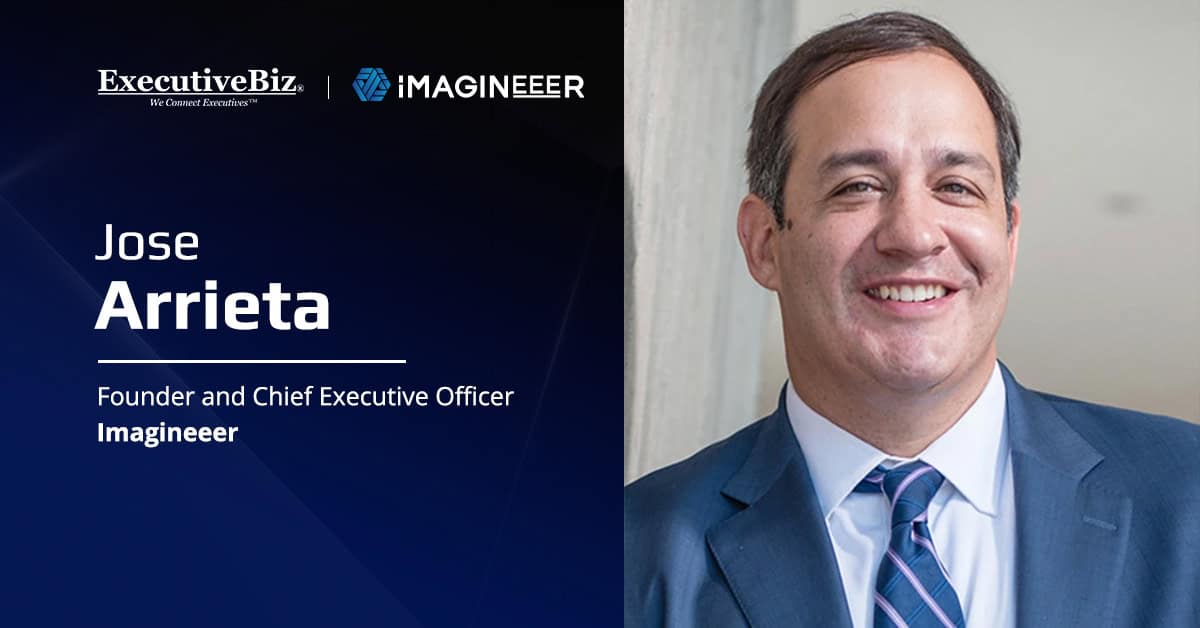
- Arrieta founded Imagineeer in 2020 after serving as HHS CIO
- Imagineeer has grown from one employee to 60 since August 2025
- A control plane keeps Imagineeer’s AI use targeted and low-cost
Before he founded technology and acquisition services company Imagineeer, Jose Arrieta set out to become a college athletic director. He was a college basketball player in the middle of a morning workout on Sept. 11, 2001, when his coach walked in with news that a plane had hit the World Trade Center. The attacks pushed him to commit himself to serving the country, and he moved to Washington, D.C., to support the government’s post-9/11 investments.
His undergraduate adviser, Bill Ward, a former Marine and Vietnam War veteran, had already been nudging him in that direction.
“Mr. Arrieta, you should consider doing something else with your life than dribbling a basketball into heaven,” Ward told him.
That path would eventually lead Arrieta to serve as chief information officer of the Department of Health and Human Services during the COVID-19 pandemic. He’ll bring that perspective to the Potomac Officers Club’s 2026 Healthcare Summit on Dec. 3, where the former HHS CIO will moderate Buying AI at the Speed of Policy: What It Actually Takes to Award, Govern and Prove Value in FY27, a panel amongst industry leaders offering practical guidance for contractors helping federal health agencies move AI from pilot to production.
Register now for the 2026 Healthcare Summit to hear from Arrieta and other federal health leaders (including CDC Director Dr. Erica Schwartz and CMS COO Kim Brandt!).
In D.C., a General Services Administration recruiter steered Arrieta toward contracting, telling him it touches every aspect of government operations. Arrieta became a contracting officer with an unlimited warrant and did the contracting work behind a roughly $500 million logistics support contract when Gen. David Petraeus took over the war in Iraq. After the attempted 2009 Christmas Day “underwear bomber” attack, he joined the Transportation Security Administration as a program manager, helping build its enrollment, vetting, adjudication and redress system.
At HHS, Arrieta oversaw a population health surveillance system that connected every state and territory, all nursing homes and all hospitals with dozens of federal agencies and private sector healthcare companies, including Cerner and Epic. His team used supervised machine learning to speed clinical trials and therapeutics distribution in about five to seven days, before Operation Warp Speed existed. The team also defended HHS against a massive distributed denial-of-service attack.
Arrieta left government at 38, turning down CIO offers from two health systems. In 2020, he founded Arlington, Virginia-based Imagineeer to help companies grow their revenue using his acquisition background. The company began pursuing federal work of its own in 2025 and has since won its first prime contract. Arrieta also served on the Department of the Navy Science and Technology Board from 2023 to 2025, focusing on autonomy programs, targeting systems, biosurveillance capabilities and mental health investments.
In this Spotlight interview with ExecutiveBiz, Arrieta discusses Imagineeer’s rapid growth, its AI control plane, the cybersecurity problem he expects to define his career and the emerging technologies the company is betting on.
ExecutiveBiz: What are Imagineeer’s core values? How do you think these values translate into continued success and growth in the GovCon market?
Jose Arrieta: When we started going after federal contracts, the first thing we realized was that we were a one-person company. Up until Aug. 12, 2025, it was just me. We were an advisory firm helping people grow revenue, and in January 2025, we decided to go after federal contracts. We thought there were only three ways we could scale, and those became our core values and our ethos.
First, we needed to identify strategic partners we could grow with. We had helped a very large company win a multibillion-dollar contract, and they never came through on their teaming agreements. So we decided to be a ready, willing and able partner to an organization we think will be responsible in its teaming agreements. Our goal wasn’t to win one contract and grow to eight people. Our goal was to capture as much past performance as possible.
We find strategic partners we can learn from and help grow revenue for. We bring our understanding of government processes and operational challenges, we win work together and they honor the relationship, because our value proposition is something they can’t replace.
Second, we have a unique opportunity in history. Any small or large business has giant teams doing proposal development, qualifying business opportunities and running HR. I used proceeds from my consulting business, plus any margin we make on our contracts, to automate the back end of our operations using agentic AI. We want to be lean enough that one or two people can prompt the operations of Imagineeer.
That efficiency matters for two reasons. One, we want onboarding and working in our environment to be frictionless, with employees accessing the information and data they need in real time. Two, Imagineeer had done a lot of commercial work across the United States and abroad, including with the Vatican and top European soccer clubs. We want to automate how we use that past performance to go after federal opportunities and punch above our weight class with our partners, because we can rapidly onboard, hire and clear people and respond to requests for information and proposals.
Third, plan to capitalize on past performance that we hadn’t earned. Most small companies win their first contract, the owner works on it, they hire six to eight people, do a good job and win follow-on work. How do we think about that from a scale perspective? I’ve led acquisition, grant, technology and small business operations, and I ran the largest contract in the world. The way we scale that expertise is we plan to bid with past performance that we don’t already have.
We built internal systems to go after opportunities and map out how to automate them. That required a lot of late nights, but it led to winning our first prime contract about a year into this journey. We’re taking the tool we built for Imagineeer’s back end and offering it to the Department of Education to productize its acquisition operations and significantly cut its costs.
Instead of being a six- to eight-person company delivering on one opportunity, we’re 60 people building out past performance while bidding on prime opportunities. With the prime contract we just won, we’ll add another 15 to 20 people.
The last thing is to hire people who are personable and truly understand customer pain points. We don’t want to be advisors to federal agencies. We want to be sounding boards. We’ve recruited a number of former federal employees, including Sarah Fitzgerald, and we’re looking for people federal leadership wants to collaborate with because they’ve been there.
Can you step out of the thought process of being a federal employee, not in a negative way, and manage an operation that serves federal employees, giving honest feedback when asked without injecting yourself into their role? That matters because in the age of AI, you cannot transform an operation unless you understand it. We’re not looking for people to execute work. We’re looking for people to understand work so we can transform it.
EBiz: How is Imagineeer using AI in a way that differentiates it from competitors?
Arrieta: Our competitors are probably trying to use AI for the same activities we are. The difference is that we’ve built a control plane that allows us to minimize our usage of AI. It moves data across our operations through boring, old-school automation, eliminating processing activities, focusing on data elements we reuse repeatedly and narrowing our AI use to the data elements most important to our business.
The most rudimentary use case of AI is dumping a set of attachments into Claude or ChatGPT and asking questions. We have nothing against that, but we wanted to be smarter about it. What are the most important data elements for running our operations? What rules should govern how they’re integrated and used? Where do they need to go, whether for accounting, invoicing or bidding? Once we understood that, we had a backbone for how the company runs, and we could target AI at more complex activities.
It sounds like we took unnecessary steps, but those steps have limited our cost of using AI and let us build controls and rule sets around the data that matters most. In the last couple of days, NVIDIA CEO Jensen Huang and Anthropic CEO Dario Amodei have been saying that’s where the market needs to go.
The idea came from the pandemic, when I realized that the way data is interpreted can fundamentally change the outcome of its meaning.
We were collecting data from every hospital in the United States. In one state, the governor’s office said we were over-reporting COVID numbers and told us, “Well, that hospital’s closed.” Our response was, “I’ve never met a closed entity that continued to respond to regulatory requests.” The hospital wasn’t closed. It was submitting data because it thought that was its regulatory responsibility.
In another case, an overworked hospital system wasn’t entering its case information every day. One Sunday, its death rate went up about 4,000 percent. When we reached out, they told us they had decided to enter the data only on Fridays.
So you need controls around data, when it should be submitted and who can access it. Otherwise, the outcome may not represent what you were actually trying to achieve. That’s where the control plane came from.
We don’t think the hyperscalers or large integrators like Accenture will want to build that control plane for government agencies, because it would create an organizational conflict of interest for them on larger work. So we think it’s an interesting place for small businesses to play.
Hear more from the former HHS CIO on how agencies can buy and govern AI at the 2026 Healthcare Summit on Dec. 3. Arrieta will moderate the summit’s Buying AI at the Speed of Policy panel alongside Jorie AI Chief Operating Officer Chris Mashburn (with more participants to be announced soon). The group may discuss:
- FY27 AI award strategies
- Measuring return on AI investments
- Post-award governance requirements
- Moving from pilot to production
- Aligning acquisition with AI policy
EBiz: Tell our audience about Imagineeer’s unique approach to the government’s toughest cybersecurity challenges.
Arrieta: For probably the rest of my career, the No. 1 cybersecurity challenge will be how you create integrity in an AI agent that’s going to work across an ecosystem, not just a network. There are point tools. Amazon has a control center that gives you visibility over all the AI agents in your environment, but that requires modernizing your entire ecosystem to Amazon Web Services. Meanwhile, most civilian agencies share data beyond their networks. HHS, for example, shares data with state and local governments and partners with private companies.
So how do you create integrity in an AI agent that’s going to leave your network, perform in a larger ecosystem and identify itself as a friendly AI agent? How does it carry a license showing it was created at HHS and what it’s able to do? What data will it be allowed to access and share? Elon Musk had a great post the other day where he had Grok go and buy something. It did everything perfectly, except the screenshot he shared exposed his addresses and payment details online. What controls are in place to govern that activity?
Our approach has been to frame that challenge for customer agencies by asking, “We understand this. Are you thinking about it?” We have the same cybersecurity past performance as everybody else, in governance, risk and compliance, privacy and network access assessments, but we’re also thinking about this problem. The historical cybersecurity work is table stakes. We focus on the emerging challenge and frame it around the agency’s mission and data assets so we can be a trusted business partner.
“Our competitors are probably trying to use AI for the same activities we are. The difference is that we’ve built a control plane that allows us to minimize our usage of AI.”
EBiz: What’s an exciting emerging technology that’s not AI that Imagineeer is utilizing?
Arrieta: Before we started government contracting, Imagineeer was lucky enough to take ownership in a number of technical ventures, and our first contract was evaluating cyber, quantum and AI technology.
We’ve been working with post-quantum encryption to transfer data securely in a post-quantum environment, as well as post-quantum optimization tools. We’re part of a team that demonstrated 14.9 quadrillion combinatorial computations in 27 seconds. Think about what that quantum-inspired processing capability means for protein folding and genetic analysis. That’s transformational.
We’ve also been deeply involved in cryptographically wrapping data elements and AI agents, embedding a record of integrity so they can leave their system of origin and carry that integrity with them. Imagine a future where 3D printers are in everybody’s garage. That market only works if you can create a technical data file to 3D print, say, a sink pipe, and wrap it with a record of integrity showing it came from you. Then when I print it in my garage, you get paid for it.
Now think of 3D printing replacement parts for unmanned systems. When a technical data file arrives at a U.S. Navy carrier strike group after crossing multiple networks, they need to know with certainty that it has integrity before they print a part. I think cruise ships will one day have unmanned systems protecting them, and shipping companies like Maersk will have fleets of unmanned systems protecting their cargo.
Last, I’m fascinated by a content challenge. You’ve probably had a video game or football game freeze when the connection drops. Right now, data packets transferred from a satellite down to a computer or TV travel in a linear format, and any interruption means you don’t get a perfect picture. In a war zone or a heavy-bandwidth environment, that becomes difficult. We’re working with a capability that lets you break content into pieces, send them out to different satellites and deliver them in any order, and the picture can be recreated in real time. That will facilitate space-based processing for space-based data centers.
Who Is Jose Arrieta?
Jose Arrieta is the founder of Imagineeer, which he launched in 2020 after more than 15 years in federal service. He most recently served at HHS as chief information officer and interim chief data officer from 2019 to 2020. Before that, he was deputy assistant secretary for grants and acquisition policy and accountability and senior procurement executive, and he also served as the department’s debarment official and acting small business executive. From 2023 to 2025, he served on the Department of the Navy Science and Technology Board, which advises Navy leadership on science, technology, acquisition and business management matters.
At GSA, Arrieta directed IT Schedule 70 contract operations, overseeing a vehicle worth about $15 billion a year, and led a first-of-its-kind proof of concept applying blockchain to automate the procurement process. Earlier, he was the first Senior Executive Service member to lead the Department of the Treasury’s Office of Small and Disadvantaged Business Utilization and chaired the governmentwide OSDBU Council. His earlier federal roles include industry liaison and ombudsman at the Department of Homeland Security, program manager at TSA, and procurement analyst and contracting officer at GSA. He has also taught as an adjunct professor at Johns Hopkins University’s Carey Business School and the University of Virginia.
What Is Imagineeer?
Imagineeer is an Arlington, Virginia-based company built around imagination, thought and a Socratic approach to creating the future. Its stated mission is to operationalize the ability to test intuition. The company began as an advisory firm helping businesses grow revenue and started pursuing federal contracts in January 2025. It has since grown to about 60 employees and won its first prime contract, with the Department of Education. Imagineeer runs its back-end operations on an AI-enabled control plane and works with emerging technologies including post-quantum encryption and cryptographic data integrity.