
 Gabriella DeCesare
The Department of the Air Force is building the DAF Battle Network to give commanders a decisive advantage in an era of multi-domain warfare, where success depends on turning massive amounts of sensor data into operational decisions faster than adversaries. By connecting sensors, communications, command-and-control systems and battle management capabilities across the Air Force and Space Force, the network is designed to improve situational awareness, accelerate the kill chain and strengthen interoperability with joint and coalition forces.
As the Department of the Air Force increasingly integrates air and space operations, success depends less on collecting more data than on turning the right information into actionable decisions faster than adversaries. During the Potomac Officers Club’s 2026 Air and Space Summit on July 30, government and industry leaders will examine how integrated sensor orchestration, data-centric architectures and commercial innovation are helping operators move from detection to decision at operational speed.
What Is Driving the Push for Faster Decision Advantage?
The Department of the Air Force is restructuring how commanders make operational decisions as modern conflicts generate more data than human operators can reasonably process. Rather than building isolated systems for individual missions, Air Force and Space Force leaders are pursuing an integrated battle network that connects sensors, platforms and operators across every domain, allowing information to move from detection to action in seconds instead of minutes.
Recent Department of the Air Force experiments demonstrate how artificial intelligence and human-machine teaming are becoming central to that vision. During the Multi-Decision Advantage Sprint for Human-Machine Teaming, or MASH, Airmen and Guardians worked alongside industry software developers to evaluate AI-enabled battle management tools capable of processing vast amounts of operational data and generating recommended courses of action across the air, space, cyber, maritime and ground domains, reported DVIDS. The initiative validated the department’s broader strategy of using machine-speed data processing while keeping human operators in control of mission decisions.
The Potomac Officers Club’s 2026 Air and Space Summit will convene senior military leaders, government officials and industry executives to discuss the technologies, acquisition strategies and operational concepts influencing the future of air and space superiority. Register today to hear firsthand how defense leaders are modernizing battle networks, accelerating innovation and strengthening national security through closer government-industry collaboration.
The panel, From Detection to Decision: Orchestration Across Air and Space Domains, will explore how the Department of the Air Force and Space Force are transforming their approach to intelligence, surveillance and reconnaissance by treating space as a fully integrated warfighting domain.
How Will the DAF Battle Network Transform Air and Space Operations?
One of the panel’s primary discussion topics will be the Department of the Air Force Battle Network, the service’s effort to create a connected operational environment spanning sensors, communications, command-and-control systems and decision-makers.
The Battle Network integrates roughly 50 programs of record to improve situational awareness, accelerate operational decision-making and provide the Air Force, Space Force and joint and coalition partners with the decision advantage needed in future conflicts. The DAF Battle Network also serves as the department’s contribution to Combined Joint All-Domain Command and Control, or CJADC2, by linking command-and-control and battle management capabilities through digital infrastructure and resilient communications. According to the Department of the Air Force, the architecture is designed to rapidly incorporate new software, data flows, algorithms and commercial technologies, allowing the services to modernize faster while maintaining interoperability across operational domains.
Panelists are expected to discuss how mission thread engineering aligns sensor capabilities with operational objectives, how data-centric architectures reduce sensor-to-decision timelines and how integrated command-and-control capabilities help commanders receive more timely, actionable information. The conversation also will examine how open architectures and human-machine teaming enable the Department of the Air Force to field new capabilities more quickly while strengthening the long-range kill chain and improving operational agility.
Why Are Commercial Innovation and Open Architectures Becoming Strategic Priorities?
The Department of the Air Force’s modernization strategy increasingly emphasizes commercial innovation alongside government-developed capabilities. During the summit discussion, panelists will explore how open architectures enable rapid integration of new technologies without requiring extensive redesign of existing systems.
According to a June 17 news release, NASA recently entered into a public-private partnership with Relativity Space for the Aeolus Mars science mission, with NASA providing the scientific payload and Relativity Space supplying the spacecraft, launch vehicle and mission operations. According to NASA, the partnership allows the agency to focus on high-value science while leveraging commercial investment to accelerate mission delivery and expand mission cadence. Although the mission supports planetary science rather than defense, it reflects a broader government trend toward leveraging commercial capabilities to accelerate complex space missions.
Where Can GovCons Learn More About Orchestration Across Air & Space Domains?
This 2026 Air and Space Summit panel brings together acquisition, operational and industry leaders responsible for delivering many of the technologies that underpin the Department of the Air Force’s future battle network. Their discussion will provide government and industry attendees with valuable insight into how integrated sensing, data orchestration and acquisition modernization are impacting the future of multi-domain operations.
Col. Ryan Frazier
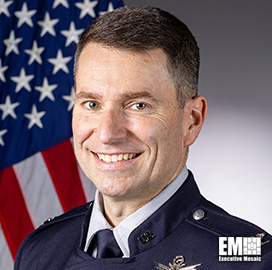
Acting Portfolio Acquisition Executive for Space-Based Sensing and Targeting
U.S. Space Force
Col. Ryan Frazier leads a nearly $40 billion portfolio spanning airborne and ground moving target indicator capabilities, environmental monitoring, tactical surveillance and reconnaissance, space data networks and tracking systems. Previously, he served as director of capability delivery for the Assistant Secretary of the Air Force for Space Acquisition and Integration and held senior leadership roles within the National Reconnaissance Office supporting mission processing and intelligence capabilities.
Col. Raj Agrawal (Pending Confirmation)
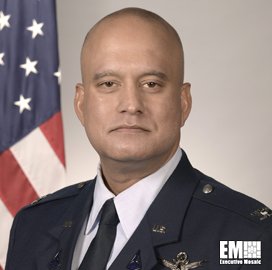
Military Deputy, DAF Portfolio Acquisition Executive for Command, Control and Battle Management
U.S. Space Force
Col. Raj Agrawal brings extensive operational command and control experience from leadership positions across multiple Air and Space Operations Centers. His background spans space battle management, offensive space control, cyber operations, missile defense and joint space operations. He currently serves as chief of future operations for Headquarters Combined Joint Task Force–Space Operations.
Col. Jason West
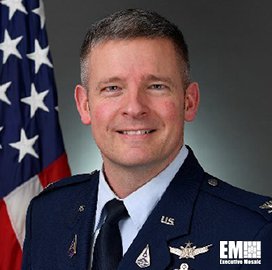
Commander, System Delta 85
U.S. Space Force
Col. Jason West leads a 750-person organization responsible for delivering sensors, software, digital systems and battle management capabilities supporting battlespace awareness and operational command and control. He oversees a $12 billion portfolio focused on achieving decision dominance through advanced space intelligence and operational capabilities.
Iain Ferguson (Moderator)

Chief Technology Officer, Air Force, Space and Intelligence Business Group
SAIC
As chief technology officer for SAIC’s Air Force, Space and Intelligence Business Group, Iain Ferguson helps guide technology strategy supporting national security missions. He will moderate a discussion focused on the technologies and operational concepts enabling faster, more informed decision-making across air and space domains.
Michael Bergen

Vice President of Air & Space
Vantor
Michael Bergen leads strategy, customer engagement and business growth for Vantor across the U.S. Air Force, U.S. Space Force and intelligence community. A former U.S. Marine, he has spent his career building partnerships throughout the geospatial and intelligence sectors while helping government organizations adopt innovative commercial technologies that improve mission outcomes.