
 Pat Host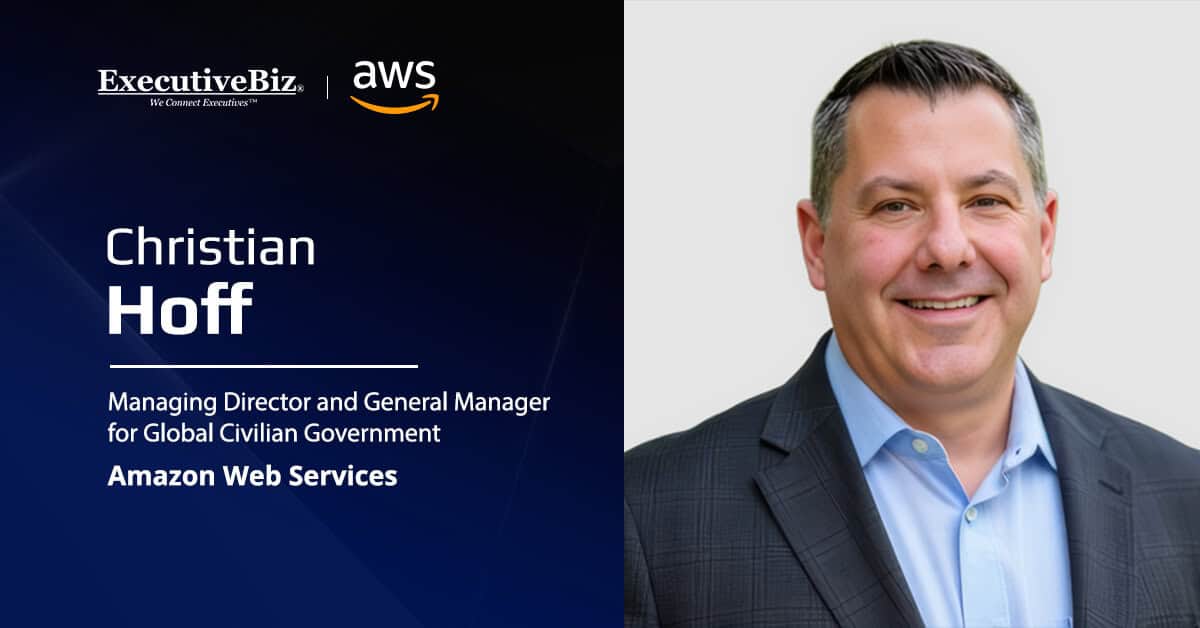
- Christian Hoff, AWS managing director and general manager for global civilian government, brings a rare combination of operational military experience, consulting acumen and hyperscale cloud expertise to GovCon.
- He previously built strategic partnerships with system integrators both large and small, as well as software as-a-service companies across the federal enterprise.
- He sat down with ExecutiveBiz to talk responsible AI, cloud computing and data security.
Christian Hoff, Amazon Web Services managing director and general manager for global civilian government, is a public sector leader whose career spans the White House, the Pentagon, the boardroom and the cloud.
A retired U.S. Army lieutenant colonel, Hoff served as a White House military social aide to the president and held assignments in the Office of the Secretary of Defense, the Office of the Joint Chiefs of Staff and Army Staff before transitioning to industry. He spent over a decade at Booz Allen Hamilton, and five years at General Dynamics Information Technology before joining AWS in 2018.
At AWS, Hoff established the federal partner team, building strategic partnerships with system integrators both large and small, as well as software as-a-service companies across the Department of War, intelligence community and civilian agencies. He then transitioned to his current role leading the U.S. federal civilian business.
Hoff brings a rare combination of operational military experience, consulting acumen and hyperscale cloud expertise to the conversation. He sat down with ExecutiveBiz for his first Spotlight interview to discuss how artificial intelligence is transforming government missions, AWS’s approach to model choice and responsible AI through Amazon Bedrock, the security advantages of the AWS cloud and how he builds a culture of innovation within his teams.
Discover new federal civilian business opportunities in AI at the Potomac Officers Club’s 2026 FedCiv Summit on October 29! Explore powering and scaling AI into action across federal missions and cybersecurity and compliance-driven initiatives with top federal officials and industry experts. Strike up new partnerships with other ambitious GovCon technology executives and score that big contract. Secure your seat today!
ExecutiveBiz: What AI trends are you seeing across government and how is AWS helping agencies tackle challenges like fraud, waste and abuse prevention, and improper payments?
Christian Hoff: Agencies are reducing improper payments, accelerating benefit delivery and detecting fraud in real time, and AI is making it possible. The pace of adoption is moving faster than any other technology solution in recent memory. Agencies are moving beyond experimentation into production deployments that directly impact mission outcomes.
The trends I see most clearly are generative AI for citizen services, agentic AI for automating complex workflows and machine learning for pattern detection at scale. We are seeing this momentum at the highest levels. The White House Genesis Mission, which aims to accelerate AI for scientific discovery across federal laboratories, is a powerful example of how government is moving from aspiration to action. AWS is proud to be a day-one partner in that effort.
Fraud, waste and abuse prevention is one of the most compelling use cases. The scale of the problem is staggering: improper payments across federal programs totaled $236 billion in fiscal year 2023 alone, according to the Government Accountability Office. Traditional rules-based approaches simply cannot keep pace with the sophistication and volume of fraudulent activity. What AI brings to the table is the ability to analyze massive datasets in real time, identify anomalous patterns that human reviewers would miss and flag suspicious transactions before payments are disbursed rather than after.
At AWS, we are working with agencies and partners to deploy AI-powered fraud detection systems that integrate with core financial systems and operate in real time. These solutions combine advanced analytics, machine learning models trained on historical payment data and generative AI capabilities that can reason through complex scenarios.
We are already working with a large civilian agency to move from a “pay and chase” model, where it tries to recover improper payments after the fact, to a preventive model that stops bad payments before they go out the door. When even a single percentage point improvement in detection rates translates to billions in taxpayer savings, the return on investment is extraordinary.
EBiz: How does AWS’ approach with Amazon Bedrock and Quick give government customers the access and choice they need when it comes to AI models?
Hoff: One of the core principles we operate on at AWS is that there is no single AI model that is best for every use case. Different missions require different capabilities: some need models optimized for reasoning, others for code generation and others for summarization or image analysis. That is why we built Amazon Bedrock around the concept of model choice.
Bedrock is a fully-managed service that gives customers access to leading foundation models from multiple providers, including our own Amazon Nova family, through a single application programming interface. Government customers can evaluate, compare and switch between models without rewriting their applications or changing their infrastructure.
We provide built-in evaluation tools that help agencies balance performance, cost and accuracy so they can make informed decisions about which model best fits their specific mission requirement. For example, an agency might use a Nova model for high-volume document summarization and a different model for complex legal reasoning, both through the same API and within the same compliance boundary.
Amazon Quick extends this philosophy of choice and flexibility into the daily work of government teams. Rather than functioning in a silo, Quick can query a wide range of applications, enabling AI agents to query and take direct actions from a single workspace. For agencies managing complex, multi-system environments, Quick provides actionable answers without switching between tools.
For government customers specifically, this flexibility is an operational necessity, not just a convenience. Amazon Bedrock in AWS GovCloud (US) has achieved FedRAMP High authorization and DOW Impact Level 4 and 5 provisional authorization. This means agencies can access leading AI foundation models while meeting their most stringent compliance requirements.
Equally important, in Amazon Bedrock, customer data is never used to train or improve base models and is never shared with model providers. Agencies retain full ownership and control of their data. That is a commitment we take extremely seriously.
Beyond GovCloud, Amazon Bedrock is generally available in the AWS Secret and Top Secret regions, making it accessible across the full spectrum of U.S. government data classifications.
Want to win more, and larger, federal technology contracts? Then you can’t afford to miss the Potomac Officers Club’s 2026 FedCiv Summit on October 29. Gain exclusive insight into powering and scaling AI across the government; data, cloud and computing infrastructure; cybersecurity and compliance-driven initiatives, and much more. Learn how priorities are influencing procurement and partnership decisions and what government leaders expect from trusted industry partners. Buy your ticket now!
EBiz: Security is always top of mind for government. What makes AWS uniquely positioned to support agencies’ security requirements, particularly as they adopt AI?
Hoff: Security is our highest priority at AWS, what we call ‘job zero.’ It is the foundation upon which everything else is built. Frankly, the urgency has never been greater.
The Cybersecurity and Infrastructure Security Agency’s Known Exploited Vulnerabilities catalog grew 20 percent in 2025 alone, topping 1,480 entries, many targeting the exact legacy systems federal agencies still operate. Federal agencies reported over 30,000 IT security incidents in FY 2022, and 567 Government Accountability Office cybersecurity recommendations remain unimplemented. The reality is that aging on-premises infrastructure running end-of-life software that no longer receives security patches leaves agencies exposed to known exploits every single day.
AWS directly addresses these security gaps in ways that legacy data centers simply cannot. We maintain 143 security certifications, including FedRAMP, FIPS 140-3, NIST 800-171, PCI-DSS and HIPAA, on a continuous basis, rather than as point-in-time assessments. We enable 40 percent faster security patch implementation through automated deployment pipelines, directly addressing the chronic patching delays that plague on-premises environments. Our integrated threat detection suite delivers significantly stronger detection and faster incident response than siloed legacy tools.
We also provide secure operations across commercial, government cloud, secret and top secret classification levels with consistent security controls. Our architecture is zero-trust-ready by design, which is critical given that many agencies have not yet fully implemented zero trust on their legacy infrastructure.
For AI specifically, Amazon Bedrock Guardrails help agencies prevent harmful content and hallucinations through automated reasoning checks, while customer data is encrypted in transit and at rest with agency-controlled keys. Gartner has noted that cloud platforms offer inherently stronger baseline protection than on-premises environments. When you combine that with the fact that agencies stuck on legacy systems cannot even adopt generative AI or real-time analytics securely, it becomes clear why more agencies are treating cloud migration not just as modernization, but as a security decision.
EBiz: How do you encourage teams to take risks in an environment where failure can have high public visibility?
Hoff: At AWS, we have a concept of “working backwards” from the customer. That discipline forces teams to think rigorously about outcomes before they build. But we also embrace the idea that not every initiative will succeed and that is acceptable as long as we learn from it. I tell my teams that the cost of inaction, of not innovating, is far greater than the cost of a well-considered experiment that does not pan out.
The key is creating psychological safety while maintaining accountability. I encourage teams to take calculated risks, to pilot new approaches with willing agency partners and to share results transparently, including what did not work. Early in my time leading the federal civilian segment, we invested heavily in a particular approach to cloud migration that we believed would accelerate agency timelines. It did not deliver the results we expected.
But the lessons from that effort directly shaped the playbook we use today, which has been far more effective. In government, where public trust is paramount, I have found that agencies actually respect a partner who says “we tried this, here is what we learned and here is how we are adjusting.” Ultimately, innovation requires courage, and courage requires a culture that rewards learning over perfection.