
 Pat Host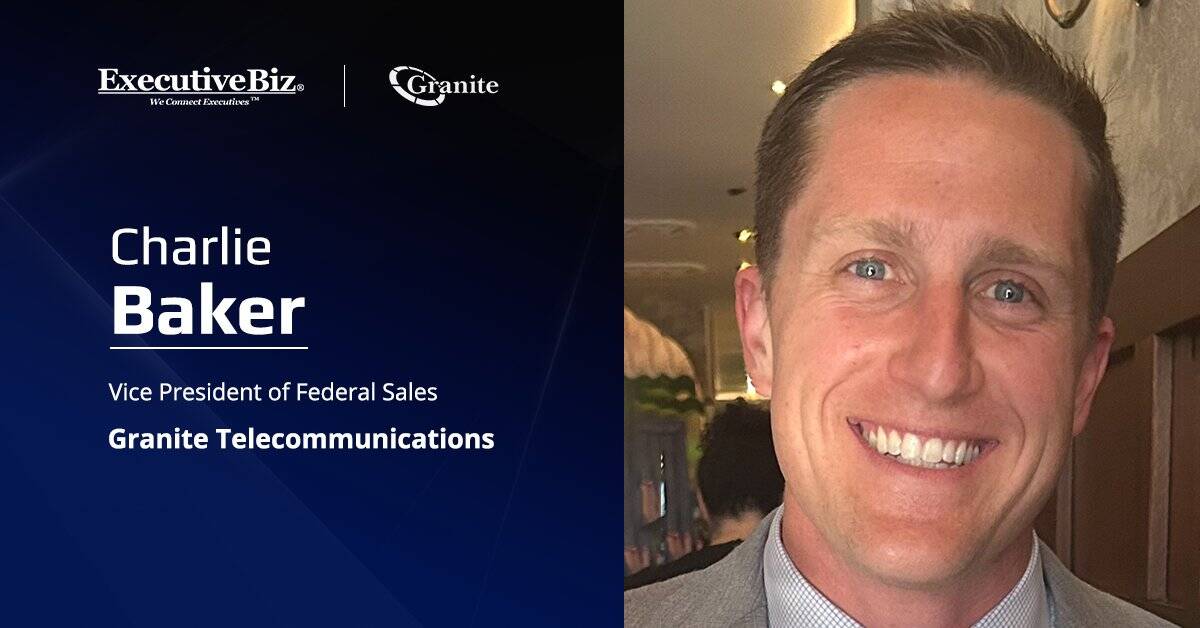
- Charlie Baker, vice president of federal sales at Granite Telecommunications, is helping federal agencies transition from legacy copper wire telephony to internet-based systems.
- This creates a major challenge as copper phone lines support everything from fire and elevator alarms to desk phones
- He sat down with ExecutiveBiz to talk AI, internet-based telecom and why updated infrastructure is critical for AI development
The copper wires and legacy telephony that have served as the bedrock of federal communications for generations are going away. Charlie Baker is helping agencies successfully make the transition to internet-based systems.
Baker, Granite Telecommunications‘ vice president of federal sales, leads the company’s work to bring modern communications infrastructure into government environments. Federal agencies and the Pentagon are making huge investments in the modernization of telecom infrastructure across their communications systems and networks. Granite is the leader for innovation in both of those areas.
Granite Telecommunications is a $2 billion business based outside of Boston that has been competing in the federal marketplace for just over a decade. It is extremely well-known in the commercial realm as 80 companies in the Fortune 100 use Granite for telecom and internet access, according to the company.
Baker sat down with ExecutiveBiz for his first Spotlight interview to discuss the federal transition from copper wires to internet-based telecom infrastructure, why proper bandwidth is important to artificial intelligence development and how the Pentagon eliminating the Joint Capabilities Integration Development System will impact contracting.
Dive into mission engineering as a defense transformation framework at the Potomac Officers Club’s 2026 Digital Transformation Summit on April 22! Learn about building a digital backbone for warfighter advantage at the Mission Engineering at Scale: the Digital Backbone of Defense Modernization panel discussion. It features Daniel Hettema, Pentagon director of digital engineering, modeling and simulation; and Col. Scott Klempner, Space Systems Command deputy program executive officer. Sign up now!
ExecutiveBiz: What’s the state of play with the copper sunset and fire and life safety phone lines?
Charlie Baker: Copper phone lines are exactly what they sound like: metal-based infrastructure that has run throughout the U.S., federal buildings and military bases for decades. That infrastructure has long been used to carry traditional telephony data.
Historically, when someone picked up a phone, that call traveled over a copper line to a central office and then out to the destination. Those days are ending quickly. Large telecom carriers are shutting down copper because it’s expensive to maintain, especially compared to internet-based alternatives.
This creates a major challenge for a number of reasons. Copper phone lines support everything from fire and elevator alarms to desk phones. They are one-size-fits-all. But modernizing them, unfortunately, is not a one-size-fits-all solution. So not only is this foundational one-size-fits-all nationwide technology infrastructure going away, but its solutions for modernizing are also the opposite of one-size-fits-all.
The market for modernization solutions is extremely competitive, strategically diverse and technologically-splintered. Depending on the approach and your needs, an IT or telecom leader may have to choose between over 50 different technologies to replace their copper and time-division multiplexing circuit inventory.
Granite Telecommunications’ role is to help customers quickly move off those legacy lines and networks by offering turnkey and managed solutions that fit a wide variety of telecom needs. In a typical telecom environment, most lines support standard voice calls, but a meaningful percentage support other functions such as fire and elevator alarms, supervisory control and data acquisition systems, and fax machines. Those use cases require specialized solutions.
That’s where EPIK comes in. It’s a managed phone-line replacement service that includes dual cellular redundancy using premier cellular provider networks, plus a wireline connection and encrypted backhaul over Granite’s nationwide software-defined wide area network. It also includes battery backup.
So the state of copper and legacy telephony is simple: it’s going away. What used to be a one-size-fits-all solution has splintered into many different modernization paths and agencies have to make those decisions quickly. Granite is helping simplify that process.
EBiz: Why is it important to have increased bandwidth and updated infrastructure for AI development?
Baker: The last major bandwidth surge happened when companies started moving to the cloud. As organizations shifted data from on-premises servers into off-site data centers, they needed bigger network pipes to carry that traffic.
AI is a much larger version of that same challenge. The amount of data organizations will need to move back and forth between facilities, applications and data centers is far greater than what was required for cloud adoption.
Bandwidth is fundamentally about physical infrastructure: having the capacity to move large amounts of data reliably and quickly. AI workloads will require more bandwidth and redundancy, and better failover capabilities.
A lot of the GovCon conversation around AI focuses on software and use cases. What gets less attention is the infrastructure required to support those tools. That means bigger pipes, upgraded networks and major modernization projects.
One example is the Federal Aviation Administration’s Brand New Air Traffic Control System, or BNACS, program, which is fundamentally about infrastructure modernization. That’s a smart approach because agencies first need the proper network foundation before they can take advantage of advanced technology.
EBiz: What has changed in the last six months in terms of government risk tolerance around AI-enabled decision-making?
Baker: There’s no question the government is becoming more curious about AI. I wouldn’t say its risk tolerance has dramatically changed, though, and that’s a good thing.
The data and missions handled by the military and the federal civilian government are sensitive and important. As a taxpayer, I don’t want that information exposed carelessly, and our adversaries are absolutely looking for weaknesses in modernization efforts.
One Army customer said something last year that stuck with me: “We’re not selling teddy bears.” That captures the seriousness of the mission. AI and modernization matter and they can absolutely solve real problems, but speed cannot come at the expense of cyber assurance and risk mitigation.
The appetite is there. The interest is real. But it’s not being approached lightly and that’s appropriate.
Are you a GovCon technology executive? Then you cannot afford to miss the Potomac Officers Club’s 2026 Digital Transformation Summit on April 22. Get the last partnership opportunities and spending priorities from Kirsten Davies, Pentagon chief information officer and Wash100 Award winner, during her keynote speech. Secure your seat today!
EBiz: How will the Pentagon getting rid of the Joint Capabilities Integration and Development System process affect how you provide goods and services to warfighters?
Baker: I think it’s a big deal for the Pentagon and a meaningful change for government contractors. At the same time, contracting has always involved adapting to the government’s rules, processes and vehicles.
When you work closely with government customers, you realize these aren’t abstract systems—they’re people trying to get things done under real constraints. In many cases, especially in defense and intelligence, they have very good reasons for being cautious.
Removing or changing a process like JCIDS may streamline some things, but it will also create friction elsewhere. Those same oversight checkpoints won’t disappear, they’ll just show up in different forms.
One thing I find interesting about the current Federal Acquisition Regulation and contracting reforms is that they are creating more communication between government and industry. That’s positive. But they are also generating a lot of interest and noise. More companies want to participate, which means more proposals, paperwork and pressure on contracting officers.
So while I think the intent is strong and the desire to open the door is real, it’s not purely a net-positive simplification. It also means more education is needed so companies understand how to compete effectively in the federal market.
EBiz: Anything else you’d like to mention?
Baker: The main point I’d leave you with is when it comes to telecom, internet access and voice modernization, we want government customers to ask for what they actually want—not just what they think they can get.
A lot of customers write requirements very generically because they’ve been disappointed by the telecom industry in the past. On the commercial side, Granite Telecommunications has been successful because we provide highly tailored, high-touch customer experiences for major companies like Walmart, the U.S. Postal Service, Target, Lululemon and Apple.
Those companies come to Granite with very specific requirements about how they want to view and manage their services, and we meet them where they are. We want to do the same for the federal government.
We have capabilities that many competitors don’t offer, but if customers don’t ask for them, we don’t get the chance to demonstrate what’s possible.