
 Pat Host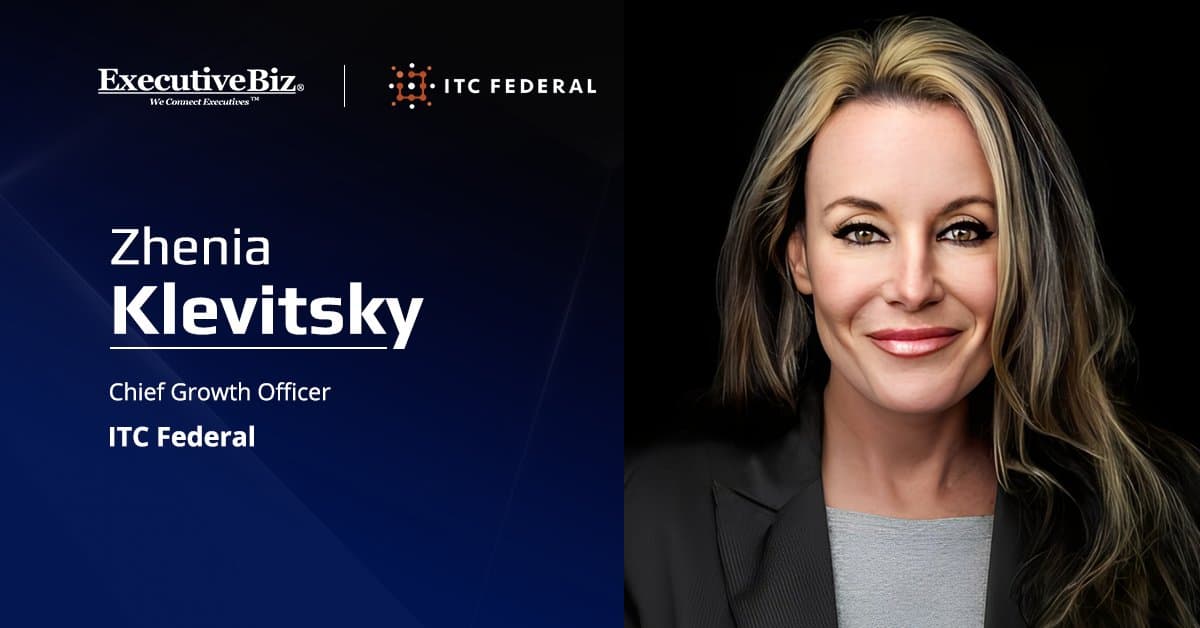
- Zhenia Klevitsky believes GovCon success is best measured by mentorship
- The ITC Federal CGO says developing a strong bench of leaders proves growth is durable
- She sat down with ExecutiveBiz to discuss AI pilots and advice for scoring that first contract
Zhenia Klevitsky believes success in GovCon is measured in more than just contract wins. The ITC Federal chief growth officer believes while a strong portfolio proves you can execute, a bench of leaders one has developed proves the growth is durable.
Why not pull junior staff into capture strategy sessions before they’re “ready”? This gives them room to run a proposal or a customer call and can provide opportunities to coach them through what goes wrong. It’s important to be honest about the judgment calls that never show up in a playbook. Klevitsky prioritizes being deliberate about developing the people behind her, helping them grow into capture or business development leaders in their own right.
Klevitsky is now building ITC Federal’s growth into a single integrated engine: capture, business development and proposals operating under one strategy. She owns that pipeline end-to-end: shaping opportunities early, deciding where we compete and carrying that same strategy through to proposal so nothing gets relitigated three months later at the 11th hour.
We last connected with Klevitsky for an Executive Spotlight in September to talk ITC Federal’s portfolio expansion and how GovCon has changed during her 25-year career. We caught up with Klevitsky for a new Spotlight interview to discuss how she measures whether to scale an artificial intelligence/machine learning pilots instead of shelving it, whether to grow organically rather than through acquisition and her advice for GovCon firms that regularly make it to final rounds of bidding without winning.
AI is reshaping how the Navy plans, fights and sustains its fleet. Get the latest business opportunities in naval AI applications at the Potomac Officers Club’s 2026 Navy Summit on Aug. 27. Dive into enabling predictive maintenance and expanding industry collaboration across the shipbuilding ecosystem at the Building the Golden Fleet with Software panel discussion from leading Navy officials and industry experts:
- Shery Thomas, Navy Installations Command enterprise IT officer
- Robert Keisler, Naval Information Warfare Center senior scientific technical manager, data science and analytics engineering competency senior manager
- Edmond Kuqo, Navy Raise technical warrant holder AI/LLM
- David Voelker, Navy zero trust architecture lead
- Capt. (retired) Rich Sussman (moderator), SAIC director of business development
- Rob McGregor, Amazon Web Services senior manager for DOW solutions architecture
Being a strong, safe choice isn’t the same as being a compelling one. If your proposals read like a capable version of everyone else’s, you’ll keep making the final round and keep losing it.
ExecutiveBiz: What metrics do you use to decide whether an AI/ML pilot is worth scaling versus quietly shelving it?
Zhenia Klevitsky: I’ve learned to distrust pilots that only prove the technology works; that’s the easy part. The metrics that matter are the ones that predict survival past the pilot phase.
First, is there a measurable mission or operational outcome, such as time saved, error rate reduced and throughput increased, that a program office can defend in a budget conversation? If the only benefit is “it’s innovative,” it’s not ready to scale.
Second is adoption. Are the actual end users including analysts, caseworkers and inspectors, using it without being told to, or does it require constant championing to stay alive? Forced adoption is a signal to shelve.
Third, I look at the path to procurement and sustainment. A pilot that only works because it’s hand-fed by a small team of contractors isn’t a program, it’s a demo. I want to see a credible plan for who owns it, funds it and maintains it once the pilot budget runs out.
Fourth is technical debt and data readiness. Does scaling this require the agency to fix upstream data quality or system integration issues they haven’t budgeted for? If yes, that’s often the real reason a pilot dies quietly a year later, and I’d rather surface it early.
Finally: executive sponsorship on the customer side. AI pilots that scale usually have a named champion inside the agency who’s willing to defend the investment when priorities shift. Without that person, even a technically successful pilot tends to lose momentum.
To put it simply, I’m scoring pilots less on “did it work” and more on “would this survive contact with next year’s budget cycle.”
EBiz: How do you decide when to grow organically versus pursue an acquisition to add a capability or customer relationship?
Klevitsky: It comes down to speed, cost and what’s hard to come by. If the capability gap is a skill set we could reasonably hire or train into over 12–18 months, it may be better to build it.
Acquisition earns its premium when what we’re really buying is something that can’t be built on a timeline that matters. Such as an incumbent customer relationship, a security clearance base, a contract vehicle with a closed competition window or a very specific technical pedigree that took someone else years to earn.
Asking blunt questions before recommending a deal is important:
- Could we win this business organically within a realistic bid cycle?
- Is the target’s value mostly in its people and relationships, or in a repeatable asset like intellectual property or a contract vehicle? People-dependent acquisitions carry much higher integration risk
- Critically: do we have the bandwidth to integrate well?
A capability we acquire, but mess up on integration, is worse than not having it at all. It damages trust with the very customer relationship we bought. In the end, the right call comes down to whichever path gets us the capability fastest without giving up more time, control or cultural fit than the opportunity is worth.
The Navy budget is expected to grow by 23 percent to $378 billion in FY 2027. Join the conversation on how the service plans to spend that budget boost by attending the Potomac Officers Club’s 2026 Navy Summit on Aug. 27. Network with other ambitious GovCon professionals and score that big contract. Get your pressing questions answered by our slate of leading Navy officers following their keynote addresses:
- NEW—Vice Adm. Rob Gaucher, Navy director of submarine programs
- Vice Adm. Brad Skillman, deputy chief of naval operations for the integration of capabilities and resources, N8
- Barry Tanner, Navy acting chief information officer
- Vice Adm. Michael Vernazza, commander of naval information forces
- Lt. Gen. Joseph Matos, Marine Corps deputy commandant for information
Buy your ticket now for this highly regarded GovCon event!
EBiz: The government shutdown lasted over six weeks last year. What did that teach you about leading growth and business development through funding gaps?
Klevitsky: It reinforced lessons I’d learned in smaller doses before, but at a scale that made them non-negotiable, particularly from a growth and business development seat rather than a general operations one.
The first is pipeline diversification, not just across agencies but across funding types: pursuits tied to multi-year or working capital funds kept moving through the shutdown in a way that annually-appropriated work didn’t. That mix now factors directly into how I build and prioritize the pipeline.
The second is contract vehicle selection. Vehicles and work that are less exposed to appropriations lapses are now a real factor in capture strategy. These are not just a nice-to-have, because a strong vehicle stack doesn’t help if the underlying funding freezes the moment Congress stalls.
The third is communication with the capture and business development teams specifically: a shutdown stalls solicitations and slows customer conversations, and not knowing which pursuits were still live was worse for morale than knowing a pursuit was simply delayed.
Fourth, it sharpened how I think about bid-and-proposal discipline. Chasing every opportunity that resurfaces the moment funding returns burns capture dollars we can’t always get back. Lastly, it was a reminder that resilience in growth leadership means protecting the customer relationships and pursuit momentum built before the gap, so business development isn’t starting from scratch once funding resumes.
I’m scoring [AI] pilots less on ‘did it work’ and more on ‘would this survive contact with next year’s budget cycle.’
EBiz: What’s your advice for a company that keeps making it to the final round of a bid, but never quite wins?
Klevitsky: That pattern almost always has a specific, fixable cause and the fix is rarely “try harder.”
Start with debriefs and read them like data, not like disappointment. If you’re consistently strong technically, but losing on price, that’s a pricing strategy and cost realism problem, not a technical one.
If you’re losing on past performance references, it means your proposals are telling a technical story instead of a relevant-experience story. Evaluators want to see themselves in your past performance, not just be impressed by it. I’d also look hard at the oral presentation and orals team: a strong written proposal with a flat oral performance loses more competitions than people admit.
Teaming choices matter, too. Finalists sometimes lose because their team, while capable, doesn’t visibly strengthen the government’s confidence in a specific known risk area of the requirement. Often, the real issue is discriminators: being a strong, safe choice isn’t the same as being a compelling one. If your proposals read like a capable version of everyone else’s, you’ll keep making the final round and keep losing it.
Treat every debrief as a diagnosis, not a formality. The companies that break this pattern are the ones that act on what the debrief actually says instead of re-running the same playbook on the next pursuit.