
 Pat Host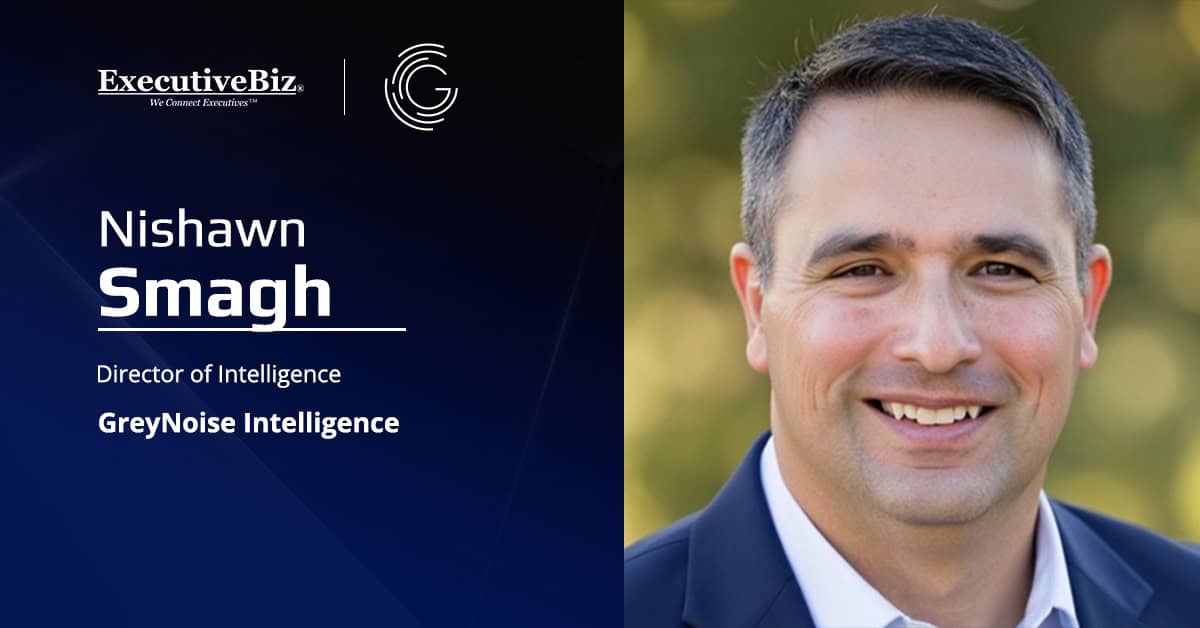
- Nishawn Smagh, intelligence director at GreyNoise, understands that success depends on combining operational expertise, intelligence, innovation and strategic decision-making.
- He’s working to establish GreyNoise as the authoritative intelligence voice on internet-wide reconnaissance and pre-exploitation activity.
- Smagh sat down with ExecutiveBiz to talk about how AI is changing both cybersecurity and threats, how cloud is changing intelligence and concerns about adversaries using AI offensively.
Nishawn Smagh understands that technology alone is never the answer. The GreyNoise director of intelligence learned during his 25 years as an Air Force intelligence officer that success depends on combining operational expertise, intelligence, innovation and strategic decision-making.
This realization drew Smagh to the private sector, where he continues supporting national security while helping bridge mission needs with emerging capabilities. At GreyNoise, Smagh helps governments and enterprises better understand adversary behavior before it becomes operationally significant.
Whether in uniform or in industry, Smagh’s mission remains consistent: help organizations anticipate threats, make informed decisions and maintain an advantage in increasingly complex environments.
Smagh is committed to establishing GreyNoise as the authoritative intelligence voice on internet-wide reconnaissance and pre-exploitation activity. While cybersecurity has typically focused on understanding compromises after they occur, he believes the future of cyber defense requires better focus on understanding adversary behavior before compromise takes place.
Smagh sat down with ExecutiveBiz for his first Spotlight interview to discuss how AI is changing both cyber defense and threats, concerns about adversaries using AI offensively, how cloud computing is changing intelligence operations and how AI is changing discovery and exploitation of zero day vulnerabilities.
Gain expertise on building a resilient network for contested environments at the Potomac Officers Club’s 2026 Air and Space Summit on July 30! Dive into securing real-time data sharing across global operations and sustaining decision advantage through adaptive infrastructure at the Winning the Digital High Ground panel discussion, featuring Didi Kuo, National Reconnaissance Office chief for geospatial intelligence systems acquisition directorate (pending confirmation). Sign up today!
ExecutiveBiz: How is AI changing both cyber defense and cyber threats?
Nishawn Smagh: AI is fundamentally changing cybersecurity by accelerating both offense and defense.
From an adversary perspective, AI is increasing the speed, scale and sophistication of cyber threat operations. It lowers barriers to entry for less-skilled actors, enhances the capabilities of advanced threat groups and expands the attack surface through the rapid adoption of AI-enabled systems. We are entering an era where vulnerabilities can be discovered and analyzed at unprecedented speed, dramatically changing the pace of cyber operations.
At the same time, AI presents a transformative opportunity for defenders. It can accelerate threat discovery, improve understanding of complex adversary activity, enhance decision-making and enable more effective actions. Organizations that successfully integrate AI into their security operations will be better positioned to operate at the speed and scale required to counter modern threats.
The strategic challenge is not simply adopting AI; it is combining AI with full-spectrum data, high-quality intelligence and experienced operators. Organizations that successfully integrate these elements will be able to create decision advantage faster than adversaries can create operational advantage.
For senior leaders, the implications extend beyond technology adoption. AI is reshaping how organizations assess risk, allocate resources and make operational decisions. The organizations that gain advantage will not necessarily be those with the most advanced AI models, but those that can effectively integrate AI into decision-making processes, operational workflows and security strategies.
Ultimately, AI is not replacing human expertise. It is amplifying it. The future belongs to organizations that can combine machine-speed analysis with human judgment. The defining challenge of the next decade will be operating at machine speed while preserving the human judgment required to make sound decisions.
EBiz: What concerns exist around adversaries using AI offensively?
Smagh: The primary concern is that AI is changing the economics of cyber conflict.
Historically, sophisticated cyber operations required significant expertise, time and resources. AI is reducing those barriers by enabling adversaries to automate and accelerate activities such as reconnaissance, vulnerability discovery, exploit development, phishing, social engineering and operational planning.
As vulnerability discovery becomes increasingly automated, the timeline between discovery and exploitation will continue to shrink. This compresses the defender’s decision window and increases the likelihood that adversaries can exploit weaknesses before organizations fully understand their exposure. This compounds the current challenges faced by defenders as many organizations do not understand their current level of exposure.
AI is also making malicious activity more convincing and more scalable. Generative AI can produce highly personalized phishing campaigns, synthetic identities, deepfake content and multilingual social engineering operations that challenge traditional detection methods and security awareness programs.
From a national security perspective, this shift has broader implications for deterrence and stability in cyberspace. When offensive capabilities become more accessible, scalable and adaptable, traditional assumptions about attacker sophistication and resource requirements begin to change. Leaders must prepare for an environment where cyber threats emerge more quickly, evolve more rapidly and can be executed by a wider range of actors than ever before.
The broader concern is not simply that attackers can do today’s activities faster. AI may enable entirely new patterns of cyber operations that function at machine speed. Organizations that continue to rely exclusively on human-speed detection and response models will increasingly struggle to keep pace.
The future of cyber defense will require greater emphasis on predictive intelligence, understanding adversary behavior before compromise occurs, automation and high operator proficiency. Success will increasingly depend on identifying intent, anticipating activity and disrupting threats before they become operationally significant.
Are you a GovCon technology professional? Then you cannot afford to miss the Potomac Officers Club’s 2026 Air and Space Summit on July 30. Gain actionable business intelligence for revenue growth in FY 2027 from our stellar lineup of the most prestigious technology executives in national security:
- Gen. John Lamontagne, Air Force vice chief of staff
- Matt Anderson, NASA deputy administrator
- Tom Ainsworth (pending confirmation), acting Air Force secretary for space acquisition and integration
- Anthony Baity, Air Force assistant deputy chief of staff for logistics, engineering and force protection
- Dr. Eliahu Niewood (pending confirmation), Air Force director for integrated capabilities
Secure your seat now for this highly anticipated GovCon event!
EBiz: How is cloud adoption changing intelligence operations?
Smagh: Cloud adoption is transforming intelligence operations by shifting organizations from infrastructure-centric models to data-centric and decision-centric models.
Historically, intelligence organizations operated across fragmented systems, specialized hardware and disconnected databases. While those environments served important purposes, they often slowed analysis, limited collaboration and complicated information sharing.
Cloud technologies enable centralized access to data, scalable computing resources and secure collaboration across teams, agencies and geographic locations. As a result, analysts can access, correlate and analyze vast amounts of information from a common environment, significantly reducing research time and accelerating insight generation.
The most significant impact is not technological; it is operational. Cloud environments accelerate rapid sense-making, allowing organizations to transform data into actionable intelligence faster than ever before. Tasks that once required days of searching across multiple systems can often be accomplished in minutes.
When combined with AI and machine learning, cloud platforms can automate routine analytical tasks, surface hidden relationships within large datasets and help analysts focus on higher-value judgment and decision-making.
Equally important, cloud adoption is helping break down organizational and institutional barriers that have historically slowed intelligence operations. By creating shared environments for data, analytics and collaboration, cloud technologies enable a more integrated approach to mission execution. This improves operational efficiency while enhancing the ability of organizations to respond collectively to rapidly evolving threats and mission requirements.
The organizations that gain advantage in the future will not necessarily be those that collect the most data. They will be the organizations that can most effectively transform data into decisions and actions. Cloud adoption is a foundational enabler of that capability and is increasingly becoming a strategic requirement for intelligence organizations seeking to operate at the speed and scale of today’s mission environment.
EBiz: How is AI changing the discovery and exploitation of zero-day vulnerabilities?
Smagh: AI is reshaping vulnerability research by dramatically increasing the speed, scale and efficiency of vulnerability discovery.
AI-powered systems can analyze large codebases, identify anomalous behavior, reason through complex software logic and uncover exploitable weaknesses far faster than traditional manual approaches. Activities that once required extensive software analysis, security testing and code inspection can increasingly be accelerated through AI-assisted workflows.
This represents a significant shift from human-constrained vulnerability discovery to machine-accelerated discovery. Organizations can identify, prioritize and assess vulnerabilities more quickly than ever before.
However, adversaries gain access to many of the same capabilities. As discovery accelerates, the gap between identifying a vulnerability and exploiting it continues to narrow. We are entering an environment where the pace of vulnerability discovery may exceed the pace at which many organizations can assess and mitigate risk.
This evolution will have significant implications for vulnerability management and cyber risk governance. As discovery cycles accelerate, organizations will need to rethink how they prioritize remediation, allocate defensive resources and assess exposure. The challenge will increasingly be one of prioritization and decision-making rather than simple visibility, as security teams face a growing volume of findings generated at machine speed.
The strategic challenge is no longer simply finding vulnerabilities. It is creating the ability to understand, prioritize and respond to emerging risk at machine speed.
Organizations that successfully combine AI, threat intelligence and proactive defense strategies will be best positioned to compete in this new era of cybersecurity. More broadly, the future of cyber defense will depend on understanding adversary behavior and emerging risk before exploitation occurs, not simply responding after compromise.