
 Charles Lyons-Burt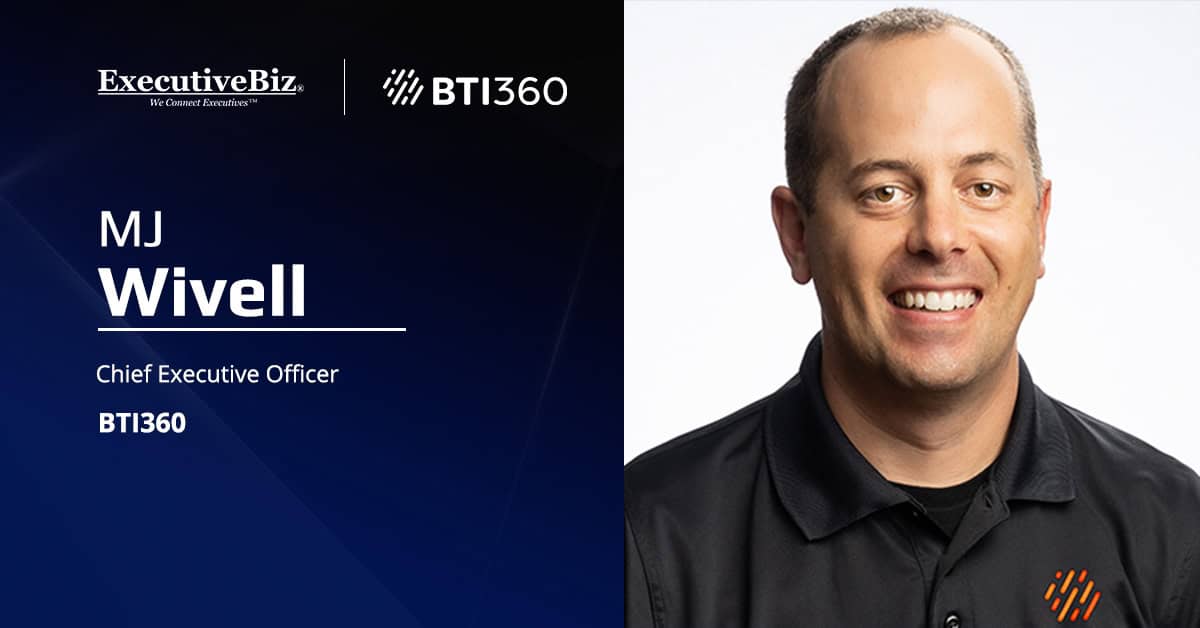
- BTI360 has never conducted a layoff in more than 20 years of operation
- Wivell co-founded the company with childhood friend Jeremy Nimtz in 2004
- He warns that consumer AI tools aren’t built for mission environments
MJ Wivell was reading “Rich Dad Poor Dad” on his honeymoon when a passage on the difficulty of starting a business struck him less as a warning than a dare. He called his childhood friend Jeremy Nimtz, and the two built BTI360 around a simple premise: an engineering firm that would put the customer’s mission ahead of its own bottom line. Twenty years later, that company has grown into a trusted partner on some of government’s hardest software, data and AI challenges.
In a Spotlight interview with ExecutiveBiz, Wivell, BTI360’s co-founder and CEO, discussed the engineering-first philosophy behind the company’s approach to AI, why he believes commercial large language models fall short of what national security missions demand and how software has become as central to defense as the hardware it supports.
ExecutiveBiz: BTI360 has a cool origin story. Share that with our readers.
MJ Wivell: BTI360 really started with a frustration. In my 20s, I was working on a $50 million software project and watching the contractor drive it into the ground. They didn’t have a strategic vision, and they weren’t bringing in talented people to lead the work. The contractor was getting paid, but the customer was getting short-changed.
Around that time, I was reading “Rich Dad Poor Dad” [by Robert T. Kiyosaki and Sharon Lechter] on my honeymoon. A passage warning readers about how difficult it is to start a business struck me as a challenge. I came home and called my childhood friend Jeremy. I asked him: “What if we built a different kind of company—one that treated people like people and put the customer’s mission ahead of its own pocketbook?”
That vision still shapes BTI360 today. My fundamental belief is that if you attract the best people, invest in their growth, and empower them to do great work, you can trust them to do a great job for the client. The rest takes care of itself.
EBiz: What does BTI360 offer government customers today?
Wivell: We bring an engineering-first approach to some of government’s hardest software, data and AI challenges. Many organizations can build an impressive AI demo. Our strength is turning those ideas into secure, scalable, adaptable systems that operate in demanding mission environments.
We help customers move AI beyond experimentation and into production, automating manual workflows, helping people make better use of complex data, and freeing mission users to spend more time on analysis and strategic judgment.
EBiz: You talk about culture a lot, and it seems to be foundational to BTI360’s work. Can you describe BTI360’s culture?
Wivell: Yes, we absolutely believe that culture is a competitive advantage. In an industry that focuses on headcount growth and quarterly results, we are committed to building a place where people can do meaningful work, continue learning and build long-term careers.
I tend to forget how unusual some aspects of our culture are until I talk with new folks or leaders from other businesses.
In 20-plus years, we’ve never laid anyone off. Over the years, many of our teammates’ spouses, siblings and friends have joined the company. One of the things I’m most proud of is that many leaders in our business started as college interns here. They got a jump-start on their careers years ago, and now, as seasoned professionals, they are helping to elevate the next generation.
EBiz: How has AI and machine learning changed the company’s focus? What’s been the impact of that?
Wivell: Urgency. We’ve been building ML solutions for more than a decade, but the proliferation of new AI technologies has dramatically changed the speed, scale and urgency of the problems we’re helping customers solve. Today, AI gives us entirely new ways to tackle problems that were difficult—or in some cases impossible—to solve just a few years ago. At the same time, it has increased the pace of change and expanded the threat surface our government customers face.
The biggest impact has been our ability to help customers automate labor-intensive workflows and unlock greater value from their data. We see talented mission users spending too much time on manual processes when their greatest contribution is in analysis and judgment. AI allows us to shift that balance, helping people focus on higher-level cognitive tasks while improving speed and efficiency.
EBiz: What do you think government customers are underestimating about AI adoption right now?
Wivell: I think many government executives are underestimating how different a mission-ready AI capability is from a consumer AI application. ChatGPT and LLMs accessed through APIs are remarkable tools, but they are not the final answer for national security. Mission environments have unique security requirements and operational constraints that demand far more than simply connecting an application to a commercial model.
They’re also underestimating the engineering challenge involved in scaling AI. You can’t simply push billions of documents through an LLM and expect a practical, affordable, or secure outcome. National Security applications require scalable systems tailored for their specific missions. AI is incredibly powerful, but realizing its full value requires thoughtful architecture, strong engineering practices, and an approach that balances innovation with the realities of operating in high-consequence environments.
EBiz: Software has become a huge focus over the last few years in government and military tech, especially in the current administration. How does BTI360 fit into that, and can you speak to the importance of software?
Wivell: Software has become a core element of national defense—every bit as important as jet fighters. The nation’s advantage increasingly depends on how quickly the government can build, adapt, secure and deploy software in response to changing mission needs.
That’s where BTI360 fits. For more than 20 years, we’ve focused on helping government organizations deliver mission-critical software faster and more effectively.
The geopolitical stakes are incredibly high. If the United States can’t adapt quickly and thoughtfully, we risk falling behind our adversaries. We feel an urgency and, frankly, a sense of duty to help our customers succeed in that effort.
Who Is MJ Wivell?
MJ Wivell is the co-founder and CEO of BTI360, a role he has held since founding the company in 2004 with childhood friend Jeremy Nimtz. Alongside his role as CEO, Wivell spent the company’s first eight years also working hands-on as a software engineer, and since 2012 has served as BTI360’s lean agile coach, an effort that aligned more than 120 engineers, managers and business staff around a unified agile framework.
Wivell has also served on the board of Justice & Mercy International, a nonprofit serving impoverished and orphaned communities.
What Is BTI360?
BTI360 is a Washington, D.C.-area software development company that builds big data, machine learning and cloud engineering solutions for federal government customers. Founded by MJ Wivell and Jeremy Nimtz in 2004, the company has built deep expertise in distributed search and AI, helping mission users move from manual data review to faster, more informed decision-making.
BTI360’s current focus centers on helping agencies move AI beyond the demo stage into secure, production-ready systems built for high-consequence environments.