
 Pat Host
- Leidos has been continually refining LAVA in response to evolving Navy requirements
- Its Seahawk MUSV was originally developed for anti-submarine warfare but is now performing ISR
- Learn about USVs in the Navy’s Golden Fleet at the 2026 Navy Summit tomorrow, Aug. 27!
Leidos is seeking foreign military customers for its Leidos Autonomous Vessel Architecture, or LAVA, platform featured on its Seahawk and Sea Hunter medium unmanned surface vessels, according to an executive.
Steve Boraz, company vice president for maritime growth and strategy, told ExecutiveBiz in an exclusive interview that Leidos has refined LAVA’s navigation autonomy over a decade of testing to ensure the ships it operates on safely navigate around, and avoid, other vessels. The company has also implemented challenging maneuvering capabilities and requirements that the Navy would need at sea.
Leidos has demonstrated and tested LAVA on 10 different ships, including the Mariner and Ranger MUSVs and the Autonomous Low-Profile Vessel, a.k.a. ALPV. The company is focusing on LAVA both being exportable and modular for maximum platform flexibility.
Leidos is marketing LAVA as supporting navigation, obstacle avoidance and mission execution without human intervention.
“Modularity is critical,” Boraz said. “We have tremendous confidence that we could take LAVA and put it on any hull form, delivering the machinery and the autonomy control.”
Get expert, unfiltered insight into the Navy’s technical need areas for unmanned systems at the Potomac Officers Club’s 2026 Navy Summit tomorrow, Aug. 27! Our Future of UUV and USV Navy-Industry Partnership panel discussion will provide frank advice unavailable anywhere else on UUV and USV evolution over time, with next steps, and unmanned applications in Golden Fleet and the AUKUS Pillar II U.S.-U.K.-Australia security partnership. Very few tickets remain—get yours now!
What Is Leidos’ LAVA?
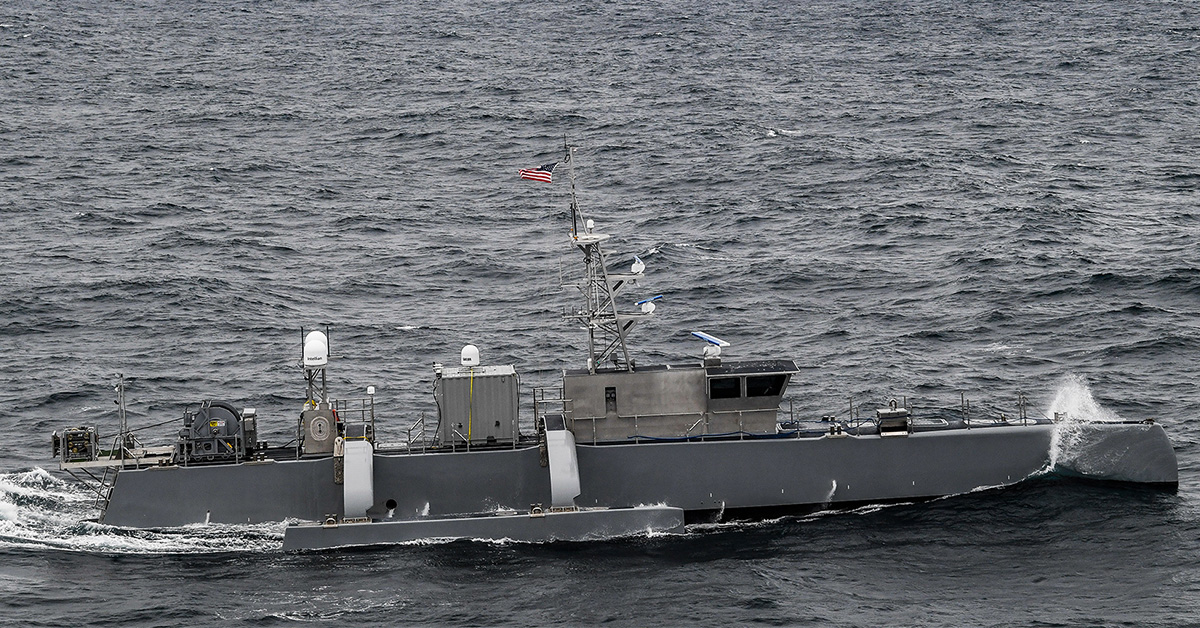
The Leidos Autonomous Vessel Architecture is the proprietary core autonomy system that powers the company’s autonomous ships, including the Sea Hunter and Seahawk MUSVs. It can be deployed across multiple vessel types and sizes and was used in long endurance missions across the Pacific.
Leidos’ Seahawk has transferred into the operational Navy and will join the Roosevelt strike group in the fall. Boraz said Seahawk, developed under an Office of Naval Research program and the follow-on to the company’s Defense Advanced Research Projects Agency-funded Sea Hunter, has evolved from performing anti-submarine warfare to multi-mission capabilities, especially intelligence, surveillance and reconnaissance.
Boraz said Leidos has experimented with LAVA across different vessel sizes and operational contexts, including beaching operations. He pointed to the challenge of getting autonomous vessels ashore for Marine Corps and Army logistics missions as one example. LAVA can also support missions including ISR, logistics and electronic warfare.
Boraz noted that the Navy has conducted a weapons demonstration from Ranger than leveraged autonomy. Boraz said this is in response to evolving Navy requirements for unmanned systems in the service’s surface warfare doctrine.
“It’s a very dynamic environment,” he said. “These are new vessels and new concepts of operations, and concepts of employment are required to really lay out what those requirements are and how you’re gonna integrate and operate with a vessel.”
Position your GovCon firm to benefit from growth in Navy unmanned systems spending by attending the Potomac Officers Club’s 2026 Navy Summit tomorrow, Aug. 27. Hear acting Secretary Hung Cao discuss in his keynote how investment in autonomous platforms to meet evolving maritime threats will shape the next generation of naval technology. Spur collaborations with other ambitious GovCon professionals and score that big contract. Sign up today!
Modularity is critical. We have tremendous confidence that we could take LAVA and put it on any hull form, delivering the machinery and the autonomy control. — Leidos VP Steve Boraz
What’s the Status of the Navy’s MUSV Program?
Leidos in late May was among seven companies, including HII, selected to advance to at-sea testing of the MUSV marketplace. Companies that complete at-sea testing will receive $15 million and be eligible for follow-on production.
Boraz expects the Navy to issue other transaction authority awards by the end of September to some of the seven providers currently performing at-sea testing, which is ongoing and is expected to end by October. This is so the service can hit its fleet delivery goals of 36 MUSVs by the end of fiscal year 2027
Boraz expects hull designs to change as the MUSV program moves forward. Seahawk has a trimaran design, he said, that was designed for quiet operations required in anti-submarine warfare. Trimarans also provide stability in heavy seas.