
 Pat Host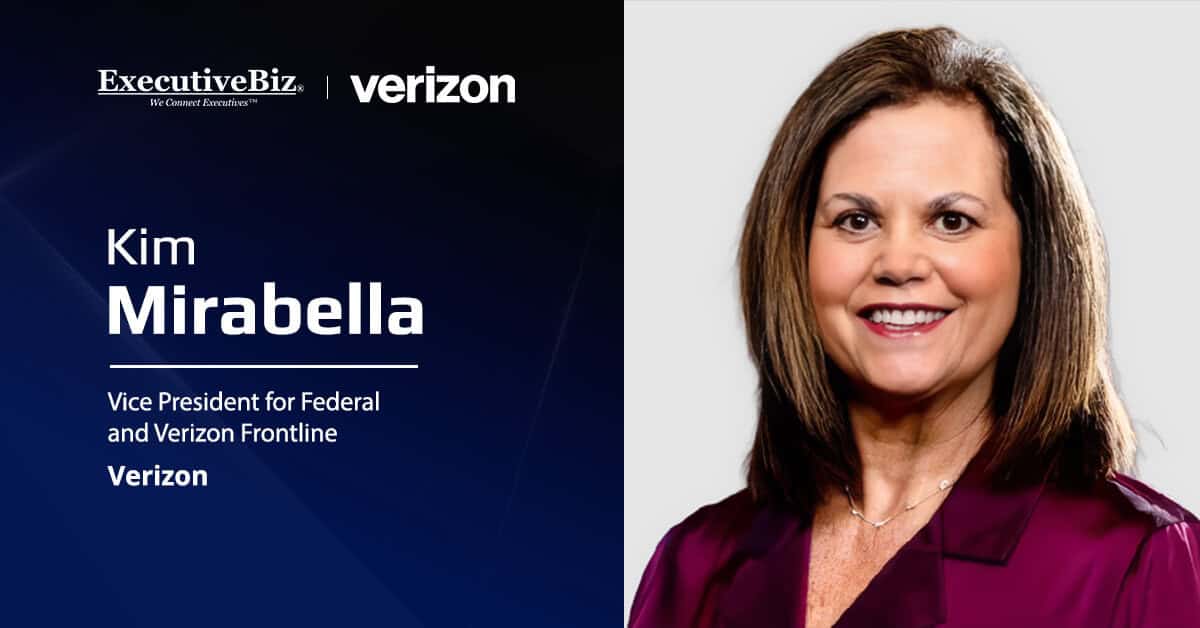
Kim Mirabella thrives on serving government customers. The Verizon vice president for Federal and Verizon Frontline is proud of how her mission-driven team works together during crises with a strong sense of purpose to support public sector agencies, including federal and national security organizations.
Mirabella is a Verizon veteran, having spent 28 years at the telecommunications behemoth, starting her career in the commercial space. She had an opportunity to take on government customers in 2017 and never looked back.
One new initiative Mirabella and her team are leading in 2026 is the expansion of the Verizon Frontline Network Slice. This is a 5G Ultra Wideband (UW) virtual network slice completely dedicated to public safety that allows for the allocation of network resources within Verizon’s network infrastructure.
Network slicing can enable multiple logistical networks to run on the same physical infrastructure by creating dedicated “slices” that are isolated, self-contained and secure.
Summer will be a busy season for Mirabella and Verizon as the company will be providing essential communications capabilities to first responders during multiple large scale events.
Mirabella sat down with ExecutiveBiz for her first Spotlight interview to discuss Verizon Frontline and the Verizon Frontline Crisis Response Team, how Verizon provides essential connectivity to agencies in a crisis, how public safety communications support works within rigid military operations and how FirstNet reauthorization in Congress could impact Verizon Frontline and other industry providers.
ExecutiveBiz: Can you tell me a little about Verizon Frontline?
Kim Mirabella: Sure thing! I am always passionate about my team and this side of our business.
The Verizon Frontline brand was established five years ago as a network built for public safety—and importantly, designed with input from public safety agencies themselves to meet their unique and evolving needs.
But Verizon has supported public safety for more than 30 years, and today we support more than 45,000 public safety agencies across the US.
The network provides priority and preemption for first responders and public safety personnel during crises, but also during large-scale events where network congestion becomes a challenge.
When thousands of people gather in one place, there is an increase in bandwidth usage, but public safety agencies still need reliable communications during those times. Verizon Frontline helps ensure those agencies have the connectivity they need when they need it. With network slicing layered on top, they now also have a dedicated communications pathway reserved specifically for first responders.
There’s another major component to Verizon Frontline: the Verizon Frontline Crisis Response Team. This is something I’m especially proud of.
The team deploys during crises and major events nationwide with mobile network assets like drones, cells on wheels, or COWs; cellular on light trucks, aka COLTs; and other large support equipment. When there’s a wildfire, hurricane, tornado, or other crisis, they mobilize immediately to help restore communications for our government and public safety partners.
What’s important is that not everyone responding to a disaster uses Verizon. Interoperability is critical.
We believe no single carrier can do it all. During crises, collaboration matters.
The Verizon Frontline Crisis Response Team operates 24/7, and we don’t charge customers for those emergency services. We show up with phones, routers, jetpacks, deployable assets and whatever else is needed.
In one instance during Hurricane Laura in Louisiana in 2020, we even helped establish a temporary city hall in one town after the original facility was destroyed. We deployed a mobile command trailer that allowed city officials to continue operations.
A lot of the work happens behind the scenes, but it’s all driven by our commitment to supporting public safety and public sector missions.
EBiz: What are priority and preemption services, and how do they support federal agencies?
Mirabella: Imagine the network as a busy highway. Priority service is the express lane, where the network identifies the user as a first responder and moves them to the front.
Preemption is a step further. When the express lane and the rest of the highway is full, it allows the first responder to cut the line, moving over the nonpriority connection, and create space instantly for them at the front.
Verizon Frontline Network Slice is the new piece of the puzzle and a great advantage. Still using the highway example, it’s like having a first responder-only HOV line. The fully isolated network slice provides dedicated 5G Ultra Wideband (UW) network resources reserved exclusively for first responders. You never compete with commercial users for bandwidth during massive events or emergencies.
Your traffic is completely separated from commercial users, complete with the always-on priority, preemption, and enhanced quality of service you need to communicate securely.
EBiz: How does network connectivity work when multiple agencies—federal, state and local—all need to communicate during a crisis?
Mirabella: A good example is Hurricane Ian in Fort Myers in 2022.
During a major disaster, everyone shows up: federal agencies, FEMA, Homeland Security, the National Guard, state officials, local agencies, and nonprofits. Many of these entities have different equipment, procedures and communications vendors supporting them.
At the same time, there may be network congestion or damaged infrastructure. Interoperability becomes absolutely essential in providing oftentimes life-saving situational awareness.
We work closely with all those organizations. We might discover the National Guard suddenly needs 50 phones and several routers for incoming personnel. We bring that equipment with us.
During Hurricane Ian, a bridge had been destroyed and a temporary bridge had to be constructed. We coordinated with state and federal agencies to deploy connectivity assets on a barge so communications coverage remained available during construction.
These operations require enormous coordination among federal, state and local agencies as well as industry partners. We approach crises not as “Verizon versus others,” but as part of a broader team effort to help communities recover.
Dive into the latest wireless business opportunities at the Potomac Officers Club’s 2026 Army Summit on June 18! Discover integrating 6G, SD-WAN and network virtualization and building secure and high-availability AI-enabled networks at the Continuous Modernization Incorporating Wireless Spectrum, SD-WAN, Open Ecosystems and Cybersecurity panel discussion. It features a stellar lineup of Pentagon technology professionals:
- Col. Alan Stephens, Army program manager for integrated enterprise network
- Dr. Tucker Swindell, Army DEVCOM C5ISR Center chief for terrestrial communications
- Josh Weaver (pending confirmation), Office of the Under Secretary of War for Research and Engineering director for spectrum initiatives and analysis
EBiz: How does public safety communications support work within the rigid structure of military operations?
Mirabella: That’s a great question. Think of Verizon Frontline as a critical, dedicated partner for the Department of War (DoW) and the National Guard. We’re there to provide essential communications infrastructure and on-site expertise during large-scale exercises and deployments.
We’re the resource making sure mission-critical connectivity stays strong. Verizon Frontline actually integrates directly into military training environments. We help reinforce what’s called Primary, Alternate, Contingency and Emergency, aka PACE, communications. These practices are essential because they get units ready for real-world disaster response and humanitarian relief missions.
Essentially, their support model is designed to offer comprehensive, end-to-end assistance for every kind of situation, whether it’s a sudden emergency or a planned “blue sky” event. In fact, we’ve recently participated in more than 70 training exercises with our military partners to help prepare for potential emergency or disaster response operations.
EBiz: With FirstNet currently going through reauthorization in Congress, how could those decisions affect Verizon Frontline and other industry providers?
Mirabella: Our commitment to supporting first responders is unwavering. At the same time, we strongly believe competition is important.
No single carrier can serve every need during a crisis. We support the concept of FirstNet, but we also believe customers deserve fair competition, resiliency and choice.
Many agencies want multi-carrier strategies for redundancy and disaster recovery. We want to continue supporting those needs.
As Congress considers reauthorization, our focus is ensuring there is fair competition and appropriate governance around funding so multiple providers can continue serving public safety effectively.
EBiz: Is there anything else you’d like to mention?
Mirabella: I’m incredibly proud of the work we’re doing at Verizon Frontline. We’re especially excited about upcoming large-scale events where Verizon is a major 5G sponsor. We’ll be continuing to support public safety and first responders in many high-profile environments over the coming years.