
 Pat Host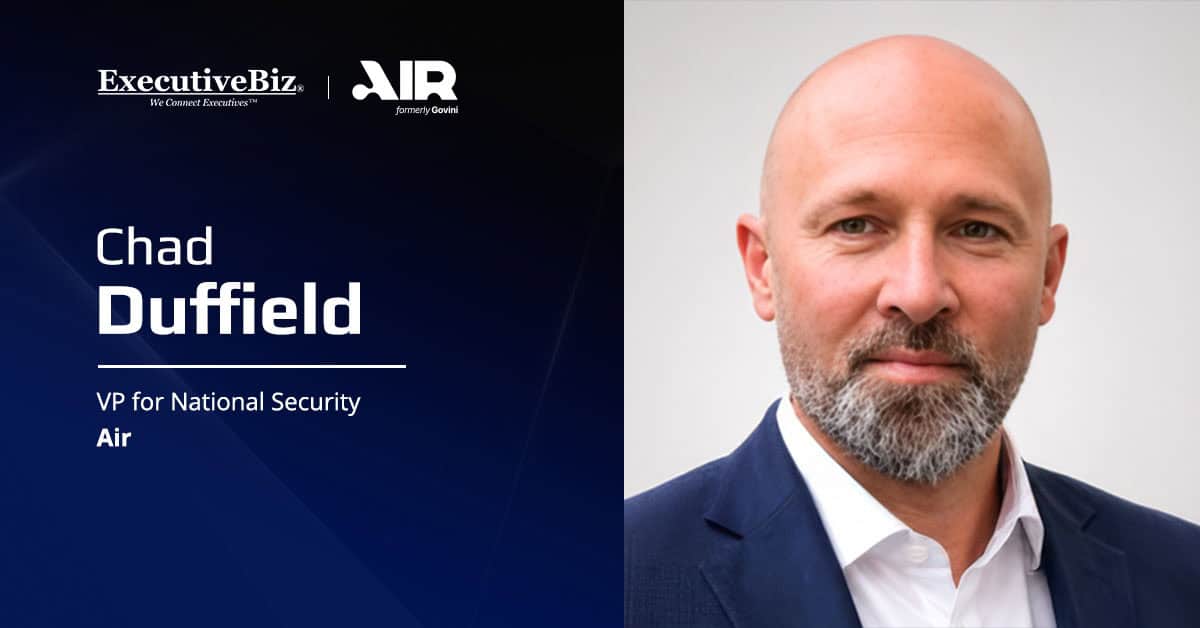
- Chad Duffield helps agencies apply commercial technology for national security
- He spent 25 years in the USAF, starting as a signals intelligence analyst
- Duffield spoke to EBiz about OSINT, AI, software and data
Chad Duffield has spent his career helping organizations make better decisions in complex environments. The Air (formerly Govini) vice president for national security spent 25 years in the Air Force, beginning as a signals intelligence analyst and ultimately leading initiatives supporting global missions including intelligence training and workforce development.
In industry, he’s helped government organizations apply commercial technology to use data-driven approaches to address national security challenges at Tableau, Salesforce and Janes. Duffield, at Air, now works with leaders across the intelligence community and other federal civilian agencies in the national security space to help them improve how they understand supply chains, industrial capacity, acquisition risk and mission readiness through data and AI.
Duffield sat down for his first Spotlight interview to discuss top intelligence challenges, how to encourage more robust public-private partnerships in classification without jeopardizing security, how Air is addressing the most pressing national security threats and the importance of software modernization to sustaining U.S. technological dominance.
Get the newest OSINT business opportunities at the Potomac Officers Club’s 2026 Intel Summit on Sept. 24! The Open Secrets: The Power of OSINT in Counter Espionage of Intellectual Property Secrets and Protection of the U.S. RDT&E Enterprise panel discussion will feature top IC, defense and industry experts discussing data, AI, cyber and secure information sharing capabilities. Get an edge on your competition to start FY 2027. Secure your seat today!
ExecutiveBiz: What’s your outlook on the global intelligence landscape? What are the top intelligence challenges and opportunities facing the U.S. today?
Chad Duffield: The global intelligence landscape has undergone a tectonic shift. The primary theater of competition is no longer traditional spycraft, but instead is the war for technological dominance.
Our adversaries are aggressively blurring the lines between commercial enterprise and military capability. As this competition now plays out in the commercial market, the U.S. national security apparatus is drowning in data, but starving for actionable insights. The workforce relies heavily on isolated databases, disconnected spreadsheets and manual-intensive processes.
Therefore, the top challenge is no longer collecting information, but making sense of an ocean of open-source and commercial data to expose adversarial intent before a crisis hits. The ultimate opportunity lies in leveraging advanced software and AI to instantly unify disparate commercial and government datasets, allowing users across the national security ecosystem to identify critical vulnerabilities and secure a decisive, preemptive strategic advantage.
EBiz: Classification can sometimes be a barrier for the IC in working with industry or even other government agencies. How can we change that narrative and enable more robust public-private partnerships without jeopardizing security?
Duffield: To enable robust public-private partnerships without jeopardizing security, we must flip the paradigm and realize that in an era of globalized, dual-use technology, the most critical data often lives in the unclassified, commercial world rather than behind a classification firewall. Ultimately, we do not need to lower our security standards. We need to elevate our data sophistication, ensuring that classification ceases to be an administrative bottleneck and, instead, becomes a targeted tool reserved only for the final, most sensitive layers of intelligence.
If you’re a GovCon executive focused on growing your intelligence business, make plans to attend the Potomac Officers Club’s 2026 Intel Summit on Sept. 24! Keynote speaker Maj. Gen. Brian Sidari, Space Force deputy chief for space operations and intelligence, will arm you with exclusive investment insights and top-level analysis to prepare you for contracting success in the upcoming fiscal year. Get your pressing questions answered during Sidari’s Q&A. Sign up now!
EBiz: What are the most pressing emerging national security threats and how is Air addressing them?
Duffield: The most pressing emerging national security threat is our systemic inability to rapidly scale and modernize the weapon systems required to deter near-peer adversaries. If the U.S. cannot accelerate production and ensure the long-term readiness of its hardware, our technological superiority is effectively neutralized.
Air addresses this existential threat head-on through Enterprise Readiness, our category of AI-native systems designed to continuously coordinate development, production, sustainment and delivery across the defense industrial ecosystem. Enterprise Readiness delivers a distinct advantage across the lifecycle—equipping acquisition and engineering teams to eliminate design and production bottlenecks. It also empowers the IC to conduct rapid commercial due diligence, uncover hidden adversarial capital and safely fast-track the deployment of commercial dual-use technologies.
EBiz: How important is software modernization to sustaining U.S. technological dominance?
Duffield: Software modernization is not simply an IT upgrade, it is an existential warfighting requirement and a mandate for survival. We currently face a dangerous asymmetry, where operational decisions on the front lines happen in seconds, while institutional procurement and software deployment back home take years due to bureaucratic logjams.
True technological dominance is no longer determined solely by who builds the best hardware, but by who can optimize their industrial base and field capabilities the fastest. By automating legacy and manual oversight processes, software modernization shrinks the timeline for innovation from years to weeks. This ensures that the U.S. can cut through institutional muck and move from strategic intent to execution at the speed of the mission.