
 Pat Host
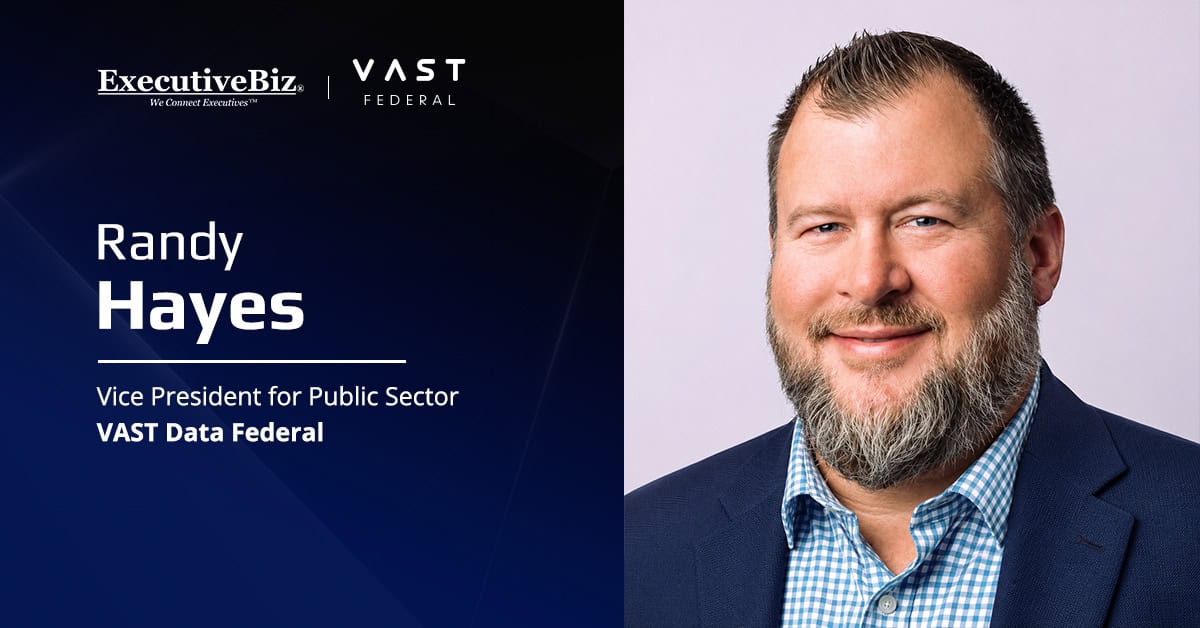
- Randy Hayes learned durable skills for GovCon success from his first job after college
- Hayes, VAST Data federal VP for public sector, is now executive of a $30 billion firm
- He sat down for a Spotlight interview to talk AI data infrastructure and data storage
Randy Hayes learned a lot about GovCon success from his first job after college: leasing apartments. Hayes, VAST Data Federal‘s vice president for public sector, discovered how to ask smart questions to better understand a customer’s goals and how to bring a customer-focused approach to daily business.
Hayes later thrived after joining GovCon and working with mission-focused agencies like the departments of Justice and Homeland Security. Hayes has also experienced rapid growth at VAST Data Federal. When he joined the company, he was employee number 35 and the company’s first sales rep.
VAST Data, the parent company, was also generating no revenue at the time. Eight years later, Hayes is an executive at VAST, which has approximately 1,500 employees and was valued at $30 billion in its latest April 2026 financing round.
Hayes sat down with ExecutiveBiz for a Spotlight interview to talk helping federal agencies prioritize between AI infrastructure spend and operational costs; the difference between real AI infrastructure expertise and hype; non-disruptive methods for legacy storage consolidation; and where agencies underestimate the scale of full AI deployment data infrastructure.
Learn the latest federal strategies leveraging AI to detect fraud, waste, and abuse in healthcare by attending the Potomac Officers Club’s 2026 Healthcare Summit on Dec. 3. At the AI Governance and the Role of Policy Expertise panel discussion, explore how agencies are bringing policy, program integrity, legal, operational and technical expertise together as AI moves from retrospective analysis into payment, oversight and enforcement decisions
It features a stellar slate of top federal healthcare officials:
- Cmdr. Darshan Thota, Department of War Joint Trauma System chief medical informatics officer
- Ricky Clark, National Institutes of Health IT Acquisition and Assessment Center director
- Christopher Wallace, Defense Healthcare Management Systems portfolio acquisition executive, medical digital solutions, chief of cyber security (pending confirmation)
- Danea Gaines, Food and Drug Administration IT acquisition project manager
ExecutiveBiz: With agencies facing less budget and fewer staff, how do you help them prioritize between AI infrastructure spend and immediate operational costs?
Randy Hayes: A lot of this accelerated with the U.S. Department of Government Efficiency. The push to reduce costs and staffing forced many organizations to rethink how they operate.
The federal government has a reputation for sticking with what has always worked. These changes forced agencies to reconsider that approach.
We were selling well before those changes began, but our view has remained consistent: agencies need infrastructure either way. Why not invest in infrastructure that was purpose-built for AI?
A lot depends on where the buyer is in their AI journey. Agencies still need many of the capabilities we provide, including unstructured and structured data storage, vector databases and runtime engines.
That lets us say, “You need these capabilities anyway. Why not choose something purpose-built for AI?” Customers can continue operating as they do today while preparing their data and infrastructure for AI.
EBiz: With so many companies now marketing themselves as AI infrastructure providers, how should a federal buyer separate real expertise from hype?
Hayes: We run into this all the time. I was on a panel recently where a similar question came up. I always look at how much commercial business a vendor is doing.
Commercial organizations have generally adopted new technologies faster than the federal government and that gap is widening with AI. When you evaluate vendors, look at their commercial installed base.
That gives you a good starting point for answering the first question: Does the product actually work? Then you can evaluate the federal-specific requirements, including certifications, security and other barriers to entry.
VAST was set up differently. Early on, our second-ever customer was the National Institutes of Health, so we were serving the federal government right out of the gate. As we grew commercially, we grew our federal business in parallel.
That allowed us to build in features and capabilities that many Silicon Valley companies only begin addressing when they enter the federal market. We were doing that from the start.
Often, companies build a commercial business and then say, “The U.S. federal government is the largest customer in the world. Maybe we should build a plan for that.”
Then they discover the investments and certifications required to serve that market. We had a head start because we were working with federal and commercial customers in parallel.
That is one of the biggest things I would recommend: Get references at scale, on the commercial side as well as the federal side.
Unpack exclusive insights into how AI can contain costs, and improve and expand access to care quality by attending the Potomac Officers Club’s 2026 Healthcare Summit on Dec. 3. The Navigating the Healthcare Trilemma: Cost, Quality, and Access to Care panel features Dr. Gil Alterovitz, Department of Health and Human Services Agency for Healthcare Research and Quality chief data officer. He’s also the agency’s first chief AI officer.
Dive into how federal healthcare agencies are leveraging emerging technologies including AI to deliver measurable improvements in care without sacrificing quality and access. Sign up now for this essential GovCon forum!
EBiz: Most agencies are sitting on decades of legacy storage across different tiers and vendors. What’s the realistic path to consolidating that without a disruptive, all-at-once replacement?
Hayes: We get that question all the time because the platform does so many things.
When we first came to market, we competed with traditional storage vendors. Then we built an analytical database, which brought us into competition with Databricks, Snowflake and open-source analytical databases. We later added a vector database and a runtime engine.
What we have consistently seen, especially in federal agencies, is that organizations have multiple storage tiers and multiple vendors. That means at least one of those systems is usually approaching a refresh cycle each year.
We can enter wherever the immediate need is, whether that is storage, an analytical database, a vector database, our Kafka-compatible message broker or streaming. We have multiple entry points into a customer’s infrastructure. We start with a use case they need to address—we like it when it’s their most challenging.
Then, as we prove ourselves and other products reach the end of support and come up for refresh, customers can move those workloads onto the VAST AI Operating System. Over time, our role expands within the organization.
That has typically been our approach: Start with a specific use case and expand as other systems come up for refresh.
Federal agencies generally do not want two separate systems for every application. When the platform meets their needs and users have a good experience, they can consolidate additional use cases onto VAST as legacy products reach end of support.
EBiz: Where do agencies most underestimate the scale of data infrastructure required once an AI pilot moves into full deployment?
Hayes: If you think about Jensen Huang at NVIDIA and his five-layer cake, the bottom layer is the one people often overlook: power. That is one of the hardest challenges for federal agencies. Many have aging data centers that cannot support the power requirements of dense graphics processing unit infrastructure.
It is easy to focus on the application: “Here’s what we want to run, and maybe we’ll pilot it in the cloud.” But when you try to deploy it broadly, the cost can become a challenge.
Then the conversation shifts: “All right, should we bring it on-premises or run it in a colocation facility?” Suddenly, the requirement is 80 kilowatts per rack, while the existing facility supports only 15. That creates a major problem.
In that layer cake, power is at the bottom, the application is at the top, and VAST is part of the connective tissue in the middle that brings the data infrastructure together. That is one reason I expect we will see more containerized data centers. I mean shipping containers, not Kubernetes containers.
They can give federal customers a way to deploy power-intensive infrastructure when their existing facilities are not designed to support it. At the same time, some organizations have been building systems at this scale for years.
I tend to divide the federal government into two groups: builders and buyers. The builders include the National Aeronautics and Space Administration, the National Oceanic and Atmospheric Administration, the Department of Energy and NIH, organizations accustomed to large-scale supercomputing. They understand power envelopes, rack space and liquid cooling.
I was at Supercomputing last year and at GTC, and with all the liquid-cooled infrastructure, it almost looked like a plumbing convention.
On the other side are the buyers: organizations that are less accustomed to building AI systems themselves and would rather rent capacity or purchase a solution. That is where hyperscalers come in.
We are also seeing more neocloud providers open their doors to federal customers. These companies focus on building full-stack AI factories. If you want to run SAP, that is not necessarily their business. Their focus is AI infrastructure.
We are starting to see those offerings gain traction in the federal market. Whether agencies build or buy, the real test is the same: Can the data infrastructure keep up when AI moves into production?