
 Kristen Smith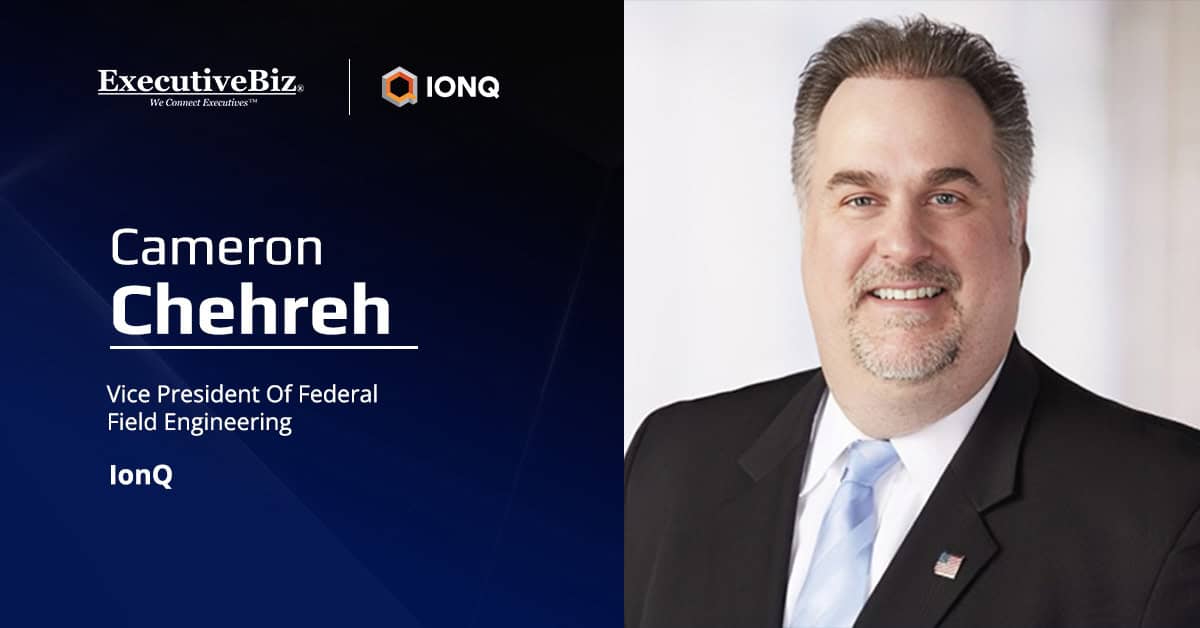
- High-value assets must transition key establishment by 2030 and digital signatures by 2031
- A pilot program is due by December 2027
- The innovation order targets a powerful quantum computer by 2028
Federal civilian agencies now face hard deadlines for moving to post-quantum cryptography, or PQC, with high-value assets required to transition key establishment by 2030 and digital signatures by 2031, according to Cameron Chehreh, IonQ‘s vice president of federal field engineering.
He made the argument in a commentary published on Federal News Network on Friday, writing that two executive orders signed by President Donald Trump amount to a mandate rather than a recommendation. Chehreh previously served as worldwide public sector general manager at Intel and as chief technology officer for Dell Technologies Federal Systems.
He wrote that every agency needs to designate a migration lead and begin inventorying cryptographic assets now.
What Do the PQC, Quantum Innovation Executive Orders Require?
The PQC order directs the Office of Management and Budget and the national cyber director to lead the migration, with a pilot program due by the end of 2027.
It also requires the Federal Acquisition Regulatory Council to ensure covered contractors meet federal cybersecurity standards by the end of 2030, and directs the Departments of Commerce and Homeland Security and the National Security Agency to issue guidance. The State Department is charged with guiding critical infrastructure operators and foreign allies through this transition.
Chehreh emphasized that allied coordination is vital, warning that uncoordinated, interconnected economies are unevenly exposed across shared networks and supply chains.
The second order sets a 2028 target for developing a quantum computer powerful enough to enable scientific discovery at scale.
It directs the Departments of Energy, Commerce and War, along with the intelligence community and NASA, to coordinate the deployment of quantum sensors and networks within five years. The order also calls for updating the National Quantum Strategy, assessing domestic supply chains and establishing workforce development institutes.
Chehreh wrote that the architecture around the goal — workforce pipelines, supply chain security and counterintelligence protections — signals an effort to build a domestic quantum ecosystem rather than fund individual laboratories.
Where Does IonQ Sit in Federal Quantum Work?
In a filing with the Securities and Exchange Commission, IonQ said it holds a $39 million contract under the Space Development Agency’s Hybrid Acquisition for Proliferated Low Earth Orbit, or HALO, program for tactical space communications that could enable mission-ready quantum space systems for national security. It was also selected for the Defense Advanced Research Projects Agency’s Heterogeneous Architectures for Quantum, or HARQ, program, which focuses on quantum interconnects, and secured a position on the Missile Defense Agency’s $151 billion Scalable Homeland Innovative Enterprise Layered Defense vehicle, which spans over 2,400 eligible organizations.
IonQ expanded its federal go-to-market organization in February, adding Chehreh to the team alongside Steve Harris and Mike Lawson.
The company reported $64.7 million in first quarter revenue and raised full year guidance to between $260 million and $270 million. Remaining performance obligations reached $470 million.