
 Pat Host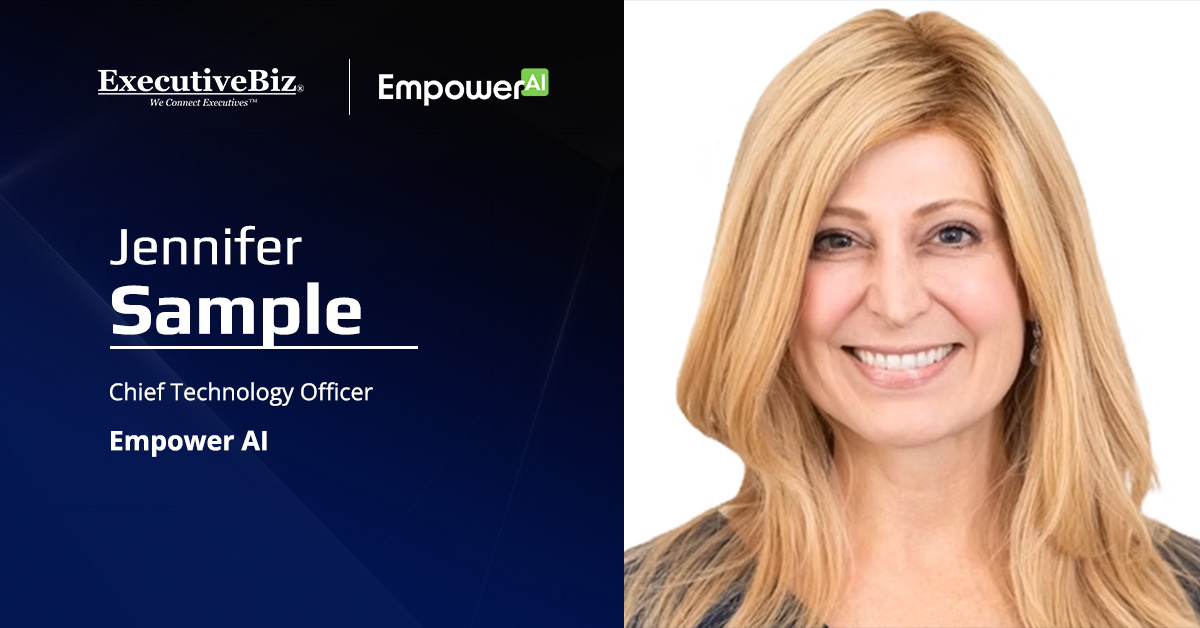
- Sample, CTO at Empower AI, is leading a company initiative around agentic AI
- Empower AI wants every contract it bids on to come with an AI agent
- Sample sat down with ExecutiveBiz to discuss pre-built accelerators and cleared talent retention.
Jennifer Sample loves a challenge. The Empower AI chief technology officer earned her doctorate in nanotechnology and spent the early portion of her career digging into data as a researcher at the Johns Hopkins University Applied Physics Laboratory.
Sample’s early work in simulations and data analysis helped JHU APL win NASA’s Parker Solar Probe contract. This is a spacecraft collecting measurements and images to expand NASA’s knowledge of the sun’s origin and solar wind. The Parker Solar Probe inspired her interest in the intersection of physical and digital worlds and led her to GovCon, which she joined as director of research and managing director at Accenture Federal Services.
Now two years into her time as CTO at Empower AI, Sample is leading a challenging and high-impact company initiative around an agentic AI workforce. Empower AI wants every contract that it bids on to come with an AI agent, such as an AI network engineer or an AI service desk technician.
Sample sat down for her first Spotlight interview to discuss what pre-built accelerators look like when first deployed at an agency, what KKR’s acquisition of Empower AI means for the future of the company and Empower AI’s retention strategy for talent with security clearances.
Cover all corners of agentic AI by attending the Potomac Officers Club’s 2026 Intel Summit on Sept. 24! Our action packed day features three (!) panel discussions on agentic AI and what it means for the future of intelligence business and tradecraft.
- Unpack compressing the decision cycle at the edge at Agentic AI Across Mission and Enterprise
- Tap into quantum’s threat to decades of encrypted intelligence at Agentic AI and Quantum Risk
- Get the scoop on adapting cyber defense to autonomous threat actors at Cybersecurity in the Age of Agentic AI.
ExecutiveBiz: Empower AI’s AI Services Framework is built on pre-built accelerators, real-world use cases and a defined data strategy to help agencies quickly integrate AI into critical operations. Walk me through what a pre-built accelerator actually looks like when it’s deployed at an agency for the first time.
Jennifer Sample: If there were any tagline that I would use for this call, it’s ‘deployed, not demoed.’
I think when people hear the term accelerator, they think of a demo or proof of concept, and that’s not how we view it at all. We view it as almost like a partially built product—a production-ready capability that’s already solved a real mission problem somewhere else that can be adapted to a new environment faster than building from scratch. It is also ready on day one.
For example, we have an accelerator called Predictive IT. It’s kind of turning into an IT teammate, but it uses machine learning to analyze historical and real-time operational data across systems that might not currently be connected in the network operations center. The goal is to identify issues before they become outages and shift that IT posture from reactive to proactive.
When we deploy it somewhere new, we’re not starting from zero. We already have the models, workflows, governance, monitoring and integration patterns built in, so it’s more about tailoring it, rather than doing everything from the ground up.
EBiz: How is the integration of newly acquired Highlight Technologies going and what does this acquisition say about the future of Empower AI under majority owner KKR?
Sample: This is another one of the most exciting things happening in our company right now. When you asked at the beginning about how things are going and what I’m excited about, this is a clear indicator of our successful strategy—the ability to make an acquisition.
It’s going so well because the two organizations are extremely complementary. Highlight brings exceptional strengths in DevSecOps and cloud modernization, software engineering, code challenges and mission execution. We bring a scaled delivery framework, decades of experience in IT service management, an accelerator portfolio and mission relationships.
Together, we’re creating, or co-creating, a company that can take agencies from modernization to AI-enabled operations, end to end.
Get insight into upcoming intelligence business opportunities before they hit the streets at the Potomac Officers Club’s 2026 Intel Summit on Sept. 24. Get beyond the headlines with our stellar lineup of top intelligence community officials:
- Dustin Gard-Weiss, CIA executive director
- Tim Kosiba, National Security Agency deputy director
- Carrie Thompson, Drug Enforcement Agency deputy assistant administrator for intelligence programs
- Matthew Fodor, FBI operations director for national security
- Matthew Kozma, Department of Homeland Security undersecretary for intelligence and analysis
- Ryan Lewis, National Reconnaissance Office chief architect for signals intelligence
- Maj. Gen. Brian Sidari, Space Force deputy chief of space operations for intelligence
Get unfiltered insights into the IC’s essential agencies straight from the source and boost your contracting success in fiscal year 2027. Secure your seat today!
EBiz: What’s your retention strategy in a labor market where cleared talent gets poached constantly? How much of that comes down to culture versus compensation?
Sample: This is a great question, and I definitely understand why you asked it because it’s on everyone’s mind.
You need both. Compensation obviously gets people’s attention, but I think culture determines whether or not they stay. We all get pinged by recruiters. Do you look at those pings or do you just ignore them? That comes down to culture.
Especially when you’re talking about the cleared labor market—cyber, AI, cloud and engineering—people definitely have options. Competitive salaries and benefits are table stakes, so we absolutely invest there.
But long-term retention also comes from giving people meaningful work. If there’s anything I’ve learned, it’s that your top talent needs challenging problems, meaningful work, career mobility, opportunities to learn and access to innovative technology, rather than blockers and bureaucracy. That’s what we try to provide.
At Empower AI, we’ve also focused on creating an environment where technical professionals can thrive. We very much have a culture of, “Raise issues. What you think matters. Do not be quiet.“ That’s how we continuously improve.
We encourage everyone to speak up and try to set the direction around what we’re trying to achieve: move the needle for the customer, grow the company and do differentiated innovation—all three at the same time.
But how to do it, that’s where people get to lean in, bring themselves and chart their course. We definitely want people to feel like they’re building the future of our company and of government technology, not just being on a contract, which is what you see a lot in this world.