
 Pat Host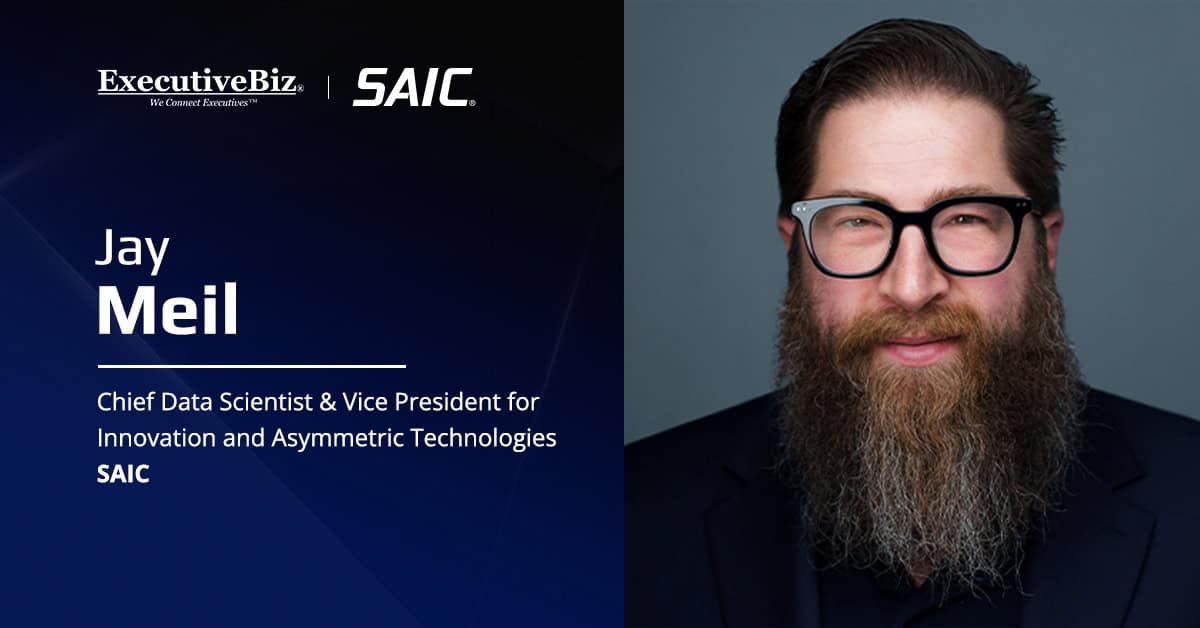
- Jay Meil started his career in applied math and econometrics before becoming an equity trader
- There the SAIC VP learned to reason under uncertainty against the clock with little information
- He sat down with ExecutiveBiz to talk protecting AI models, data and advanced analytics
Jay Meil has been performing data science since before it was cool. The SAIC vice president for innovation and asymmetric technologies and chief data scientist started doing data science back when it was known as operational research, math and statistics.
Meil started his career in applied math and econometrics before spending time as an equity trader with a few investment firms. There he learned to reason under uncertainty with incomplete information against an unforgiving clock, which is similar to intelligence analysis.
That work eventually led Meil into following adversary money through fusion and analysis, which attracted him to big data processing, machine learning, statistical inference and expert systems. Later, Meil landed with the Department of Homeland Security and the intelligence community because they needed people who understood the tradecraft around data and analysis.
Meil is leading a pair of major initiatives at SAIC: analytical rigor and deep semantic knowledge graphs for agentic systems, and adversarial machine learning and defeating cyber adversaries. We sat down with Meil for his first Spotlight interview to discuss the evolving federal use of AI, how agencies should approach securing AI models from data poisoning and adversarial attacks, data challenges preventing the federal government from fully reaping the benefits of AI and how commercial data technologies can be better integrated into federal environments.
Connect with top IC officials and leading industry experts at the Potomac Officers Club’s 2026 Intel Summit on Sept. 24. Get the latest requirements before they’re published and exclusive technology investment insights from our stellar slate of keynote speakers, including:
- NEW–Dustin Gard-Weiss, CIA executive director
- Tim Kosiba, National Security Agency deputy director
- Ryan Lewis, National Reconnaissance Office chief architect for signals intelligence
- Carrie Thompson, Drug Enforcement Administration deputy assistant administrator for intelligence programs
- Matthew Fodor, FBI operations director for national security
- Matthew Kozma, Department of Homeland Security undersecretary for intelligence and analysis
- Maj. Gen. Brian Sidari, Space Force deputy chief of space operations for intelligence
We need to move toward horizontal integration across truly open systems built on authoritative data substrates that are wholly separate from the application layers and owned by the government. That creates real competition
ExecutiveBiz: How has the federal government’s approach to AI procurement evolved over the past few years?
Jay Meil: It has really changed over the last 18 months, it has been all about adoption and advancement, as opposed to restraint and safety. The framing is explicitly competitive when it comes to keeping pace with China and denying our adversaries advantage in a technology cycle now measured in weeks.
From my perspective, I am seeing that more program officers are willing to use non traditional acquisition pathways to get hard mission work done. Other transaction authorities, commercial solutions openings and broad agency agreements are all about iteration, failing fast, failing forward and getting to a production asset on evidence of success, not PowerPoint slides. That’s what has changed the most: the customer’s tolerance for experimenting with capabilities and doing so commercially.
EBiz: How should agencies think about securing AI models from data poisoning, model theft and adversarial attacks?
Meil: I spend a significant amount of time on this, it is a passion of mine. This is really one of the more consequential problems that we are underappreciating.
As we proliferate models out to sensors, autonomous systems and embedded devices, among others, each becomes a physically and logically accessible attack vector. Additionally, traditional cybersecurity is not the same discipline as securing AI because the attack signatures are very different. Examples include poisoning, which can corrupt models through training data supply. Extraction and distillation can steal the capability while masked as legitimate queries. Evasion can beat the model at runtime.
With agentic systems, where the models have agency, the danger compounds with emergent and latent behaviors inside security boundaries. I have called the introduction of agents a sort-of digital maginot line scenario. All of your end point defense, defense in depth and security policies are useless if you allow egress and action by an agent.
Nominally, what is required is a multidimensional approach to security: thinking differently about the data, the models, the behaviors to mitigate the threats, and the introduction of agentic defensive operations to counter adversarial AI.
Get the full picture on the road ahead for agentic AI adoption in intelligence at the Potomac Officers Club’s 2026 Intel Summit on Sept. 24. Discover successful use cases for AI across the IC and the technology’s impact on efficiency, transparency and responsiveness at our intriguing Elevating Intelligence Operations With AI panel discussion. Walk away with actionable business intelligence for enhanced contracting success in fiscal year 2027. Sign up now for this eagerly anticipated GovCon forum!
EBiz: What data challenges are preventing agencies from fully realizing the value of AI and advanced analytics?
Meil: The data itself is often not ready for prime time. We spend all of our time on the action end of the chain, rather than on the steps to make actions valid. Data has to be organized before it is information and it has to be contextualized before it becomes knowledge. Knowledge has to be enriched before it can be understood and it must be subjected to logic before it can be reasoned.
Reasoning must be paired with judgement before it can become a decision worth acting upon. This enrichment chain is key and each pivot is a logic gate where errors can be identified and mitigated. When we collapse this continuum by skipping steps, we do not just propagate the defect, it ends up amplified. If your bearing is off one degree at the data layer, by the time you reach action, you are a thousand miles away and in the wrong ocean.
Getting the models right means first getting the data right. That means rigorous ontologies that map identity, relationship and meaning into asserted objects with explicit attributes. It then means going a step further and adding axiological and epistemological warrants. That way, each data object can be traced by provenance, and, in addition to knowing what an object is, we also know how we know what that object is, and why it matters operationally.
We need to move away from vertically integrated stacks…When a vertical stack owns it all, the nation has not acquired a capability. It has, instead, rented access to its own information.
EBiz: How can commercial data technologies be more effectively integrated into federal environments?
Meil: I believe we need to move away from vertically integrated stacks where one vendor controls ingest, storage, semantics, analytics and presentation. When a vertical stack owns it all, the nation has not acquired a capability. It has, instead, rented access to its own information. The costs keep going up and the schema keeps drifting.
We need to move toward horizontal integration across truly open systems built on authoritative data substrates that are wholly separate from the application layers and owned by the government. That creates real competition because vendors compete on the quality of their product, rather than the cost imposed on the government for switching off of a propagated legacy system.
The data substrate is always the enduring asset. All applications should be consumers of a common data layer and those applications should be replaceable without decimating the data underneath.