
 Pat Host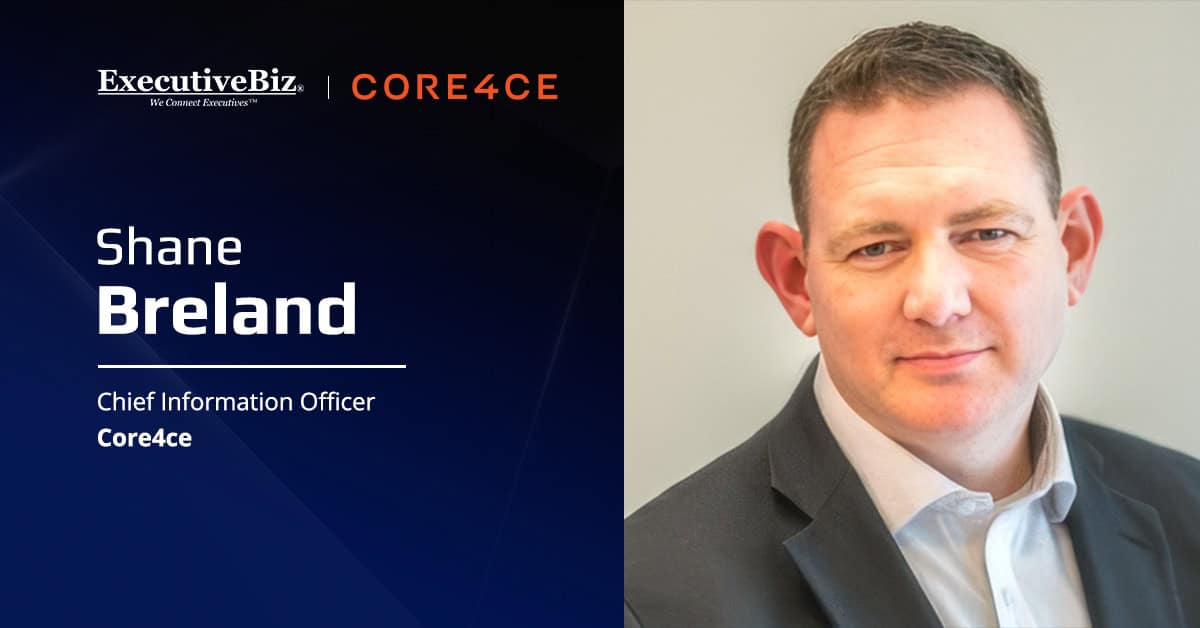
- Breland learned early that becoming a tech executive requires more than technical expertise
- He’s now successfully integrated four acquisitions as Core4ce’s CIO
- Breland sat down with ExecutiveBiz to talk cyber, growth and retaining cleared talent
Shane Breland has built his GovCon career on one core belief: that long-term planning pays off. The Core4ce chief information officer understood upon graduating from college that becoming an effective technology executive requires more than technical expertise. This led him to set goals to build experience across infrastructure, cybersecurity, financial operations and leadership, among other areas.
Today, Breland is transforming Core4ce’s technological and cybersecurity capabilities while supporting roughly 80-percent growth in both the company’s revenue and workforce. His team has successfully integrated four acquisitions, migrated its enterprise environment to the Microsoft GCC High cloud environment and achieved Cybersecurity Maturity Model Certification, or CMMC, Level 2 with a perfect assessment score of 110.
Breland is leading a major initiative by directing Core4ce’s enterprise AI strategy and the development of a secure and governed environment for adopting AI across the company. This initiative is not simply about deploying more AI tools. Rather, it’s about creating clear decision rights, approved platforms, data boundaries, human oversight and sustainable paths for moving AI capabilities from experimentation to production.
ExecutiveBiz caught up with Breland for his first Spotlight interview to discuss balancing competing priorities among business growth, mission delivery and cyber compliance; making compliance requirements like CMMC more than simply checkbox exercises, Core4ce’s strategy for retaining security cleared talent; and underappreciated defense industrial base technology trends.
Restructure your defense architectures for AI-era threats by attending the Potomac Officers Club’s 2026 Intel Summit on Sept. 24. Our Cybersecurity in the Age of Agentic AI panel discussion, featuring top federal officials and industry experts, will bolster your expertise on maintaining effective security under faster attack cycles and adapting cyber defenses to autonomous threat actors. Sign up today for this essential GovCon forum!
ExecutiveBiz: How do you balance business growth, mission delivery, cybersecurity and compliance when those priorities compete?
Shane Breland: I try not to treat those as four separate priorities. In a defense industrial base organization, they are tightly connected. Sustainable growth depends on delivering the mission well, protecting the information entrusted to us and meeting the obligations that come with serving government customers.
The real challenge is they do not always move at the same speed. Business development may see an immediate opportunity: a program may need a capability quickly, cybersecurity may identify risks that require additional controls and compliance may introduce specific contractual or regulatory requirements. The CIO’s role is not simply to say yes or no. It is to help the organization understand the tradeoffs and find a path that supports the mission without creating unacceptable risk.
I believe strongly in bringing cybersecurity and compliance into the conversation early. When those teams are engaged only at the end of a project, they are often placed in the position of delaying deployment or accepting risk that could have been avoided. When security, legal, contracts, operations and technology divisions participate from the beginning, the organization can design a workable solution, rather than bolt controls onto it later.
At Core4ce, we have experienced significant growth while continuing to support sensitive national security missions. That has reinforced my view that cybersecurity and compliance are not barriers to growth when they are designed into the operating model. In fact, they can become business enablers by strengthening customer trust, improving execution and allowing the company to pursue more demanding opportunities with confidence.
EBiz: How do you prevent Cybersecurity Maturity Model Certification, and other compliance requirements, from becoming checkbox exercises?
Breland: The first step is to be clear about the objective. The objective is not to pass an assessment or earn a certificate; it is to protect sensitive information and maintain the trust of our customers. Compliance frameworks such as CMMC are important because they establish a common baseline, but they should be viewed as the floor, not the ceiling.
At Core4ce, we achieved CMMC Level 2 more than a year ago and we are proud of that accomplishment. But we did not make that investment simply because certification was expected to become a contractual requirement. We did it because safeguarding our intellectual property and the sensitive government information entrusted to us is fundamental to supporting the national security mission. That responsibility does not change when implementation schedules move or regulations evolve.
To effectively protect the data and systems to which we have been entrusted, security controls must become part of normal business operations. Identity management, access reviews, vulnerability remediation, secure software development, configuration management, incident response and continuous monitoring should not be activities performed only before an assessment. They should be embedded into how systems are designed, deployed, operated and supported every day.
Culture is equally important. Cybersecurity cannot belong exclusively to the IT or security organization. Every employee who handles sensitive information has a role in protecting it and leaders must consistently reinforce that responsibility. Training, accountability and clear processes help turn compliance requirements into everyday habits rather than annual exercises.
Ultimately, the best way to prevent compliance from becoming a checkbox exercise is to build a security program that would still make sense even if the framework disappeared tomorrow. CMMC remains an important step forward for the defense industrial base, but a certificate is only a point-in-time validation. Trust is earned continuously through the decisions we make and the actions we take to protect the information our customers place in our care.
Engage with the IC’s top decision-makers at the Potomac Officers Club’s 2026 Intel Summit on Sept. 24. Hear firsthand from senior IC leaders controlling billions of dollars in spending during intriguing keynote addresses by:
- Tim Kosiba, National Security Agency deputy director
- Maj. Gen. Brian Sidari, Space Force deputy chief of space operations for intelligence
- Matthew Fodor, FBI operations director for the national security branch
- Carrie Thompson, Drug Enforcement Administration deputy assistant administrator
- Vice Adm. Thomas Henderschedt, Joint Chiefs of Staff director for intelligence
- Matthew Kozma, Department of Homeland Security undersecretary for intelligence and analysis
- Ryan Lewis, National Reconnaissance Office chief architect for signals intelligence
Conversations from the 2026 Intel Summit will shape the IC roadmap for years to come. Ensure your GovCon firm has a seat at the table. Buy your ticket now!
EBiz: Cleared cyber talent is scarce across the entire GovCon sector. What’s Core4ce doing differently to recruit and retain that workforce?
Breland: We recognize that cleared cyber professionals have choices, so compensation alone is not enough. People stay where they are connected to an important mission, respected for their expertise, given opportunities to grow and able to see the impact of their work.
Core4ce recruits heavily from the military and intelligence communities because those professionals already understand the mission, the operational environment and what is at stake. Veterans currently represent approximately 38 percent of our workforce.
Our Vet4ce employee resource group helps veterans maintain that sense of community and continue serving the national security mission after leaving uniformed service. Core4ce has also received the Department of Labor’s HIRE Vets Medallion Award for four consecutive years showing our commitment to our veterans, national guard and reserve teammates.
Retention requires more than recruiting the right people. We invest in tuition and certification reimbursement, technical development, innovation activities, competitive benefits and opportunities for employees to work across cyber, data, engineering and AI challenges. We also try to maintain the responsiveness and personal connection of a smaller company even as we grow.
Ultimately, our differentiator is that we treat cleared talent as mission partners, not interchangeable labor categories. We want employees to understand why their work matters, develop new capabilities and see a long-term career path at Core4ce.
EBiz: What technology trend is receiving too much attention in the DIB, and which one is not receiving enough?
Breland: I think it’s easy to place too much emphasis on individual AI models and not enough on the secure data, integration, governance and operational infrastructure required to make those models useful. The model itself is only one component of a much larger system and it is rarely the hardest part of putting AI into production.
The real challenge is whether an organization can securely connect AI to authoritative data, mission systems, workflows and users. An advanced model will still produce limited value if the underlying data is fragmented, poorly governed, outdated or inaccessible. It can also introduce significant risk if the organization cannot control what data the model can access, how that information is used or where the output goes.
That is why I believe the platform matters more than the model. Organizations need a secure AI environment that provides identity and access controls, data protections, approved integrations, logging, monitoring, model flexibility and clear accountability. They also need the ability to trace outputs back to their source data, understand how decisions were made and apply appropriate human oversight.
Governance is another area that deserves more attention. Too often, governance is viewed as something that slows innovation. It should do the opposite, if done correctly. Clear rules around approved platforms, acceptable data, testing requirements, risk levels and production deployment give teams a safe and predictable way to move faster.
The long term advantage will not come from being the first organization to gain access to the latest model. It will come from building a secure, governed and adaptable AI ecosystem that can incorporate new models as they emerge without having to redesign the entire environment each time.
The organizations that get the data, platform, governance and operating model right will be able to adopt AI faster, manage it more responsibly and generate more lasting mission value than those that focus primarily on model selection.