
 Elodie Collins
- Agentic AI is automating cyberattacks at machine speed and widening the cyber blast radius
- Harvest-now-decrypt-later campaigns make quantum computing an immediate national security threat
- Join the agentic AI and quantum risk panel at the 2026 Intel Summit on Sept. 24
The cyber landscape is being upended by emerging threats driven by advanced technologies. Agentic artificial intelligence tools are automating cyberattacks, accelerating the time it takes to infiltrate systems and exfiltrate data at scale. Quantum computing is about to further complicate cybersecurity as it threatens to break traditional cryptography that has protected networks and systems for decades.
The intelligence community has identified AI and quantum computing as the two defining technological challenges to national security in its Annual Threat Assessment, or ATA. Issued in March, the report identifies the biggest threats facing the United States.

At the Potomac Officers Club’s 2026 Intel Summit on Sept. 24, agentic AI and quantum computing will be evaluated as cybersecurity and national security threats. Technology experts from industry will join the Agentic AI and Quantum Risk: The Blast Radius Problem in Classified Environments panel to understand the evolving threat landscape and identify strategies to protect the nation’s critical systems and data from AI- and quantum-enabled cyberattacks. Register here!
How Has Agentic AI Been Used in Cyberattacks?
Cyber threat actors associated with China and North Korea have already been observed utilizing AI for reconnaissance and vulnerability exploitation. Anthropic’s November 2025 disclosure that Claude Code, its AI coding assistant, was manipulated by a Chinese state-sponsored group to infiltrate targets, including financial institutions and government agencies, demonstrates the severity of the AI-powered cyberthreat.
First Documented AI-Enabled Zero-Day Exploit
In May, researchers from Google Threat Intelligence Group identified a zero-day exploit that was developed using AI. According to the team, the cybercrime group intended to use the exploit for a large-scale attack, but Google immediately alerted the susceptible vendor of the threat and averted a potential breach.
The incident is probably not the first time that attackers used AI to build zero-day exploits, but John Hultquist, chief analyst at GTIG, noted in an interview with CyberScoop that the team “finally uncovered some evidence this is happening.” He also warned that the incident is “probably the tip of the iceberg” and more efforts to build vulnerability-exploits are probably underway.
AWS Access & LLMjacking
Cyber actors also used AI to gain administrative access to an Amazon Web Services environment within less than eight minutes. The Sysdig Threat Research Team, which discovered the compromise, explained in a report published in February that the threat actor utilized large language models to automate reconnaissance, create malicious code and make decisions in real time.
The team observed that the threat actor assumed multiple roles and moved laterally across 19 principals. During the attack, the threat actor also abused Amazon Bedrock for LLMjacking, wherein the victim’s cloud account is used to hijack cloud-hosted LLMs.
Taiwan Government Compromise
In July, suspected Chinese operatives used publicly available AI tools to carry out what researchers described as a “near-autonomous” cyberattack on Taiwanese government systems. Dream, an Israeli cybersecurity firm, revealed that the cyber actors utilized open source Hermes and OpenClaw AI agents and sub-agents, each assigned a target and attack technique, throughout 12 attack waves that occurred from July 1 through July 4.
The attack compromised 85 government user accounts and exfiltrated over 2,500 personnel records. The compromise also affected a nuclear safety agency, government IT supply chain vendors and at least seven energy companies, the Register reported.
How Does AI Widen the Blast Radius?
A blast radius is a concept for evaluating the extent of the damage caused by a single security incident.
Agentic AI expands that blast radius at machine speeds. AI agents are granted access and authority to systems, such as a database or an application programming interface, to automate tasks, like sending a message or correcting code, on the user’s behalf. So, when the technology is compromised, the blast radius will include every part of the system it is permitted to operate in.
An agentic AI’s trusted status also accelerates compromise. According to CrowdStrike’s 2026 Global Threat Report, the average cyber breakout time is 29 minutes. The fastest breakout observed is 27 seconds. AI agents already have the credentials needed to access a system, making all cyber measures designed to stop a breakout and mitigate an attack ineffective.
“It’s not just about authenticating once and then letting the agent run wild. It’s about continuously verifying and scrutinizing every single action the agent’s trying to take, because at any moment, that agent can go rogue.” — Matt Caulfield, VP at Cisco
A wider blast radius created by agentic AI poses a major threat to the IC, where networks and systems are interconnected. Edacheril Mathew, chief information officer at the Defense Intelligence Agency, noted that about 600 organizations utilize the Joint Worldwide Intelligence Communications System, or JWICS, a global network for collecting, analyzing and disseminating highly-classified information.
Mathew added that agencies deploying AI in interconnected environments must establish boundaries where autonomous systems can operate.
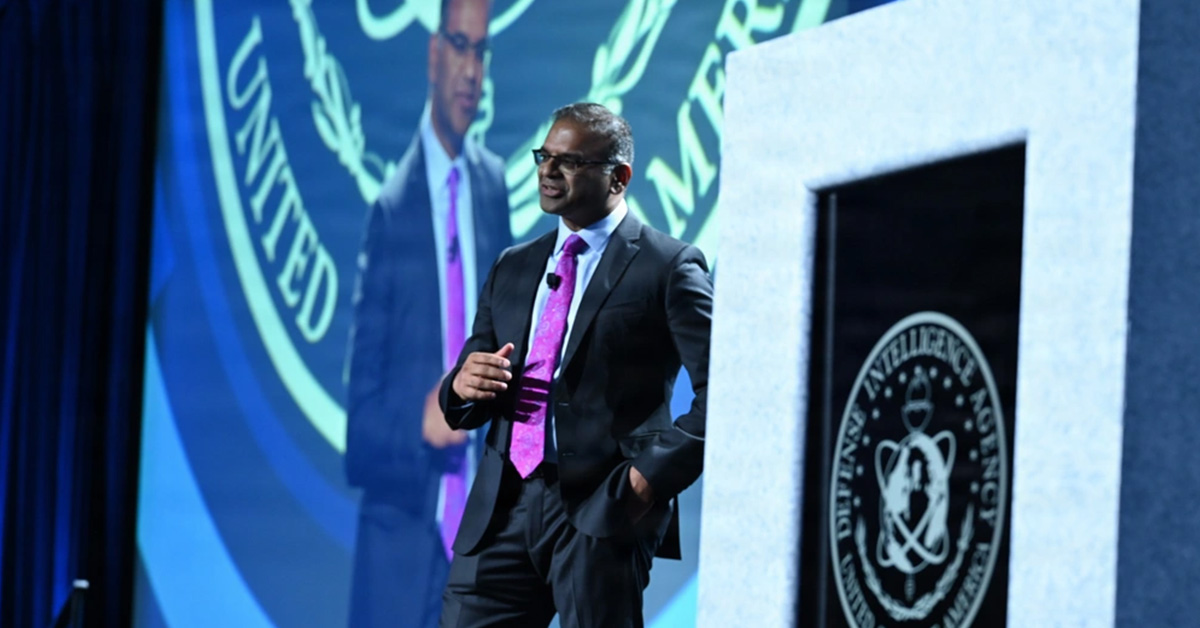
Roger Greenwell, director of enterprise integration and innovation and CIO of the Defense Information Systems Agency, also warned that cyber actors are using AI to find flaws in software, putting pressure on federal IT personnel to detect and patch vulnerabilities. He added that escalating cyberthreats can cause service disruptions.
For national security organizations, service disruptions can be detrimental to the mission. Leaders need access to critical information to guide decision-making during a crisis.
Greenwell shared that the IC is working with industry partners to develop a capability that will speed up the process of patching vulnerabilities.
Discover opportunities to support DIA and the intelligence community at the 2026 Intel Summit. Intelligence leaders from across the IC, including Matthew Kozma, under secretary for intelligence and analysis at the Department of Homeland Security, are expected to discuss agency priorities. Sign up here to secure your seat!
Why Quantum Computing Is a National Security Threat
Beyond the immediate risks of agentic AI, the emerging quantum threat imperils the encryption safeguarding global digital infrastructure.
Right now, quantum computers are not powerful enough to break modern encryption algorithms, but Q-Day — when quantum computers render public-key encryption obsolete — is coming. When it happens, much of the world’s secure digital infrastructure could become vulnerable overnight.
The world is in a race to build a cryptographically relevant quantum computer. China recently placed quantum technology as a priority frontier field in a five-year national plan. The plan calls on Chinese companies to conduct research and development to advance quantum technology, which could include tools that have an impact on national security, Quantum Insider said.
Michael McLaughlin, former chief of counterintelligence and human intelligence in the Cyber National Mission Force, emphasized that quantum research should be treated as a counterintelligence priority.
“Quantum is exactly the kind of target foreign intelligence services prioritize. It is a small field, the talent is concentrated in a handful of universities and companies, and the work sits at the seam between fundamental research and national and economic security,” he explained to NextGov/FCW.
“That combination of extremely high value and a small, open community is what the counterintelligence community calls a soft target. Our adversaries do not need to break encryption to win here,” he added.
Harvest-Now-Decrypt-Later Threat
The cyberthreat of quantum computing is not a distant concern. Experts have warned about harvest-now-decrypt-later campaigns, wherein adversaries intercept and store encrypted data with the intention of unlocking and accessing it once a cryptographically relevant quantum computer becomes available.
How to Address Agentic AI & Quantum Threat
Vasu Jakkal, corporate vice president at Microsoft Security, said at the RSA Conference in March that zero trust must extend to AI. However, Matt Caulfield, VP of product for identity and Duo at Cisco, told VentureBeat that cyber defense against agentic AI must go beyond zero trust.
“While the concept of zero trust is good, we need to take it a step further,” he stated in an interview. “It’s not just about authenticating once and then letting the agent run wild. It’s about continuously verifying and scrutinizing every single action the agent’s trying to take, because at any moment, that agent can go rogue.”
Against the quantum threat, the federal government is mandating the transition of critical systems to post-quantum cryptography.
In June, the White House issued Executive Order 14412, Securing the Nation Against Cryptographic Attacks, which aims to accelerate the federal government’s transition to National Institute of Standards and Technology-approved PQC.
The National Security Agency previously released a cybersecurity advisory for the adoption of quantum-resistant algorithms among national security systems, or NSS, owners, operators and vendors. The agency’s Commercial National Security Algorithm Suite 2.0 requires that all new acquisitions for NSS by January 2027 must support approved quantum-resistant algorithms.
The White House also recently published EO 14413, Ushering in the Next Frontier of Quantum Innovation, which calls for the advancement of quantum technologies research to strengthen national security.
Learn more about the risks associated with agentic AI and quantum computing at the Potomac Officers Club’s 2026 Intel Summit on Sept. 24. NSA Deputy Director Tim Kosiba has joined the event’s lineup of keynote speakers, which also includes leaders from the FBI, the National Reconnaissance Office, and the Space Force. Secure your tickets today!