
 Pat Host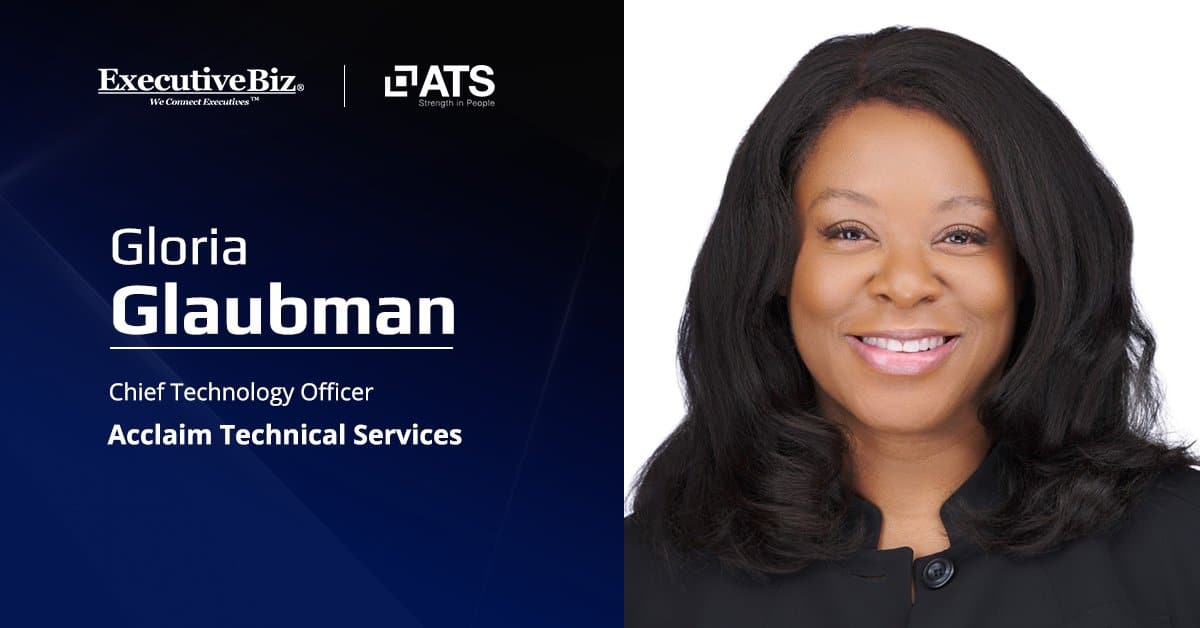
- Gloria Glaubman chose GovCon after federal service to move faster in tech and talent
- The Acclaim Technical Services CTO is building a secure and practical tech ecosystem
- She sat down with ExecutiveBiz to discuss underserved cyber mission areas and virtual reality
Gloria Glaubman wanted to move faster in technology and talent after her 20-plus-year federal career in roles at the CIA and the State Department. That’s why the Acclaim Technical Services chief technology officer chose GovCon following senior government leadership roles focused on cybersecurity, national security and international partnerships.
GovCon allows Glaubman to stay connected to public service while also having the flexibility to innovate. She is the most effective working at the intersection of mission, technology, business and people.
Glaubman views her job as building leaders, not followers. She’s proud of watching people she’s hired, coached or mentored progress to become senior technical executives, chief information security officers and trusted advisors in their own right.
Glaubman is leading ATS’ enterprise technology and AI transformation, a major company initiative. The goal is to move beyond isolated tools and build a secure and practical technology ecosystem that improves how the company operates internally and how it delivers for government customers.
She sat down with ExecutiveBiz for her first Spotlight interview to discuss underserved cyber mission areas, advice for contractors looking to differentiate themselves in the federal data and analytics market, the role of virtual reality in future defense and civilian operations and the status of federal agencies in their zero trust journeys.
Federal civilian agencies are ramping up investment driven by mission urgency and priorities like AI adoption and infrastructure resilience. Join the Potomac Officers Club’s 2026 FedCiv Summit on Oct. 29 to hear senior federal officials and leading industry executives explore scaling AI, data, cloud and compute infrastructure, cybersecurity and compliance, workforce enablement, and more. Gain insight into where agencies are focusing resources and what they expect from trusted partners. Sign up now!
Zero trust is a continuous architecture and management discipline. The remaining work is less glamorous than the initial technology rollout, but it is where the real security value will be created.
ExecutiveBiz: What cybersecurity mission areas remain underserved by industry?
Gloria Glaubman: Industry is very good at bringing new products to market. It is less consistent at closing the operational gaps between those products, the mission and the people who have to use them. The most underserved area is not another security tool. It is integrated mission assurance.
The first gap is security for AI-enabled systems. Agencies need more than broad responsible AI principles. They need practical ways to evaluate models, protect training and operational data, test for manipulation and misuse and manage third-party model and software dependencies.
They also need methods to monitor performance over time and determine when a system is safe enough for a specific mission. At the same time, agencies need AI-enabled cyber defenses that help analysts find weak signals, prioritize risk, accelerate investigations and respond faster without removing accountable human judgment.
The second gap is cybersecurity for operational, legacy, classified and edge environments. Many commercial solutions assume modern cloud infrastructure, persistent connectivity and standardized data. Federal missions often involve older systems, specialized hardware, disconnected networks and operational technology that cannot simply be patched, replaced or taken offline. Industry needs to do a better job engineering security around mission constraints rather than asking the mission to conform to the product.
The third gap is cryptographic discovery and post-quantum migration. The algorithms are only part of the challenge. Organizations must first identify where cryptography is embedded across applications, devices, certificates, protocols, vendors and data flows. That inventory and the ability to change cryptography without rebuilding everything are still immature in many environments.
Across all three areas, the missing ingredient is often sustainment. Agencies need solutions they can operate, measure, update and staff after the pilot ends.
EBiz: What advice would you give contractors looking to differentiate themselves in an increasingly competitive federal data and analytics market?
Glaubman: Stop leading with the platform. Lead with the decision the customer needs to make, the mission outcome that decision supports and the evidence required to improve it.
The federal market has no shortage of data lakes, dashboards, analytics tools and AI demonstrations. Differentiation comes from showing that you truly understand the customer’s data reality. That includes ownership, access, quality, provenance, security, classification, interoperability and the operational processes that create and use the data.
Contractors should also demonstrate the solution before asking the customer to take the full delivery risk. Build in a controlled environment, test assumptions, measure performance, identify integration challenges and show what will be reusable. At ATS, we use this principle in our FORGE environment: prove the work before we promise the work. That discipline improves the technical solution and makes the proposal more credible.
Open architectures and portability matter. Agencies are increasingly sensitive to vendor lock-in, particularly as AI models, cloud services and data platforms evolve. Contractors should be able to explain how data, models, prompts, workflows and evaluation results can move or be replaced without dismantling the entire solution.
The strongest differentiator is a combination of mission expertise, technical depth, speed and candor. Tell the customer what the data can support, what it cannot support yet and what must change to produce a defensible result. Credibility compounds.
Learn how to win more, and larger, federal technology contracts in FY 2027 by attending the Potomac Officers Club’s 2026 FedCiv Summit on Oct. 27. Get exclusive insights on tailoring your proposals for success from Pavan Pidugu, soon-to-be-former Department of Transportation chief digital and information officer, during his illuminating keynote address. Get requirements before they’re publicly released during panel discussions on critical topics like Modernizing Federal Civilian IT Through AI for Mission Impact. Secure your seat today for this highly anticipated GovCon summit!
EBiz: What role will virtual reality play alongside AI, digital twins and augmented reality in future defense and civilian agency operations?
Glaubman: Virtual reality will be an important part of the future operating environment, but I do not see it as a standalone destination. Its greatest value will come as the immersive and collaborative interface to AI-enabled simulations, digital twins and real-world operational data.
Each technology plays a different role. A digital twin provides a dynamic representation of a physical asset, system, environment or process. AI helps analyze that environment, predict outcomes, generate scenarios and adapt the experience.
Augmented reality places relevant information into the user’s physical field of view. Virtual reality places the user inside a controlled synthetic environment where teams can train, rehearse, design, test and make decisions without the cost or danger of recreating every condition in the real world.
For defense organizations, the clearest use cases are mission rehearsal, equipment maintenance, medical training, cyber ranges, intelligence visualization, logistics planning and collaborative command-and-control exercises. For civilian agencies, the same capabilities can support disaster response, aviation and transportation safety, infrastructure maintenance, emergency medicine, scientific missions and workforce training.
The real opportunity is a closed learning loop. Operational data updates the digital twin. AI generates scenarios and identifies likely failure points. Teams experience and test those scenarios in virtual reality. Augmented reality then supports execution in the physical environment. Results from the real-world operation feed back into the models.
Adoption will depend on more than headset quality. Agencies will need confidence in data fidelity, model validity, latency, interoperability, cybersecurity, human factors and the protection of sensitive operational information.
The winners will not be the organizations that build the flashiest virtual environment. They will be the ones that connect immersive technology to measurable readiness, lower training costs, safer operations and faster decisions.
Tell the customer what the data can support, what it cannot support yet and what must change to produce a defensible result. Credibility compounds.
EBiz: Where are federal agencies in their zero trust journeys and what work remains?
Glaubman: Federal agencies are making progress, but they are not at a common level of maturity. Most have moved beyond debating whether zero trust is necessary. The challenge now is moving from compliance-oriented implementation to an operating model that continuously manages access and risk.
The most visible progress has generally been in identity, multifactor authentication, endpoint visibility, cloud security, and stronger access controls. Those are important foundations, but zero trust is not complete when an agency deploys a set of products or satisfies a checklist. The Cybersecurity and Infrastructure Security Agency’s maturity model treats zero trust as a progression across identity, devices, networks, applications and workloads and data, supported by visibility, analytics, automation, and governance.
The harder work is deeper in the enterprise. Agencies still need accurate inventories of users, devices, applications, data, workloads and mission processes. They need to modernize or isolate legacy systems, implement meaningful segmentation, apply policy at the data and application layers, improve privileged access controls and integrate telemetry so that access decisions can change as risk changes. Operational technology and mission systems remain especially difficult because availability, safety and specialized protocols limit standard approaches.
Data is often the least mature pillar. Agencies must know what data they have, how sensitive it is, where it moves, who should access it and how policy follows it across cloud, on-premises and partner environments. Without that, zero trust can become stronger authentication around poorly-governed information.
The next phase should focus on measurable mission outcomes. Agencies should be able to show that zero trust reduces attack paths, limits lateral movement, improves detection, protects high-value assets and enables secure collaboration. Contractors can help by delivering sequenced roadmaps, integrating existing investments and measuring risk reduction, rather than proposing a wholesale replacement of the environment.
Zero trust is a continuous architecture and management discipline. The remaining work is less glamorous than the initial technology rollout, but it is where the real security value will be created.