
 Pat Host
- The U.S. Navy is using AI to find undersea mines and improve predictive maintenance
- It’s being used in Maritime Operations Centers to sift through data sets
- Learn about AI in shipbuilding at the 2026 Navy Summit on Aug. 27!
The U.S. Navy is pioneering the use of AI to help officers and sailors make faster, more informed decisions and accelerate productivity gains across the service. It’s helping the service in critical missions like intelligence analysis, supply chain optimization and acquisition.
Let’s discover the five most innovative ways the Navy is using AI to improve productivity and enhance mission success.
Learn new business opportunities in AI and shipbuilding at the Potomac Officers Club’s 2026 Navy Summit on Aug. 27! Discover advancing AI-native shipbuilding and digital engineering practices, and transforming acquisition through software-driven development at the Building the Golden Fleet With Software panel discussion, featuring Shery Thomas, Navy Installations Command enterprise IT officer. Get exclusive investment insights into one of the Navy’s highest-priority programs. Sign up now!
What Are Some Innovative Navy AI Use Cases?
1. AI-Powered Sea Mine Hunting
The Navy is speeding up efforts to use AI to find Iranian mines in the Strait of Hormuz, according to a May 1 Reuters article. The service recently awarded a nearly $100 million contract to Domino Data Lab to accelerate software development to teach unmanned undersea systems to find mines.
The software uses data from various sensor types, such as visual imaging and side-scan sonar, to help the Navy monitor how various AI detection models are performing. It allows the service to identify malfunctions and issue corrections to improve performance.
“Mine-hunting used to be a job for ships,” said Thomas Robinson, Domino Data Lab chief operating officer. “It’s becoming a job for AI. The Navy is paying for the platform that lets it train, govern, and field that AI at a speed required for contested waters that block global trade and imperil sailors.”
2. AI-Enabled Predictive Maintenance
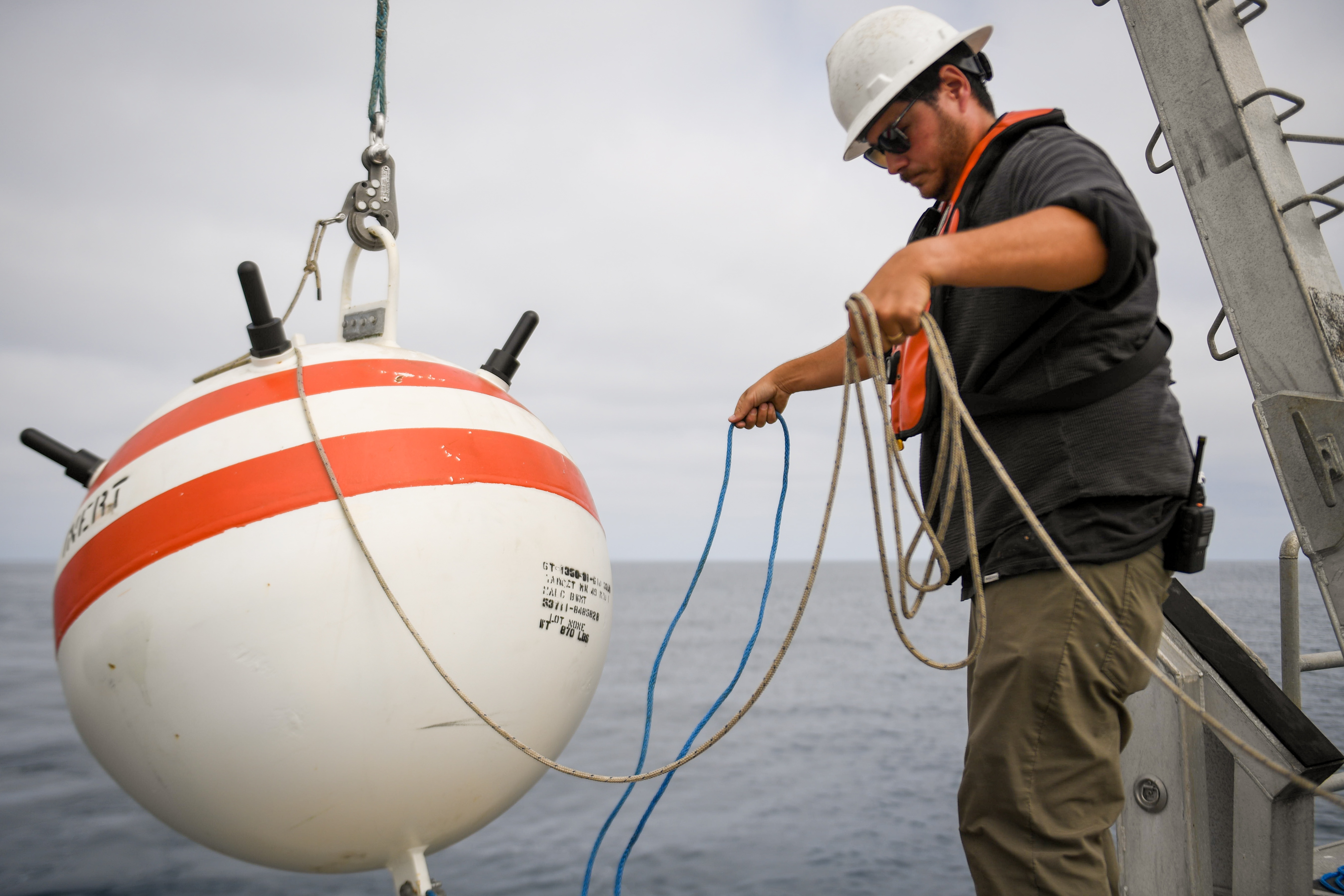
The sea service is leveraging AI to help maintenance teams plan for when ship parts will fail, requiring them to stock one replacement instead of 15, FedTech Magazine reported in January. The Pacific Fleet headquarters has a Readiness Operations Center where natural language processing is being used to sort through data messages and analytics support capabilities to help commanders make decisions on deploying ships.
“We’re not really buying AI, we’re buying operational outcomes,” said Task Force Hopper CTO Lt. Artem Sherbinin. “In operational outcomes, they happen to use that as an underlying technology.”
The service wants to be more intelligent about the commercial off-the-shelf AI it acquires for sailors and improve how it uses these capabilities. This is because software is regularly updated on ships in the Red Sea as new ships and aircraft are slow to arrive.
3. Better Maritime Operations Through AI
The Navy is having AI serve as an orchestration layer in its Maritime Operations Centers to help operators better distill complicated datasets into usable intelligence and accelerated decision cycles, GovCIO Media and Research said in April.
Rear Adm. Susan BryerJoyner, Office of the Chief of Naval Operations director of warfighting integration, said AI products in MOCs are already active in three capabilities:
- Course of action generation. Accelerating the commander’s decision cycle by modeling potential responses to enemy actions.
- Data aggregation. Automating the process of making sense of large amounts of data so analysts can focus on more critical decision-making.
- Machine-level autonomy. Leveraging machine-to-machine data exchanges for fast and automated sequences of events.
Integrating AI into MOCs allows commanders better access to data for decision-making, BryerJoyner said, especially in combat scenarios.
Are you a GovCon technology executive? Then you cannot afford to miss the Potomac Officers Club’s 2026 Navy Summit on Aug. 27. Our stellar keynote speaker lineup of top officials will prepare you for contracting success in FY 2027:
- Hon. Hung Cao, Navy acting secretary
- Lt. Gen. Joseph Matos, Marine Corps deputy commandant for information
- Vice Adm. Brad Skillman, deputy chief of naval operations for integration of capabilities and resources, N8
- Barry Tanner, Navy acting chief information officer
- Vice Adm. Michael Vernazza, Naval Information Forces commander
- Vice Adm. Robert Gaucher, Navy director for submarine programs
Secure your seat today for this highly-anticipated GovCon forum!
4. ‘Promptathon’ for Creative AI-Powered Solutions
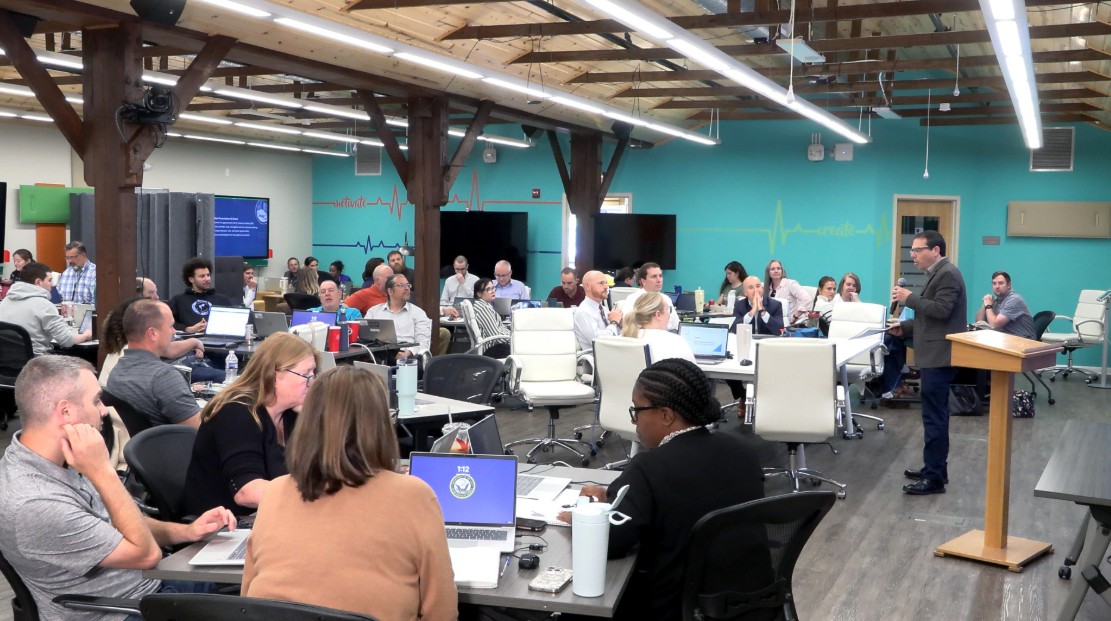
NAVAIR recently held its first “promptathon,” a 48-hour hackathon-style event where 10 teams used AI to create innovative capabilities to solve complex challenges, according to a June 16 service statement.
One hackathon team, focused on speeding up the typically slow contracting process, created an AI agent to automate usually tedious tasks involved with creating cost and schedule data review requirements. NAVAIR can issue contracts faster by automating that process.
Another team took on an essential and data-rich task critical for cost estimating: identifying accurate analogies for novel aircraft systems. The AI agent quickly went through extensive historical documentation to identify comparable systems. This substantially accelerated a time-intensive research process.
5. Encouraging Competition for Navy-Wide Productivity Gains
The Navy is asking stakeholders to compete with each other on measurable AI-powered productivity achievements to help speed up generative AI use across the service, GovCIO Media and Research reported on June 30.
Core to the effort is the AI Efficiency Challenge, which suggests users and teams submit time-saving data and other examples. It was replicated after Marine Corps innovation efforts and uses metrics and a service-wide scoresheet to identify substantial gains.
“When we give them better tools, we want them to show us who can turn better tools into bigger outcomes,” said Justin Fanelli, Navy chief technology officer and past Potomac Officers Club speaker. “It’s a [return on investment] contest.”