
 Pat Host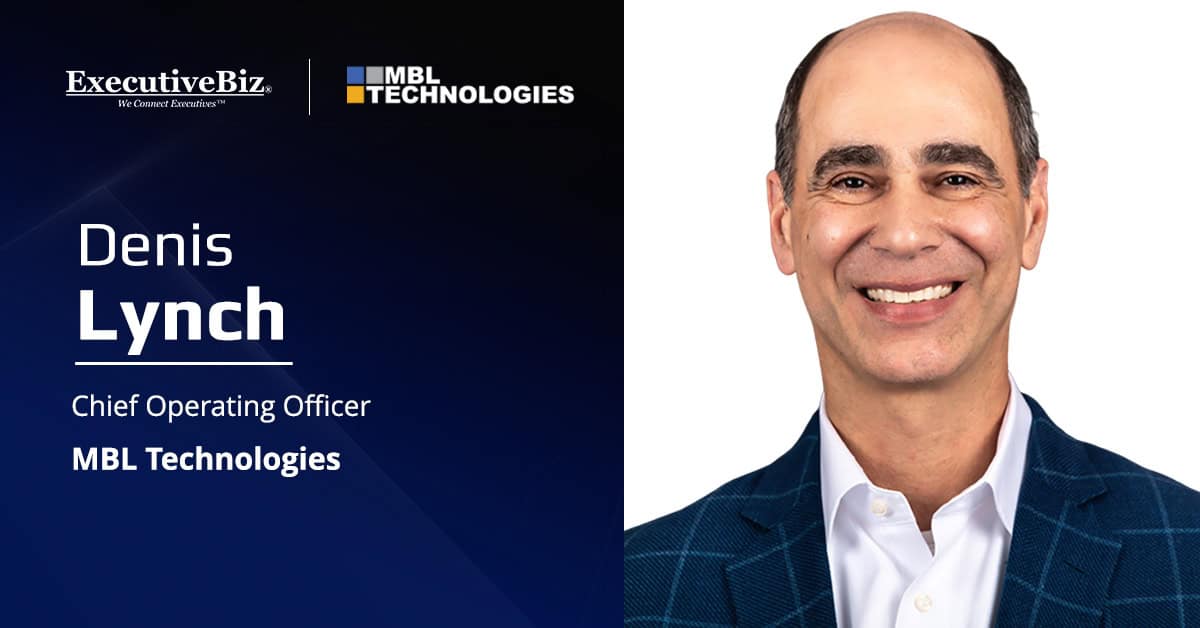
- Denis Lynch, chief operating officer at MBL Technologies, believes positive mentoring relationships are foundational to career success in GovCon
- Lynch attributes his career achievements, including 14 years at Booz Allen Hamilton after starting as an intern, to leaders who gave him chances to stretch and learn
- He sat down with ExecutiveBiz to talk growing SDVOSBs, maintaining company culture and values while scaling and tips for GovCon executives to increase profitability
Denis Lynch believes positive mentoring relationships are foundational to career success in GovCon. The MBL Technologies chief operating officer attributes his rise up the career ladder, including 14 years at Booz Allen Hamilton beginning as an intern, to his great managers who provided opportunities to stretch and learn through experience without micromanaging.
It’s easy to focus on wins, awards and growth metrics in an industry that often places a premium on measurable outcomes. While those are important, Lynch maintains they don’t compare to hearing that you helped someone navigate a challenge, build confidence or take the next step in their own journey. This is why he defines success as making that broader impact and creating an environment where people can grow, contribute and succeed.
Lynch is leading the transformation of MBL Technologies’ operating model to ensure it remains competitive and scalable as an emerging small business in an increasingly complex GovCon environment. The company has formalized enterprise risk management and expanded into digital services. A key component of this effort is its MBL Catalyst Program, an initiative to recruit interns and veterans to help launch their careers in GovCon while bringing valuable perspectives and skills to the company.
Lynch sat down with ExecutiveBiz for his first Spotlight interview to discuss maintaining MBL Technologies’ culture and values as it scales, the differentiator that has driven the most growth for the company, how factors like consolidation and private equity investment are reshaping GovCon competition and his advice for companies trying to increase profitability.
Grow your GovCon business with the Potomac Officers Club’s Summer Service Series of military-focused GovCon conferences! The 2026 Army Summit kicks things off on June 18, the 2026 Air and Space Summit follows on July 30 and the 2026 Navy Summit concludes the series on Aug. 27. Hear directly from top service officials and connect with peers across the defense industrial base. Sign up today!
ExecutiveBiz: How do you ensure your company’s culture and values remain consistent as you scale and take on larger, or more complex, government contracts?
Denis Lynch: As we scale and pursue more complex government contracts, we’ve learned that maintaining a consistent culture requires deliberate and continuous reinforcement. Culture doesn’t scale on its own—systems, behaviors and leadership alignment are what carry it forward. In my role as COO of a nearly 20-year old service-disabled veteran-owned small business, or SDVOSB, I focus on embedding our values into how we operate every day, not just how we describe ourselves.
At the core is our guiding principle: “mission first, people always.” This isn’t just a slogan, it’s a decision framework. It ensures that as we grow, we never create a false tradeoff between delivering for our customers and investing in our people.
We codify this in how we set expectations for leaders, how we evaluate program performance and how we recognize success across the organization. If a decision doesn’t support the mission or our people, we challenge it.
We also make a conscious investment in developing the whole person. Growth can easily push organizations toward transactional relationships, particularly in GovCon environments. We counter that by emphasizing mentorship, professional development and clear career pathways aligned to both contract needs and individual aspirations. We ask our people to bring their best effort each day, and in return, we create an environment where they can grow, lead and find purpose in the work.
Equally important is how we define ourselves, not as a “family-oriented” or lifestyle company, but as a high-performing team. This distinction reinforces accountability, shared standards and a commitment to outcomes. As we onboard new employees, whether through organic growth or new contract wins, we are intentional about integrating them into that team mindset, with clear expectations around performance, collaboration and integrity.
Finally, we extend our culture beyond our internal workforce. How we engage with customers, partners and the community reflects who we are. Treating others as we want to be treated, while consistently delivering on commitments, has helped us build trust and reinforce our brand.
Sustaining culture at scale ultimately comes down to alignment: aligning people, processes and leadership behaviors with our values.
EBiz: In a crowded GovCon market, what differentiator has actually driven the most growth for your company—not just in theory, but in wins?
Lynch: In a highly competitive GovCon market, our most meaningful differentiator, and the one that has consistently translated into wins, is the maturity and credibility of our privacy capability. While many firms treat privacy as a compliance checkbox or a niche add-on, we have invested in building it as a core competency and strategic growth engine. That investment has enabled us to compete successfully not only against peer small businesses, but also against large system integrators and top-tier consultancies.
What sets our privacy capability apart is both its depth and operational integration. We’ve developed a true Privacy Center of Excellence, grounded in real-world federal mission delivery and not just advisory services. Our teams bring a combination of policy expertise, technical acumen and implementation experience that allows us to move beyond strategy into execution. This enables us to help agencies operationalize privacy in complex and evolving environments, and protect our stakeholders’ personally identifiable information or protected health information, without negatively impacting the mission.
Equally important is the infrastructure we’ve built around that capability. As a nearly 20-year company, we have mature corporate systems, delivery frameworks and governance processes that give our customers confidence we can scale and sustain performance on larger, more complex contracts. This maturity often narrows the perceived gap between us and large integrators, while our agility and focus frequently give us the edge.
Finally, our collaborative delivery model reinforces our differentiation. We work closely with our customers and partners, embracing a “one team, one mission” approach that not only improves outcomes, but also strengthens our reputation in the market. Over time, it has helped us build a well-regarded brand in privacy, one associated with trust, execution and mission impact.
Are you a GovCon technology executive? Then you cannot afford to miss the Potomac Officers Club’s Summer Service Series of Department of War service-focused GovCon events. They’re strategically tailored to boost your revenues! The 2026 Army Summit begins the series on June 18, the 2026 Air and Space Summit takes place on July 30 and the 2026 Navy Summit wraps the summer up on Aug. 27. Explore how Pentagon leaders are strategizing to leverage advanced technologies and maintain an advantage in combat. Secure your seat now!
EBiz: How are factors like consolidation, private equity investment and contract vehicle saturation reshaping competition in the GovCon market?
Lynch: The GovCon market is undergoing a structural shift and we are seeing competition reshaped along several fronts—each of which disproportionately impacts small businesses.
First, consolidation is happening at both the contract and company levels. Agencies are increasingly bundling requirements into larger, enterprise-scale contracts, limiting entry points for smaller firms. At the same time, we’re seeing continued merger and acquisition activity, joint ventures and mentor-protégé arrangements that allow competitors to rapidly scale capabilities. While these moves can create opportunity, they also raise the bar, requiring small businesses like ours to be more deliberate about where we compete and how we differentiate.
Second, contract vehicle saturation is changing the dynamics of access. With the proliferation of government-wide acquisition contracts, aka GWACs, indefinite delivery/indefinite quantity and agency-specific vehicles, simply getting on a vehicle is no longer a differentiator, it’s the cost of entry. The real competition has shifted to task order level performance and positioning, which favors firms with strong customer intimacy and proven delivery.
Layered on top of this are policy and regulatory shifts. The Revolutionary FAR Overhaul introduces uncertainty into how procurements may be structured and evaluated. Reductions in Office of Small and Disadvantaged Business Utilization, or OSDBU, resources can limit advocacy for small businesses within agencies, while the increased use of bid protests is extending procurement cycles and raising the cost of doing business, particularly for smaller firms with fewer resources to sustain long pursuit timelines.
Finally, these dynamics are influencing private equity and venture capital investment. While GovCon has historically been attractive due to stable revenue streams, increased uncertainty and longer return horizons are forcing investors to be more selective. They are placing greater emphasis on differentiated capabilities, scalable platforms and defensible market positions.
EBiz: What advice do you have for GovCon companies trying to move up in today’s market and increase profitability?
Lynch: One of the most important lessons I share with companies looking to move up in today’s GovCon market is this: sustainable growth and profitability come from focus, discipline and intentional investment, not from simply expanding your bid volume.
First, invest in building and managing a high-quality pipeline. Too many firms are reactive, chasing opportunities late in the cycle with limited probability of a win. Instead, establish a disciplined pipeline process with clear qualification criteria and gate reviews. Focus your energy where you have access, insight and a compelling value proposition.
The most successful firms shape opportunities early, driving capture activities as far to the left as possible, so they are informing requirements, not just responding to them. This is where relationships and customer intimacy become true differentiators.
Second, be deliberate about capability development. In a crowded market, breadth alone won’t win. You need depth. Identify a few mission-aligned areas where you can be genuinely best-in-class, and invest in talent, tools and delivery excellence around those capabilities. That focus not only improves win rates, it strengthens your brand and supports margin expansion over time.
At the same time, scale your infrastructure intelligently. You don’t need to build a large back-office footprint prematurely. Leveraging fractional or outsourced support across functions like human resources, finance, IT and even capture can provide the sophistication of a larger enterprise while preserving cash and flexibility. It’s a practical way to mature without overcommitting overhead.
Relationships also remain foundational. Avoid spreading your business development organization too thin across agencies or customers. Depth matters more than breadth. A deep understanding of your customer’s mission, challenges and operating environment positions you to anticipate needs and offer meaningful solutions. The same principle applies to teaming: be selective and align with partners who truly complement your strengths.
Finally, profitability requires operational discipline. Embrace technology, such as AI, machine learning and robotic process automation, to automate workflows, improve throughput and reduce manual effort. Firms that leverage these tools effectively can scale delivery, control costs and reinvest in growth. In today’s market, those efficiencies are not optional, they are a competitive advantage.