
 Charles Lyons-Burt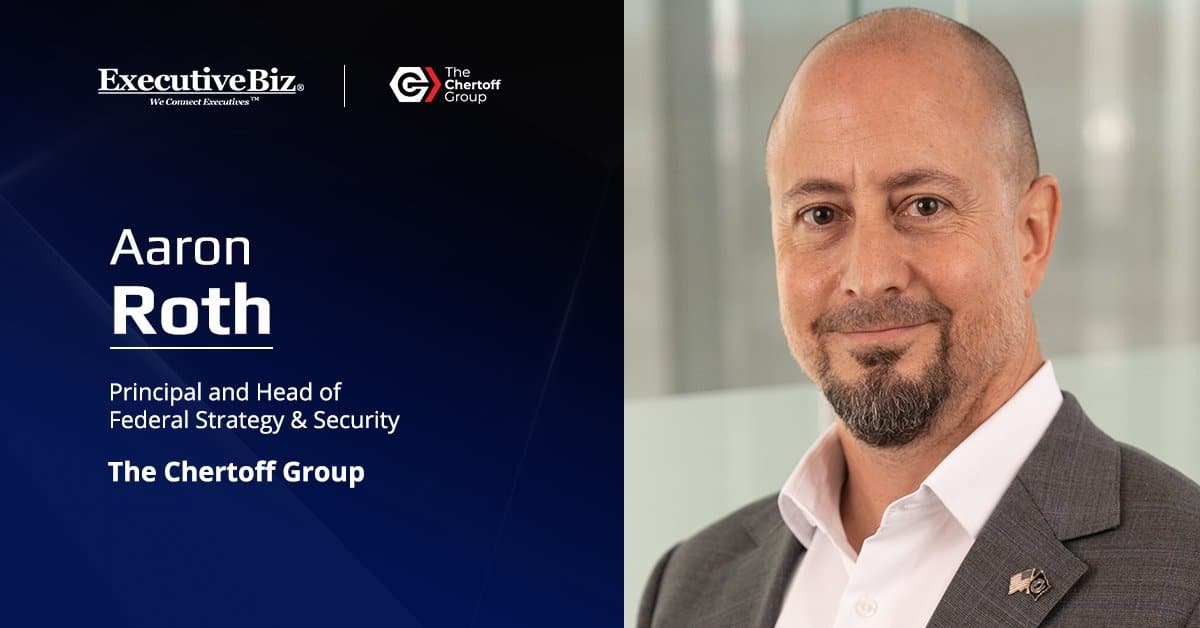
As federal agencies navigate a new wave of funding, acquisition reform and competitive pressure, contractors are being forced to rethink how they engage with government customers.
Few leaders have seen these dynamics from as many angles as Aaron Roth, principal and head of federal strategy and security at The Chertoff Group. A former senior Transportation Security Administration official and retired Coast Guard captain, Roth now advises companies on navigating homeland security priorities, emerging threats and federal market opportunities.
In this Executive Spotlight, Roth shares his perspective on the surge in Department of Homeland Security funding, how contractors should position themselves in a shifting acquisition landscape and why both government and industry must rethink how they engage with innovation and capital markets.
ExecutiveBiz: As a former TSA official and Coast Guard servicemember, what do you make of the current surge in DHS funding and how should contractors posture for this new era?
Roth: I’ve seen DHS from its early days through its maturation, and where we are now is pretty remarkable. There’s always been this waxing and waning politically around immigration, and with this administration, border security is a huge priority. So you’re seeing a tremendous amount of money flowing there.
What’s surprising, though, is the scale of investment in other areas. The Coast Guard, for example, received about $25 billion, which is roughly double its annual appropriation. That’s life-changing money for that organization. We’re also seeing major shipbuilding investments that connect to broader national security priorities.
For contractors, yes, you follow the money. But more importantly, you follow the mission.
There’s also a shift in acquisition philosophy. We’re moving away from traditional program executive office models toward portfolio management. That changes who the stakeholders are and how decisions get made.
The biggest mistake I see is contractors trying to sell something before fully understanding the problem the government is trying to solve. You need to stay locked in with mission owners, understand their operational requirements and work backward to deliver a solution.
And in places like the Coast Guard, it’s not just ships and planes anymore. There’s growing demand for technology, data integration, command and control and mission enablement. If you can solve real mission problems in an affordable way, you’ve got a strong position.
EBiz: What’s an under-discussed national security issue the GovCon community should be talking about more?
Roth: There are two things that come to mind, one strategic and one more tactical.
Strategically, we’re in a world where we have to deal with both state and non-state actors at the same time. Over the past 50 years, we’ve shifted between focusing on one or the other. Now we don’t have that luxury.
We’ve got to think about China and Russia while also dealing with terrorism, regional instability and other non-state threats. The question is how do you build a national security apparatus that can handle both simultaneously.
On the tactical side, technology is a huge challenge. Everyone talks about integrating technology into missions, but we don’t always appreciate how it can also be part of the problem.
That includes supply chain risk, where adversaries could be embedded in the technology, and the sheer proliferation of solutions. The government is very good at executing missions, but it’s not always equipped to keep up with the pace of technological change or identify best-of-breed solutions.
Traditionally, primes helped bridge that gap, but now the market is far more fragmented. It’s increasingly difficult for the government to distinguish what’s truly best for a given mission.
In April 2025, Roth joined a panel of experts at the Potomac Officers Club‘s 2025 Digital Transformation Summit to talk acquisition change. Read our recap of the discussion.
EBiz: What are your recommendations for company growth in the wake of FAR 2.0 and increased contract scrutiny?
Roth: This is still evolving, and a lot of it is cyclical. But there are some important differences this time.
One is the shift toward portfolio management. Contractors need to understand how their capabilities fit within broader mission portfolios, not just individual programs.
Another is how the government wants to buy. There’s a growing emphasis on commercial solutions, getting something that’s 80 percent of the way there but can be delivered quickly.
That means companies need to think about being commercial-first, moving faster and helping the government understand what’s best of breed.
Shaping activity has always been important, but now it’s even more critical and more prolonged. You need to engage early, work closely with mission owners and contracting officers and help shape requirements before they reach the RFP stage.
The old model of large, highly specified procurements with a small number of bidders can create frustration on both sides. There’s a shift toward speed, flexibility and continuous engagement.
And because technology evolves so quickly, you can’t wait for a five-year procurement cycle to introduce something new. You need to stay engaged so the government can adapt as the technology changes.
EBiz: How should legacy defense contractors respond to venture-capital-backed, non-traditional competitors?
Roth: The primes have been challenged over the past year, and I think some of that is justified.
When the government’s acquisition model becomes stale, the contractors that serve it tend to become stale as well. So change inside the government forces industry to evolve.
Some companies are hoping things revert back. Others are doing real soul-searching about how they need to change, whether that means moving into technology, combining products and services or rethinking their business models.
The companies that embrace that change are going to come out leaner, smarter and more effective.
At the same time, the rise of venture-backed companies is incredibly healthy. It creates competition and expands the pool of innovation. No one has a monopoly on best-of-breed technology anymore.
What’s interesting is that capital markets are now helping determine winners and losers. That creates a new dynamic where the government needs to better understand where investment is flowing and why.
EBiz: What does that engagement with capital markets look like in practice?
Roth: Traditionally, the government engages industry through things like industry days. They explain their priorities and companies use that to shape their strategies.
I think the government needs to do something similar with capital markets.
They should be communicating their mission problems and priorities directly to investors. That helps inform where capital gets deployed and encourages investment in technologies that actually support mission needs.
It’s about creating a dialogue so that the flow of capital aligns more closely with what the government is trying to achieve.
Who Is Aaron Roth?
Aaron Roth is principal and head of federal strategy and security at The Chertoff Group, where he advises companies on risk, operations and growth strategy within the federal market.
He previously served as deputy executive assistant administrator for operations support at the Transportation Security Administration, where he led global strategy, policy, intelligence and industry engagement efforts.
Roth is also a retired U.S. Coast Guard captain with 24 years of service, including roles as commandant’s strategic advisor and operations officer for the Maritime Security Response Team.
What Is The Chertoff Group?
The Chertoff Group is a security-focused advisory firm that helps organizations navigate risk, technology and growth opportunities across government and commercial markets.
The firm works with clients ranging from Fortune 500s to emerging technology companies, providing expertise in homeland security and defense, market strategy, risk management, and federal acquisition dynamics.