

 Pat Host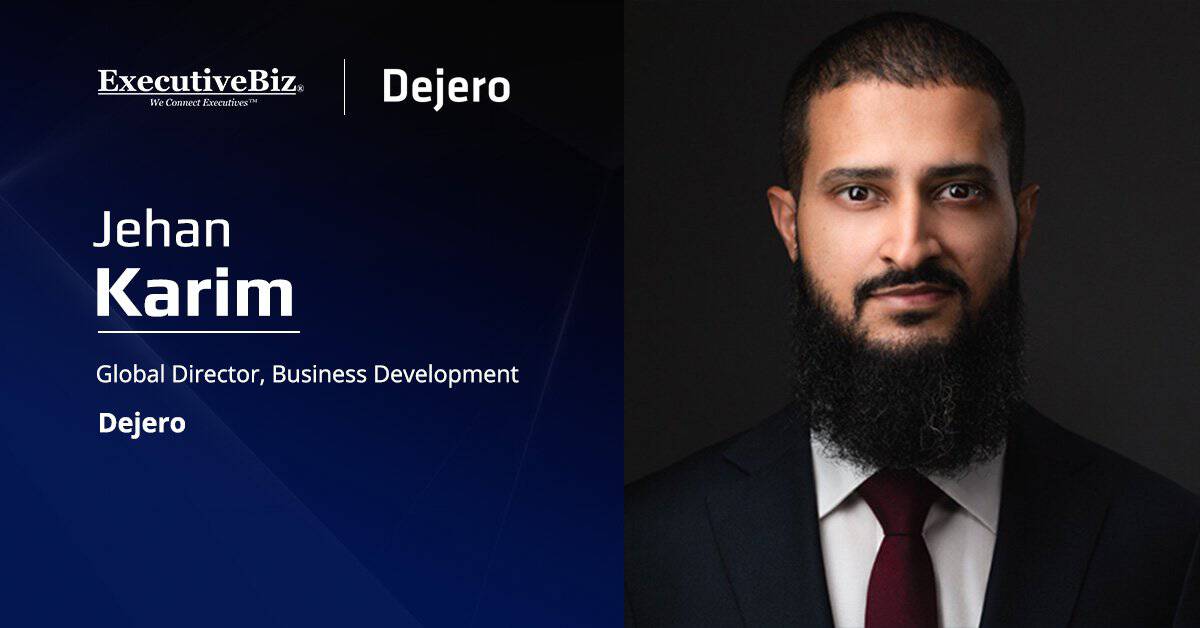
- Jehan Karim, global director of business development at Dejero, is helping the company broaden from live broadcast communications into mission-critical government functions, including 911 centers.
- Dejero supports all 457 emergency call centers in California and helped eliminate network-related outages over a six year period.
- He sat down with ExecutiveBiz to talk cybersecurity risks in 5G, growth opportunities in wireless and how to maintain a healthy company culture.
If you’re watching a live newscast, there’s a strong chance it’s powered by Dejero technology. Jehan Karim, the company’s global director of business development, is working to extend that same level of reliable connectivity to government customers worldwide—supporting operations at border crossings, ports of entry and tactical environments, where resilient communications are essential.
A technology executive with a background spanning semiconductor innovation and communications infrastructure, Karim previously held roles at AMD and Texas Instruments. Over the past nine years at Dejero, he has helped expand the company’s footprint into mission-critical government functions, including public safety and federal operations.
One notable milestone includes supporting all 457 emergency call centers in California, where Dejero’s technology has helped eliminate network-related outages over a six-year period—highlighting the importance of reliable, redundant connectivity in life-critical environments.
Karim sat down with ExecutiveBiz for his first Spotlight interview to discuss cybersecurity risks in 5G deployments, the growing importance of interoperability and how leadership and policy are shaping the future of communications.
Get the latest military cybersecurity business opportunities at the Potomac Officers Club’s 2026 Cyber Summit on May 21! Dive into protecting controlled unclassified information across non-traditional vendors and securing rapid adoption of commercial technologies at the Securing Chief Security Officer Innovation for Defense Missions panel discussion. It features John Baase, Defense Information Systems Agency DOW E-ICAM program manager. Secure your seat today!
ExecutiveBiz: What are the biggest cybersecurity concerns unique to 5G deployments in government environments?
Jehan Karim: Cybersecurity is a major part of the conversation around 5G, but it’s not the only risk. While the attack surface is expanding, resilience also depends on infrastructure investment and how these networks are designed, deployed and managed.
There’s a growing recognition that global competitors have outpaced the U.S. not just in cybersecurity, but in overall communications infrastructure. Closing that gap is critical. We’re seeing massive investment in areas like artificial intelligence infrastructure, and wireless communications needs that same level of commitment as these systems are interconnected.
There are also policy-driven protections—frameworks like the National Defense Authorization Act and the Trade Agreements Act in the U.S.—that aim to secure the ecosystem and prevent compromised actors from participating. Those standards are continuing to evolve.
Finally, execution risk is important. These are large-scale infrastructure programs that depend on strong public-private partnerships. They can’t be entirely government-driven or entirely private. Success depends on aligning incentives and delivering together.
EBiz: Where do you see the biggest growth opportunities in wireless over the next three to five years?
Karim: The market is evolving quickly, with both established players and new entrants reshaping the landscape. You have traditional telecom providers and satellite companies, and now organizations building low earth orbit constellations, all contributing to a more complex ecosystem.
The biggest opportunity is interoperability across these technologies.
Today, connectivity is still fragmented. We manage separate systems for cellular, home internet and satellite, and that complexity becomes even more challenging in government environments where reliability is critical.
There’s a significant opportunity to unify these capabilities into a seamless experience. That includes not just technical integration, but also simplifying procurement and deployment so organizations can adopt these solutions more effectively.
Innovation is happening quickly, but the real value will come from how well these technologies work together.
EBiz: How do you define interoperability in this context?
Karim: At a basic level, interoperability means being able to operate across different networks—fiber, cellular and satellite.
But from a customer perspective, it goes much further. True interoperability requires standards-based approaches that allow technologies to integrate without locking users into proprietary ecosystems.
Proprietary innovation will always play a role, but it has to coexist within open frameworks that allow trusted partners to contribute. That applies across the ecosystem—from satellite providers to cloud platforms and network operators.
The goal is not just compatibility, but creating a cohesive environment where technologies work together seamlessly. We’re not fully there yet, but progress toward more open, standards-based systems will be critical.
Want to win more technology contracts in 2026? Then you can’t afford to miss the Potomac Officers Club’s 2026 Cyber Summit on May 21. Get spending insights and actionable business intelligence from Robyn B. Celestino, White House Office of the National Cyber Director general counsel, during her illuminating keynote address. Buy your ticket now!
EBiz: What practical steps do you take as a leader to keep your culture healthy and aligned with your vision?
Karim: It starts with a shared sense of purpose. Our work supports high-impact missions, and that creates alignment across the organization.
Different teams have different objectives, but they’re all working toward the same goal—delivering reliable outcomes for our customers. That alignment makes it easier to navigate challenges and differences of opinion.
Open dialogue is important. Strong teams don’t avoid disagreement—they work through it constructively because they’re grounded in a common mission.
From a leadership perspective, my role is to enable the team. That means helping people maximize their strengths, supporting their development and recognizing that success comes from collective effort, not individual direction.
EBiz: Are Pentagon policies around modularity and open architecture keeping pace with advances in technology?
Karim: There has been clear progress in recent years. Policy is moving in the right direction, especially in areas like modularity and commercial technology adoption.
At the same time, implementation takes time. Government is a large and complex system, and translating policy into execution across organizations doesn’t happen overnight.
We started from a position where we were behind in several areas, including communications and emerging technologies. There’s now strong momentum to close that gap, but sustained acceleration is needed.
This includes not just technology policy, but also procurement, cybersecurity frameworks and broader regulatory alignment. Areas like communications resilience, data sovereignty and emerging technologies such as quantum encryption will continue to be priorities.
Overall, the direction is positive, but continued collaboration between the public and private sectors will be essential to maintain progress.