
 Charles Lyons-Burt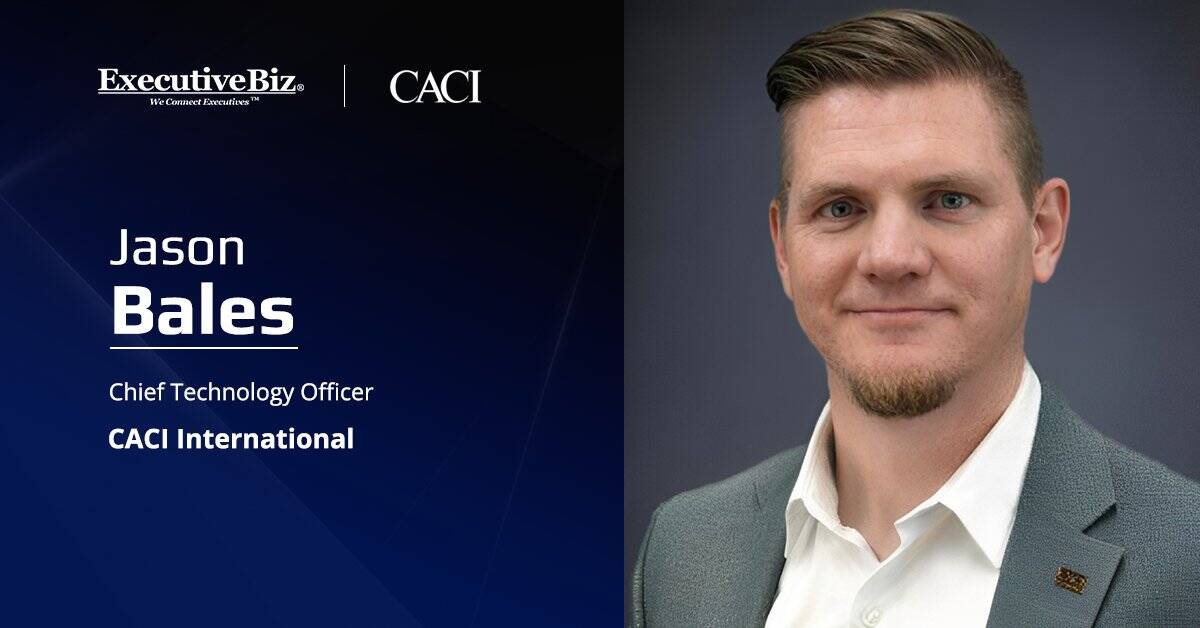
Jason Bales’ path into government contracting started close to the mission and close to home.
A Navy brat by upbringing, Bales began his career as an electronics engineer at the Army’s Night Vision and Electronic Sensors Directorate, developing small, deployable sensors soldiers could leave behind while clearing buildings. The goal was simple but consequential: give warfighters a way to know if someone had returned before they reentered a space, and reduce the risk of ambush.
“That was the moment it really hit home for me,” Bales said. “This work could save lives.”
More than two decades later, Bales has scaled that same mission-driven mindset from backpack-sized hardware to enterprise, cloud-based systems. As senior vice president and chief technology officer at CACI International, he now oversees the company’s technical investments and strategy across national defense, helping guide where the company places its bets as threats evolve and domains converge.
In this Executive Spotlight, Bales maps the trends shaping CACI’s technology investments, from electromagnetic spectrum operations and space-based sensing to resilient data and networks, as well as how mergers and acquisitions help close mission gaps and accelerate capability delivery.

Explore the latest trends in government tech modernization at the 2026 Digital Transformation Summit on April 22. This Potomac Officers Club GovCon conference will gather top federal CIOs and industry innovators to identify new opportunities for partnership. Register now!
ExecutiveBiz: What major technology trends are shaping CACI’s growth strategy as you look to the future?
Jason Bales: There are a lot of trends in GovCon, but if I focus on the ones that are most impactful to CACI’s technical strategy, a few stand out.
First is the electromagnetic spectrum as a warfighting domain. Over a decade ago, we made the decision that this was going to be a domain with increased importance, especially as conflicts move away from counterterrorism and toward near-peer and peer engagements. There is an ongoing conflict inside the electromagnetic spectrum now. That invisible wireless world around us affects all of our daily lives, but it also has an increasing presence on the battlefield. Delivering capabilities that give warfighters an advantage in that domain is critical for us.
The space domain is another major trend. We see it today with initiatives like Golden Dome, and more broadly as nations invest heavily to gain advantage in space. It’s a highly congested and contested domain, but one with enormous capability and relevance to modern conflict.
Homeland security and homeland defense are also key areas. As peer competitors develop advanced capabilities, those threats don’t stay overseas. They find their way back to the homeland, often through proxies. Being able to apply capabilities we’ve developed globally to defend here at home is an important adjacency for us.
Finally, there’s resilient data. All of these sensors, systems and weapons depend on command and control. You have to be able to move data reliably, securely and at speed. Resilient networks and resilient data architectures are foundational, and we’ve invested heavily there.
Our growth strategy around those trends centers on a few core principles. One is software-defined everything. Threats evolve rapidly, and the only way to keep pace is to deliver capability incrementally through software-defined platforms.
Another is building technology specifically for the mission. We design data and systems for the analysts by the analysts. A good example is our Navy spectral program, where we are modernizing electromagnetic spectrum processing and signals intelligence across naval fleets. We combine software-defined platforms with deep analyst expertise so the intelligence coming off those systems is actionable in real time.
The last piece is expertise. It’s not just about having smart people. We have hundreds of people deployed forward today, conducting mission operations around the world. That real-world experience directly informs the technology we build, helping us close gaps faster and deliver what warfighters actually need.
EBiz: How does M&A help CACI close mission gaps and build differentiated technology?
Bales: CACI has been in business for more than 60 years, and a big part of our history is mission expertise. Over a decade ago, we made a conscious shift toward building a more differentiated technology portfolio, starting with the acquisition of Six3 Systems in 2013.
At that time, our business was roughly 80 percent expertise and 20 percent technology. Today, that balance is closer to 40 percent expertise and 60 percent technology, and that’s intentional. The expertise doesn’t go away. It informs the technology, and the technology enables the expertise in a continuous feedback loop.
Through M&A, we’ve added electromagnetic spectrum capabilities, network modernization for resilient communications, space-based sensing and processing, modernized software development, and stronger partnerships with commercial technology providers. But just as important as the technology is the people.
Cultural fit matters. We want teams that stay connected to the mission and to customers. Today, about 75 percent of our workforce is cleared, and roughly 40 percent are veterans. These are people who understand the mission firsthand, and that perspective is critical to keeping our technology relevant.
EBiz: What role do you play as CTO in shaping CACI’s M&A strategy?
Bales: It’s both strategic and tactical.
I’m constantly assessing where our current technology portfolio is and where threats are heading. I spend a lot of time in the field, talking to teams doing mission operations and hearing directly where gaps exist.
From there, we look at how to close those gaps. Sometimes that’s internal investment. Sometimes it’s partnerships. And sometimes it’s through acquisition. When we do look at M&A, I’m heavily involved in evaluating whether a company is the right technical and cultural fit and whether we can integrate and deliver mission capability quickly.
We call it investing ahead of need. The goal is to outpace the threat, not react to it.
EBiz: What space technology trends are you seeing gain the most momentum?
Bales: Resilient communications from space are critical. We’re deploying sensors and assets globally, and space is a key part of moving data securely and reliably. Our optical communications terminals, for example, provide low probability of intercept and detection while pushing large volumes of data forward.
Sensing is another major trend. With the proliferation of satellites, particularly in low Earth orbit, space-based sensing has exploded. That includes tracking friendly forces, monitoring adversaries and building a clearer picture of the battlefield.
All of this ties into what we call “left of launch” activities. The goal is to produce actionable intelligence that helps you win before you ever reach a kinetic fight. That means knowing what’s happening, tracking threats early and responding before situations escalate.
That theme connects directly to our pending acquisition of ARKA, which will be our largest to date upon closing. ARKA expands our sensing capabilities into the space domain. Before that, we’ve deployed 1000’s of sensors across land, air, sea and cyber. With ARKA, we cover every domain, making us a true multi-intelligence processing powerhouse.

Who Is Jason Bales?
Jason Bales is senior vice president and chief technology officer at CACI International, where he leads technology strategy, investment and innovation across national security missions. He brings more than two decades of experience spanning electromagnetic spectrum operations, space, cyber, communications, intelligence and command and control. Bales began his career as an electronics engineer at the Army’s Night Vision and Electronic Sensors Directorate and holds bachelor’s and master’s degrees in electrical engineering from George Mason University.
What Is CACI?
CACI International is a Fortune 500 company providing differentiated technology and distinctive expertise in support of national security missions. With more than 26,000 employees, CACI delivers software-defined solutions and technology to customers across defense, intelligence, homeland security, and federal civilian markets, with a focus on advanced analytics, cyber, space, electromagnetic spectrum operations, and resilient data systems.