
 Charles Lyons-Burt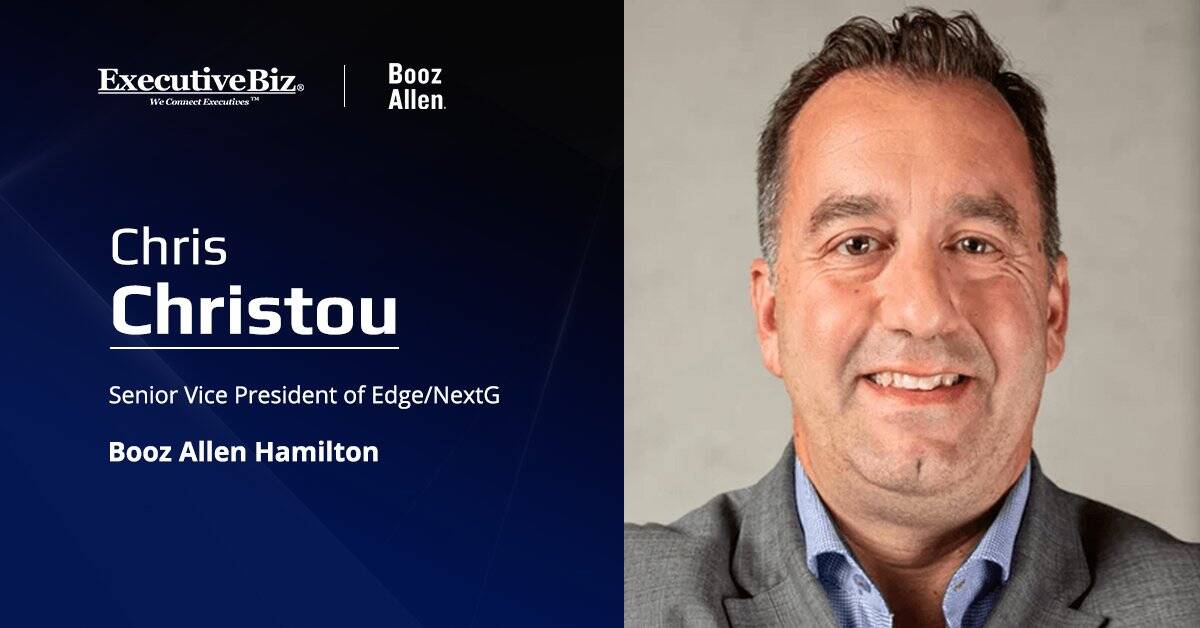
Booz Allen Hamilton Senior Vice President Chris Christou’s passion for telecommunications has powered his work for the last quarter century. It was solidified when he earned a master’s degree in telecom from the University of Maryland, subsequently working in the telecom industry, and then for one of the largest internet providers of the day. After gaining this important experience, he joined Booz Allen in 2002, where he’s been involved in a wide range of IT infrastructure projects, including advanced networking, satellite, and wireless efforts.
“I’ve always found it very interesting to design new networks using cutting-edge technologies and to explore how those networks connect with other parts of the infrastructure, including cloud environments and related capabilities,” Christou, who is SVP for edge and NextG in Booz Allen’s chief technology office, told us in a recent Executive Spotlight interview.
In the 2020s, Christou said the company has achieved a number of significant wins related to 5G. They constructed a private 5G network in Guam and announced an initiative called AI Wireless Innovation Networks, or AI WIN, in partnership with several other U.S.-based companies. Christou spoke to us about AI WIN, as well as 5G security hygiene, barriers to adoption and much more.

AI and 5G will be central topics at Potomac Officers Club’s 2026 Defense R&D Summit, happening Jan. 29. Get exclusive intel from field-leading experts like Department of War FutureG/5G Principal Director Dr. Thomas Rondeau. Register now!
ExecutiveBiz: How are you ensuring security while delivering 5G service to your customers?
Chris Christou: Security is a core part of our pedigree and it’s integrated into everything we do. That includes standard security hygiene, but it also goes beyond that. We operate a lab where we test and harden infrastructure before deployment.
We’ve also been involved with international carriers, helping bring security-by-design principles into their environments. In addition, through some of the National Telecommunications and Information Administration notice of funding opportunity efforts, we’ve helped develop fuzzing tools to evaluate networks and assess the security protocols they’ve implemented.
EBiz: I’ll admit I’m a little less familiar with the regulatory side of 5G and communications compared to something like CMMC. Are there FCC regulations or other rules you have to be especially mindful of?
Christou: One of the biggest issues is spectrum, specifically access to it and guaranteed access over time. Whenever we deploy a private network, particularly for government customers, there are generally three options.
One is the Citizens Broadband Radio Service, or CBRS, which has created a useful spectrum-sharing regime, although it can come with challenges. Another option is government bands such as N79. The third is leasing spectrum. Spectrum access is always a critical consideration in any deployment.
We’re also involved in efforts where the government has legacy incumbents operating in certain frequency bands and is exploring how those bands can be opened up and shared with commercial industry. We’ve worked on spectrum-sharing solutions, including participation in an other transaction authority, and we have additional efforts underway around dynamic spectrum sharing.
That work becomes even more important as 6G approaches and commercial industry seeks access to additional frequency bands based on emerging standards.
EBiz: What barriers remain in achieving widespread 5G deployment and getting 5G into the hands of our warfighters/mission leaders?
Christou: In some ways, there’s already been a lot of success. Commercial carriers have transitioned to 5G and made significant progress, but there’s still work to be done.
A big part of it comes down to use cases and clearly demonstrating the value 5G provides. That includes ensuring organizations have the funding allocated and a clear understanding of how much impact 5G can have on their missions, applications and deployed devices.
Another barrier is device readiness. One area we’re actively working on is testing and evaluating new types of devices that can connect to 5G networks. It’s no longer just about smartphones or tablets. As those capabilities mature, and as we’re now on the cusp of an AI-driven shift, it will be interesting to see how that changes the dynamics and further increases the demand for advanced wireless networks.
EBiz: That makes sense. When you mentioned new device types, were you also referring to the Internet of Things?
Christou: Yes, definitely. Internet of Things is a big part of that. We’re also looking at new classes of 5G devices based on something called reduced capability, or RedCap. These are smaller, less power-hungry devices that can still connect to 5G networks.
That opens the door to a wide range of use cases, including asset tracking, logistics and other IoT-driven mission applications.
EBiz: How would you characterize the relationship between the government and commercial markets for 5G/NextG application tools?
Christou: I think it’s very intertwined. The government is looking at where commercial industry is headed and how it can leverage the technologies being deployed there. Mobile network operators, in particular, drive a significant amount of investment in wireless communications.
At the same time, government networks can offer opportunities to test new types of private networks and explore the kinds of use cases they enable. It’s definitely an area where dual-use technologies make a lot of sense.
Don’t miss the trio of 5G panels at Jan. 29’s Defense R&D Summit — Bridging Domains: 5G to FutureG in Defense; Smart Installation and Logistics Modernization Through 5G; and Innovating Wirelessly within INDOPACOM. The event is sponsored by Nokia Federal and Ericsson Federal. Save your spot before they sell out.
EBiz: That makes sense. Companies like Ericsson and Nokia are standing up federal groups when they didn’t necessarily have a dedicated business there before. I was recently talking with Christopher Ling at Ericsson about a new consortium Ericsson and Nokia are forming. Is Booz Allen partnering in that space?
Christou: Yes, definitely. In fact, we have a video on our website that highlights some of the partnerships we’ve done with Nokia and Ericsson. We also have a partnership with NVIDIA, which is moving more aggressively into the wireless space.
We recently expanded our partnership with Nokia via the award from the National Spectrum Consortium and the Department of War for more than $25 million to demonstrate spectrum sharing technology as part of the Advanced Spectrum Coexistence Demonstration program. Booz Allen will provide our R.AI.DIO® Enabled Spectrum Coexistence and Sharing, or RESCS, solution to this work.
Depending on the solutions we’re developing, we look to partner with key technology companies like these to bring the right products and capabilities to market.
EBiz: Can you share a real-world example or pilot where AI-RAN’s self-healing or adaptive capabilities could protect critical systems — whether in defense, disaster response or civilian infrastructure — and what that demonstrates about readiness for 6G?
Christou: One of the key areas we’ve been focused on is spectrum agility. As part of our AI Wireless Innovation Networks, or AI WIN, initiative, we worked with NVIDIA and MITRE on several demonstrations that showcased the ability to detect interference from emitters operating in the same frequency band as a 5G network.
We were also able to demonstrate how AI can help mitigate the impact of that interference, either by reducing the effect on the 5G system itself or by limiting the impact the 5G network has on other systems sharing the spectrum. That capability can significantly improve communications resilience.
Beyond that, we’re also exploring how AI-RAN enables the development of new network applications, or dApps, by providing access to wireless data. That opens up a wide range of possibilities for creating innovative applications that make networks more resilient and adaptive.
EBiz: And that work helps pave the way for 6G?
Christou: Yes, definitely. Two areas are particularly critical as we look toward 6G. The first is the application of AI to wireless communications. The 3rd Generation Partnership Project—or 3GPP—standards body is identifying a number of use cases for future standards focused on how AI can improve communications performance and efficiency.
The second area we’re working on is called integrated sensing and communications, or ISAC. This has been a priority for the Department of War’s FutureG office. The idea is that the network itself becomes a sensor. With access to wireless data and the application of AI techniques, the network can detect the presence of objects, determine where they are, how fast they’re moving and similar characteristics.
Both AI for wireless communications and ISAC are expected to be foundational features of upcoming 6G standards. Our goal is to develop, prototype and eventually deploy these capabilities so we can apply that experience to help inform and influence future standards development.